

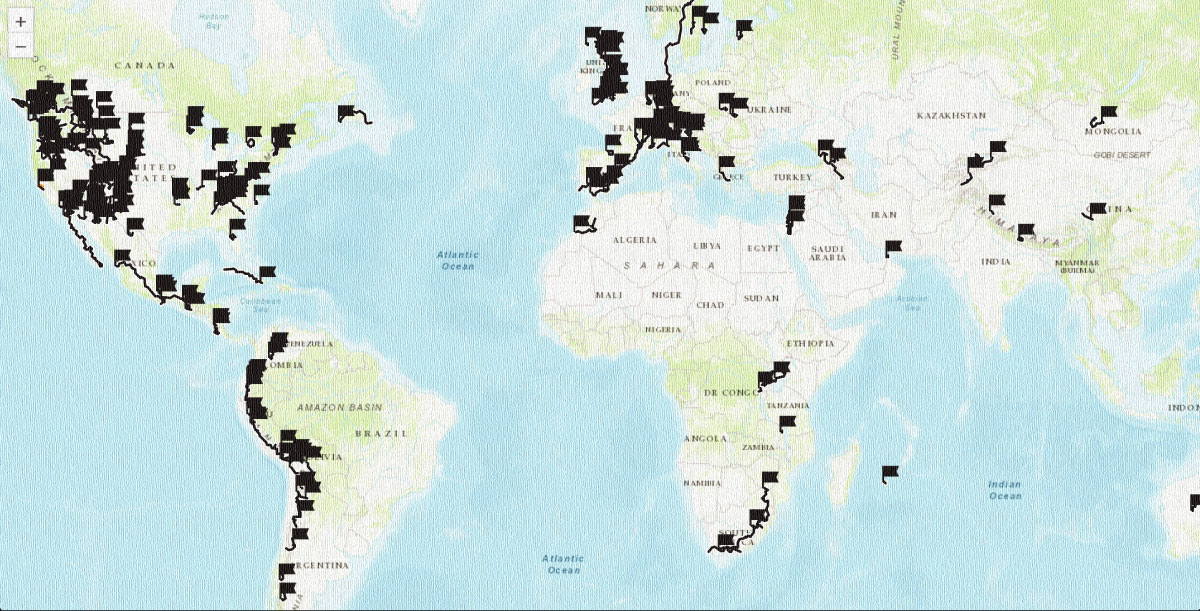
 Mountain Bike (MTB)
 Gravel Bike
 All-Terrain Bike (ATB)
 Fat Bike


Outer Shell Mega Bar Bag Review: Framed for Function



Announced earlier this year, the Outer Shell Mega Bar Bag is the California-based bag maker’s first foray into a large, top-opening handlebar or saddle bag. While it might look like any other bag, it has a nifty trick up its sleeve that sets it apart. Over the last few months, Miles and Emily used it on a week-long bikepacking trip, several overnighters, and plenty of day rides. Find the full review here…
PUBLISHED Sep 24, 2025
It’s hard to believe I published my first real bikepacking bag review over seven years ago. Scrolling through the archives, it’s encouraging to see just how much things have changed, and how many more bag makers and options exist. It may seem overwhelming when considering all the variations, but it’s incredibly promising for those who try to shop local whenever possible. I’ve tested products from dozens of different brands over the years, and there’s a short list that consistently leaves me impressed.
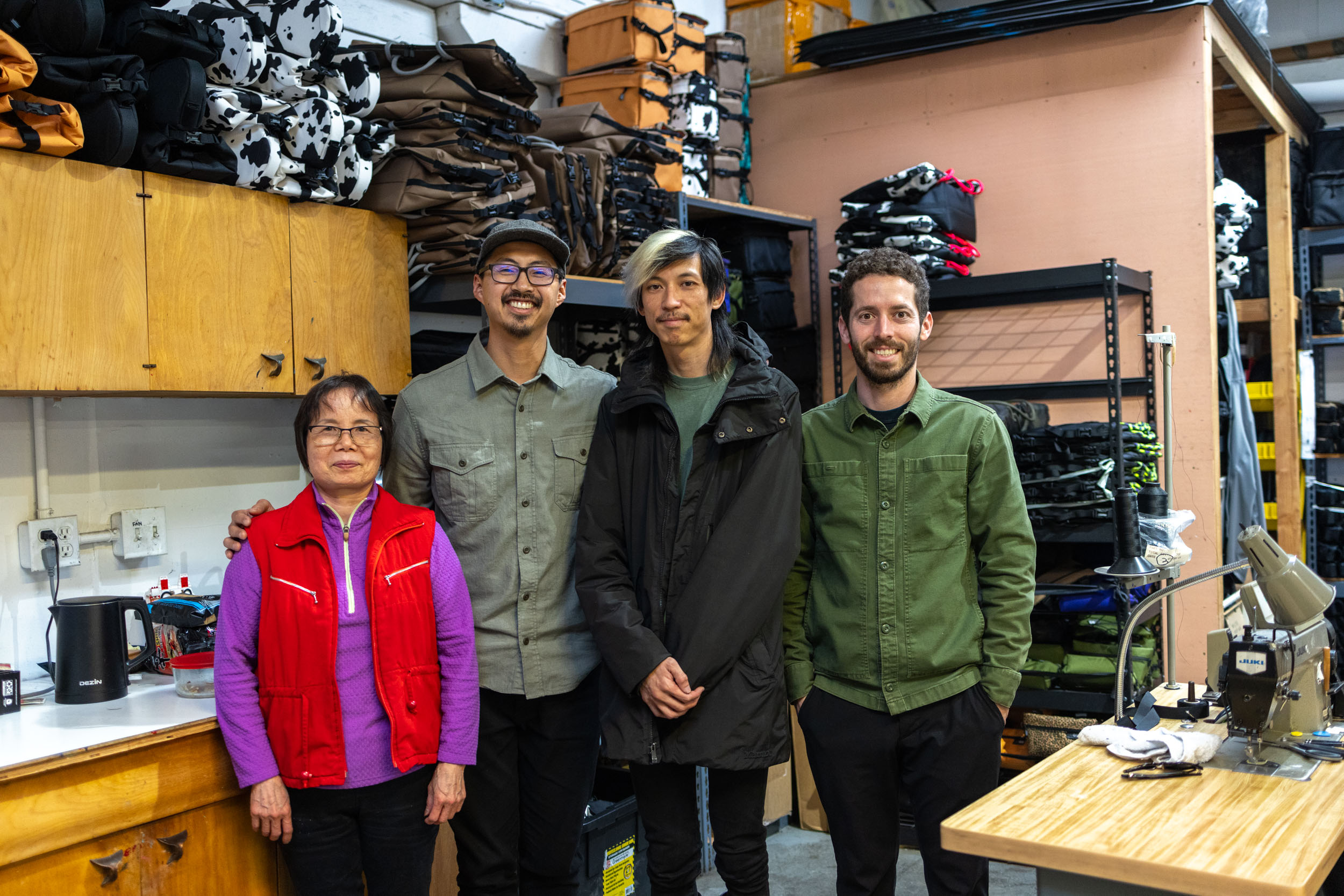
Coincidentally, my first published bag review was Outer Shell’s Drawcord Handlebar Bag and Harness, and I’ve been fortunate enough to spend time with several more of this little brand’s creations, including their camera strap, the updated handlebar harness and drawcord bag, and their top tube bags. Last spring, I had the chance to meet the small team at Outer Shell headquarters in San Francisco. It was eye-opening to see their processes in action, from a team that leverages everyone’s strengths and experience to the spreadsheets that keep the business, its products, and employees on track. What stood out to me was the intentionality behind every decision founder Kyle Ng makes, and how that has trickled into the products they choose to bring to production. Everything I’ve seen from Outer Shell feels calculated and functional, so I always keep a close eye on their product launches.
Introducing the Outer Shell Mega Bar Bag
This spring, Outer Shell launched a bold new bag called the Mega Bar Bag. If you’ve been following their lineup, then you may have noticed that they’ve never offered a large, unsupported handlebar or saddle bag. Aside from their Basket Bag and Rack Bag, their lineup is chiefly bags that don’t require additional support or mounting hardware. According to Outer Shell, a larger handlebar-mounted bag was by far their most requested product, so they made one.
At first glance, the Mega Bar Bag looks like any other medium-to-large capacity top-opening handlebar bag. However, it’s what you can’t see that sets it apart from others in this category—many of which I’ve also tested. Inside the bag, between the bright white liner and exterior fabric, is an internal laser-cut aluminum frame unlike anything we’ve seen.
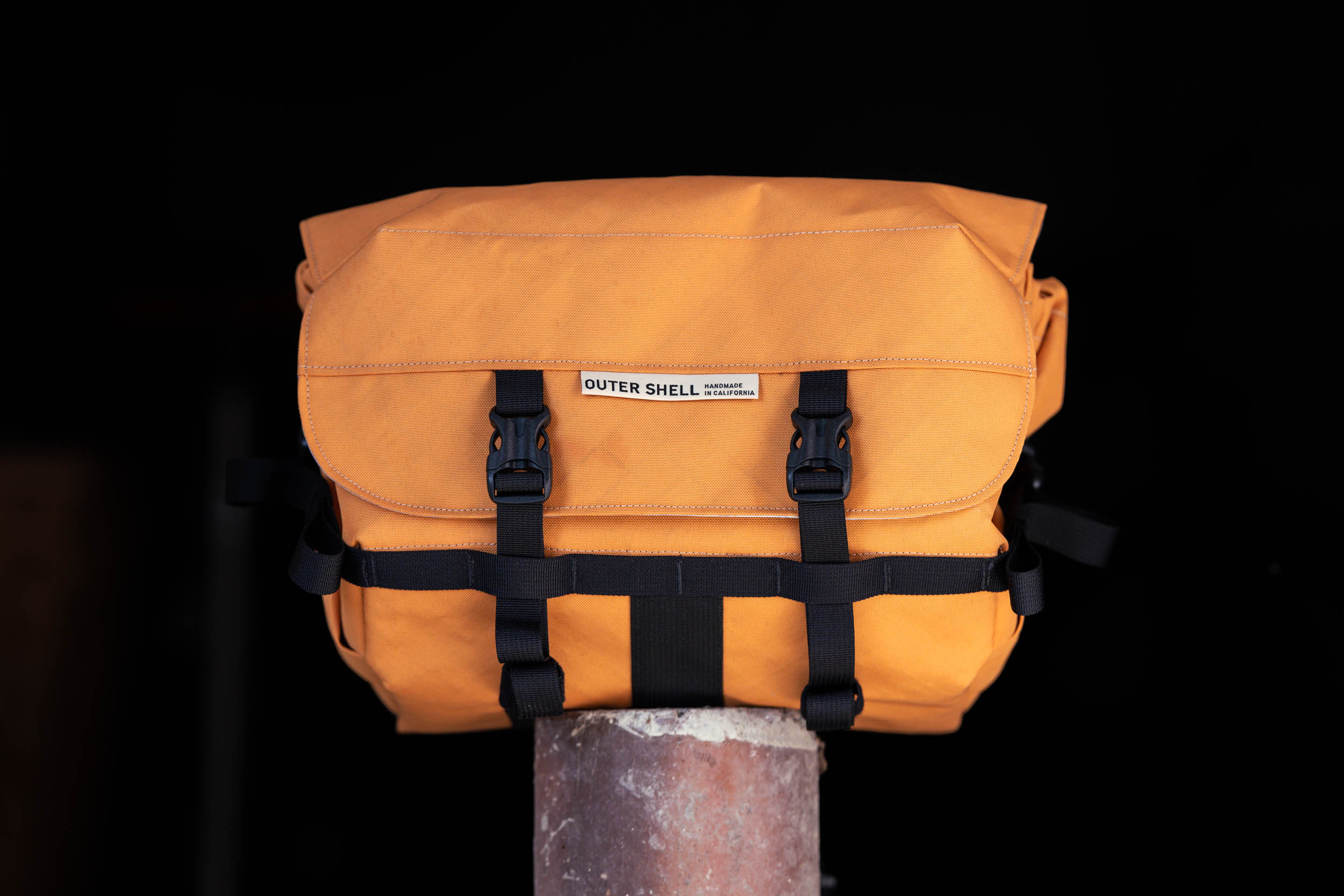
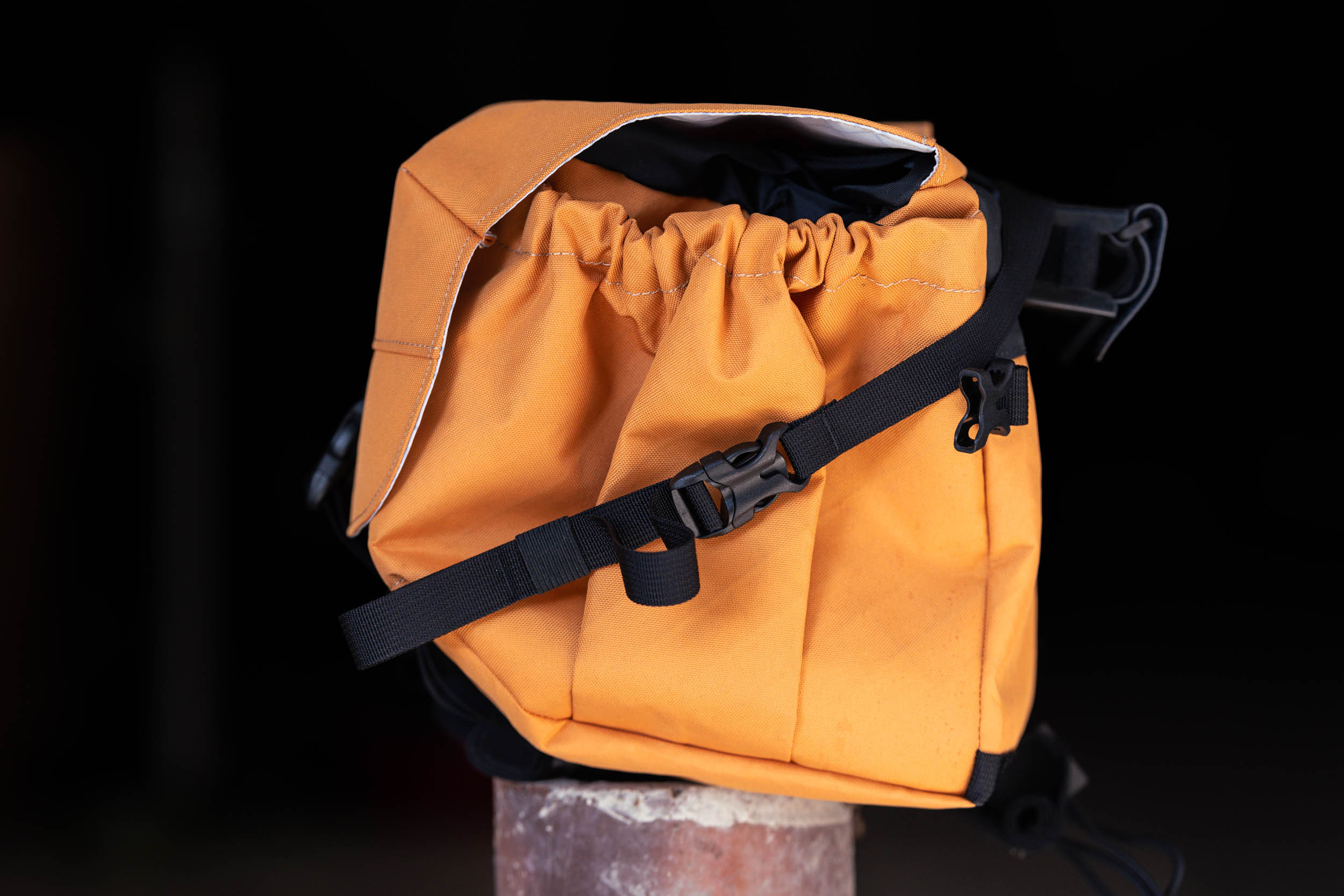


Most bags in this category rely on dowels and HDPE sheets for structure, but Outer Shell raised the bar with a unique aluminum skeleton to eliminate bag deformation and sagging. The aluminum frame is sewn into the bag, with a center section that runs from the upper mounting points along the back, and up around the front of the bag. Additional supports extend outwards horizontally along the upper mounting points to the lower mount and the base of the front of the bag. It acts exactly like a lightweight front rack, but is far easier to install since it’s integrated into the bag itself.
The frame features slots sized for M6 bolts along the bottom and front, which can be used to mount bag supports, such as the Shovel Research Rod Steward, a front light, or even a rack diving board attachment to hold the bag away from your bike’s headtube. Outer Shell explains the process for using the internal frame in different ways on their website. The various external webbing sections, attachment points, and compression straps align with the frame, so you’re never yanking on unsupported fabric to keep things tight.

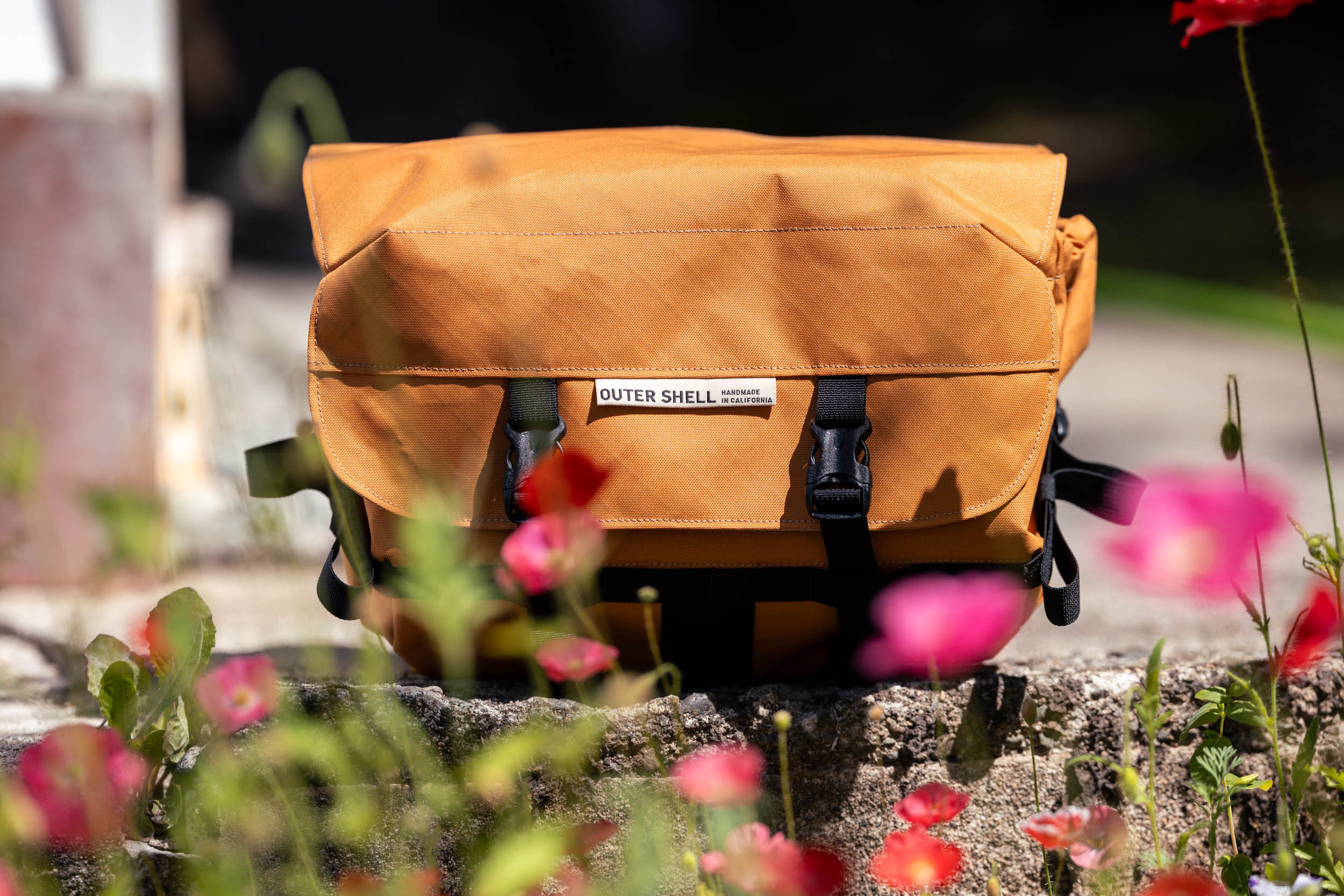

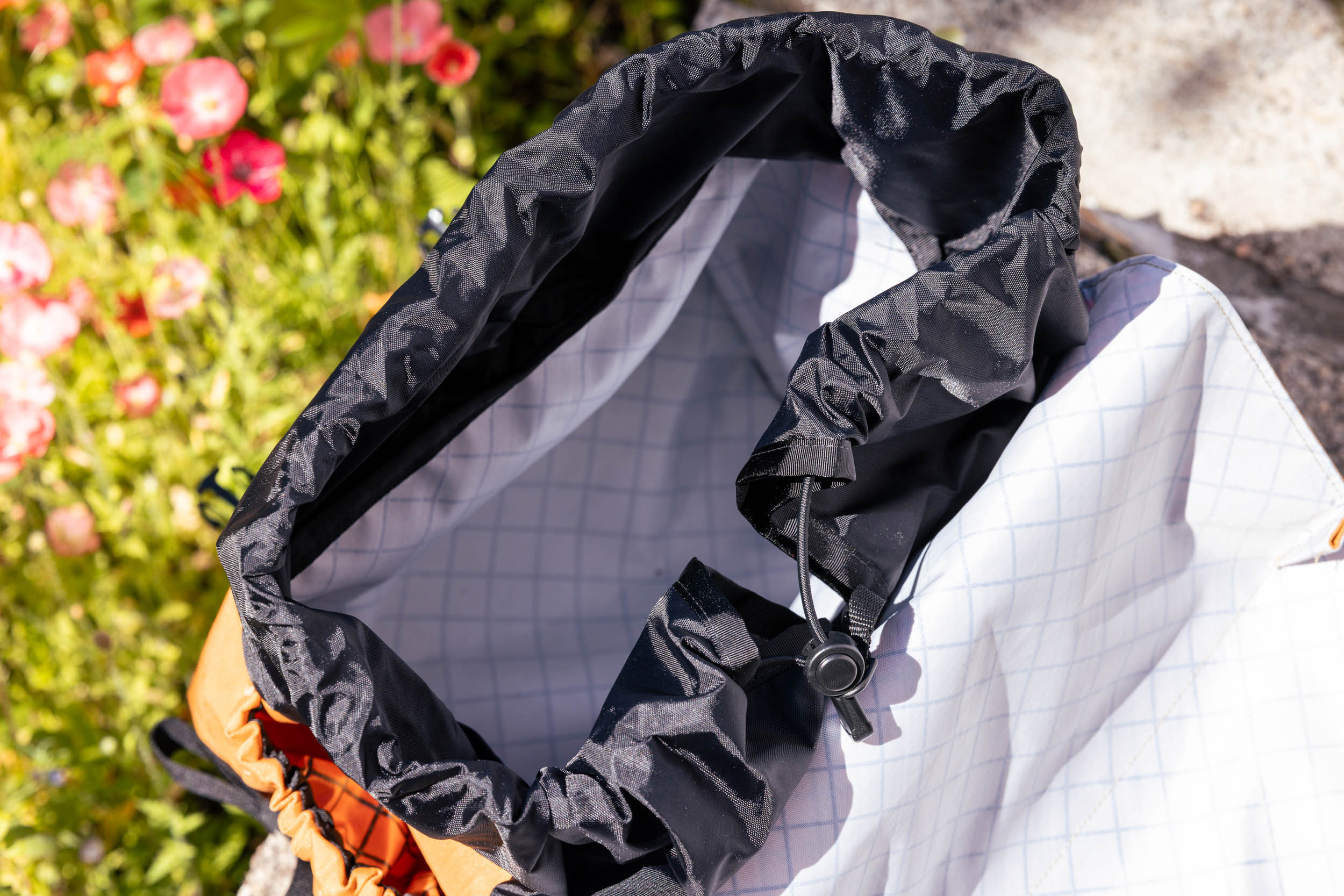
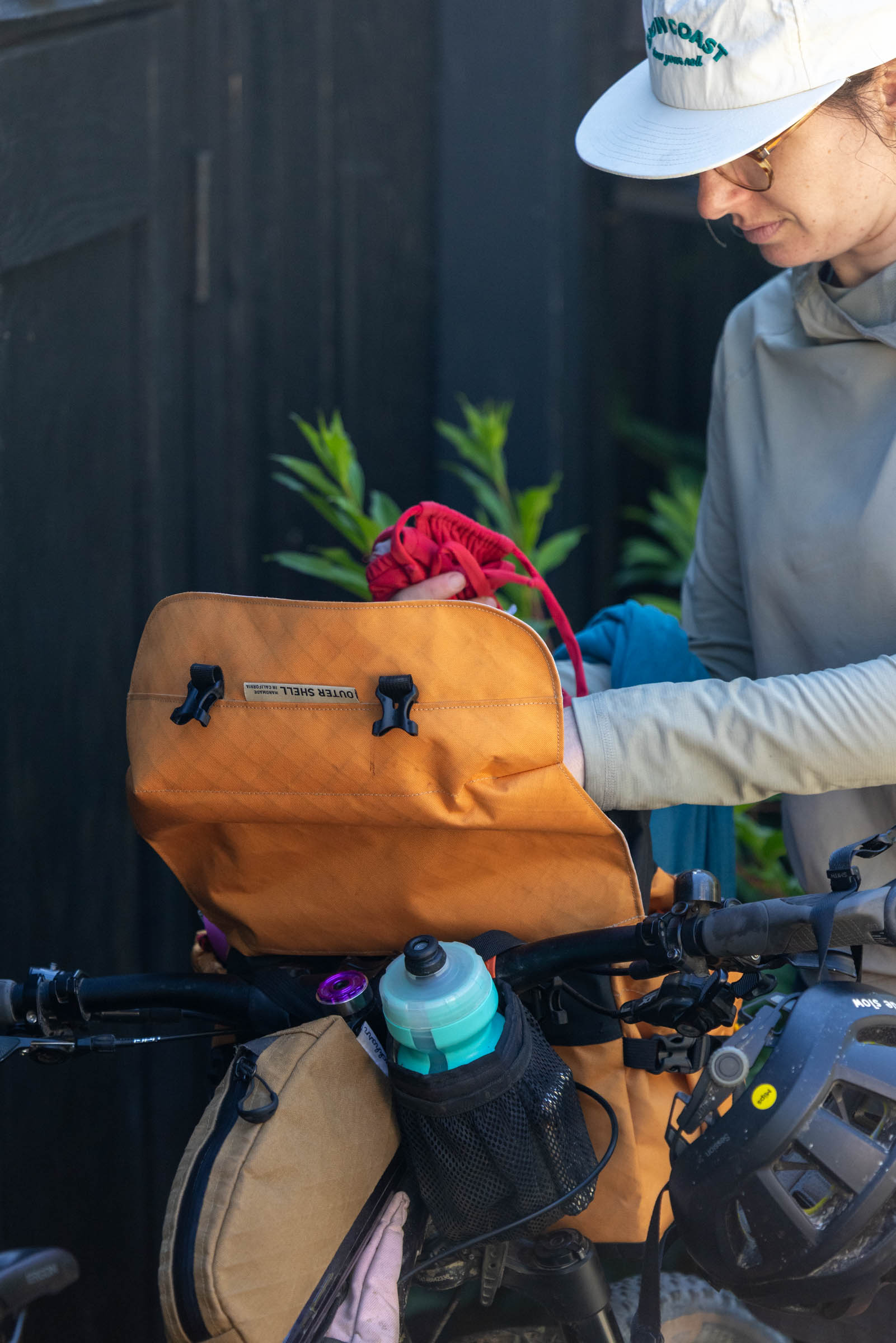
Starting from the top, there’s a larger flap-style closure that wraps around the top of the bag and secures in place with two side-release buckles out front. An internal drawstring closure keeps the contents secure and expands as needed. There’s a rider-facing zippered sleeve on the top of the main flap, which is easily accessible while riding or during brief stops, and a flat sleeve pocket on the front of the bag adds more utility for other quick-access items. Plus, there’s an elastic side pocket on each side, providing a bit more storage for items you want to keep safe. The entire exterior—including all the pockets—is made from the same material: either burly 1000-denier Cordura or EcoPak, lined with a lightweight EcoPak.
Outer Shell designed the Mega Bar Bag to be mounted in three ways: directly onto a flat or drop-bar handlebar, supported by a rack, or as a saddle bag. As a handlebar bag, which is how I tested it, it attaches to the handlebar using two rubber-backed velcro straps. Two injection molded spacer blocks space it away from the bar and cables. A small elastic cord and foam spacers are included for the lower daisy chain attachment point, which extends horizontally to attach two included velcro straps to a rack or fork crown.



To prevent sagging, Outer Shell includes an anti-sag webbing strap that can be attached to either side of the bag, or, for extra stability, wrapped over the bars, under the stem, and attached to both sides of the bag. I primarily used the latter, which pulls the bag up and away from the front tire. At 8.5″ tall (21.6 cm), shorter riders may run into tire clearance issues, so having so much structure built into the bag gives them a fighting chance to avoid having to add a rack or support system.
Mega Bar Bag Goes Bikepacking
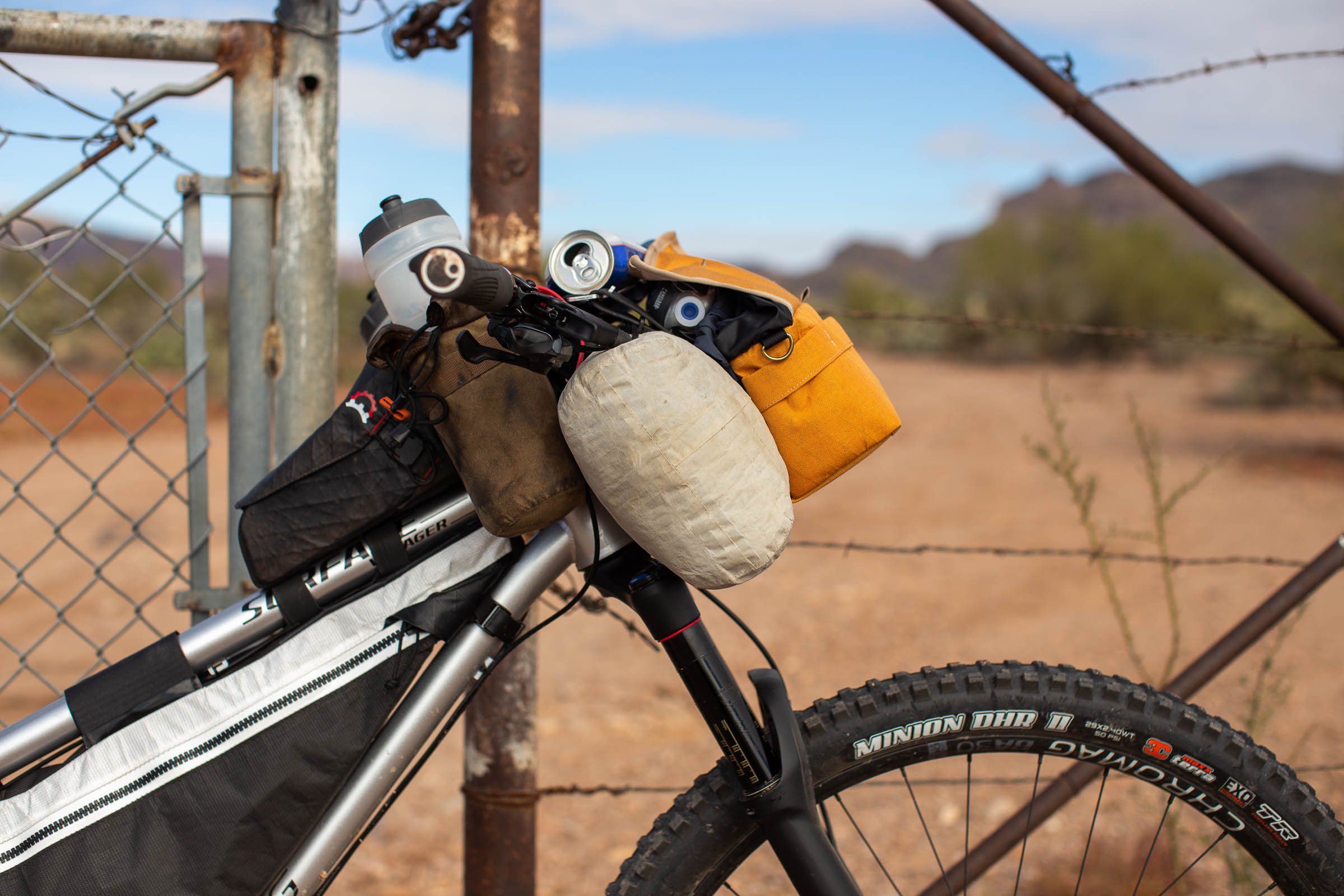
Emily and I have both spent a fair amount of time with the Mega Bar Bag over the last few months. In fact, we’ve been fighting over it not only because of the fun summer-approved marigold color, but because it’s quickly become one of our favorite mid-sized handlebar bags.
With the drawstring closure in the lowest position, the 10.6-liter capacity is on the smaller end of the spectrum, and almost identical to the small Bags by Bird Piccolo I tested. It’s not big, but it hits a sweet spot for commuting, big day rides, and warm-weather bikepacking when extra capacity isn’t needed—or if you simply have a lot of room in panniers and elsewhere. With the drawstring closure expanded and the webbing straps opened, it can carry up to 18.5 liters and adds 6 inches of height, which would extend right over the handlebars. We’ve definitely taken advantage of the bag’s expandability when picking up food on the way to camp, but we tried to avoid overpacking it. Our typical strategy was using the bottom of the bag for a sleeping pad or camp shoes, and then layering items on top—things that are sometimes needed during the day, like layers, food, water filter, etc. After all, top-opening handlebar bags stand out against rolls and cradles because of how easy it is to access their contents along the way.


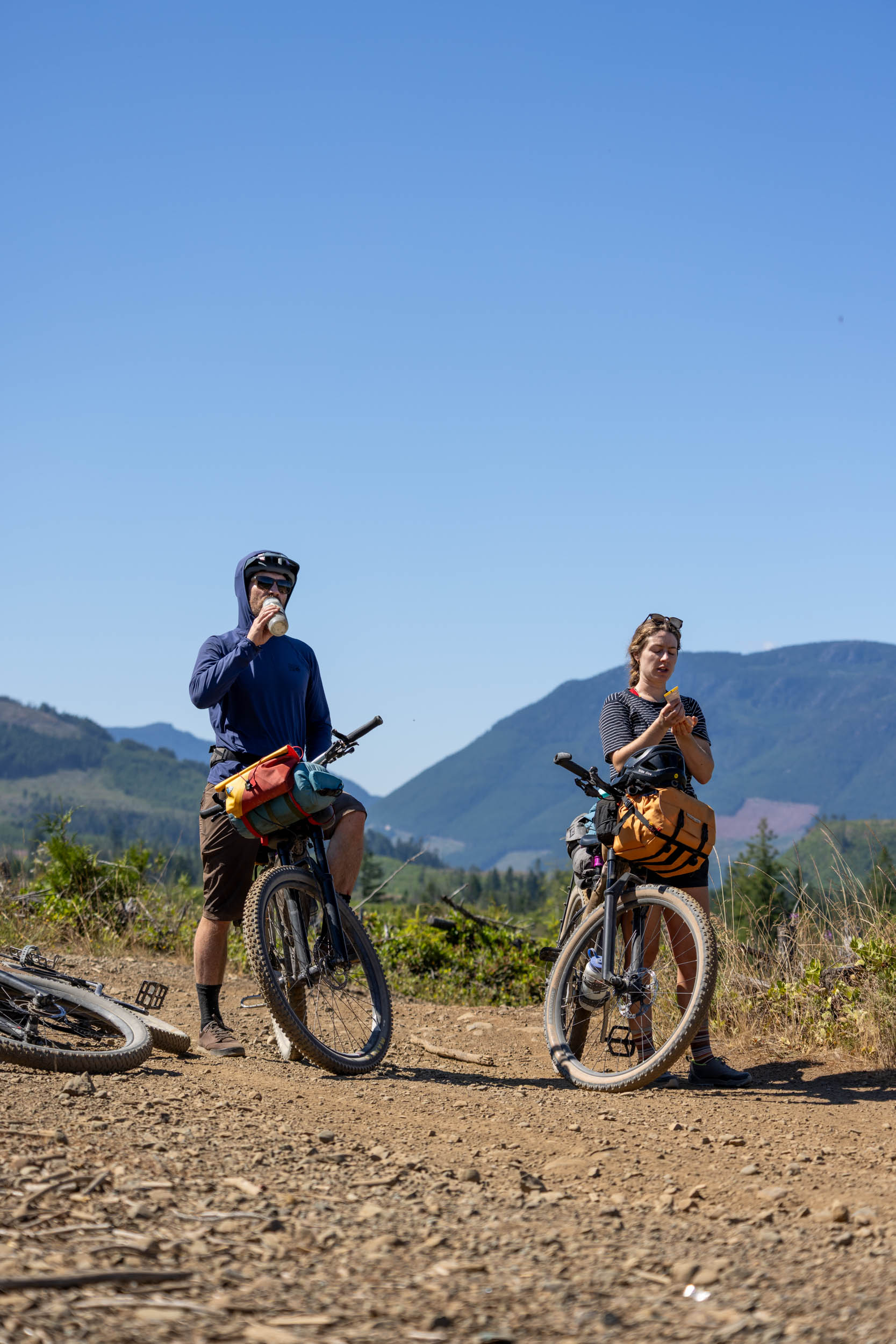
No matter how much gear was in the bag, there were practically no wiggles, sags, or movement. It seems like the internal aluminum frame, anti-sag strap, and thoughtful design are all working in tandem to accomplish this. The Mega Bar Bag is easily one of the most stable top-loading bags I’ve used, and that’s with just the included shock cord lower attachment. Adding velcro or additional Voile Nano straps in its place would probably make it even more solid.
I never had to utilize the M5 internal frame slots, but it’s really cool to see Outer Shell thinking ahead and integrating so much personalization into the bag. Some folks, like those on smaller frames, will likely need a rack or bag support of some sort, and the internal slots future-proof the bag. At first, I wasn’t sure about the side pockets having no type of cinch closure, but the elastic is tight enough to keep items secure on rough terrain, and I had no problem trusting them to hold my fuel, pump, snacks, and other small items. They match the full height and depth of the bag, which makes them quite spacious. The top rider-facing zippered pocket is also surprisingly roomy, and not just a slim zippered sleeve like it might appear. It’s large enough to hold a small mirrorless camera, wallet, snacks, and other valuable items. Plus, the zipper is smooth and easy to operate one-handed, which is important for any quick-access zippered pocket.


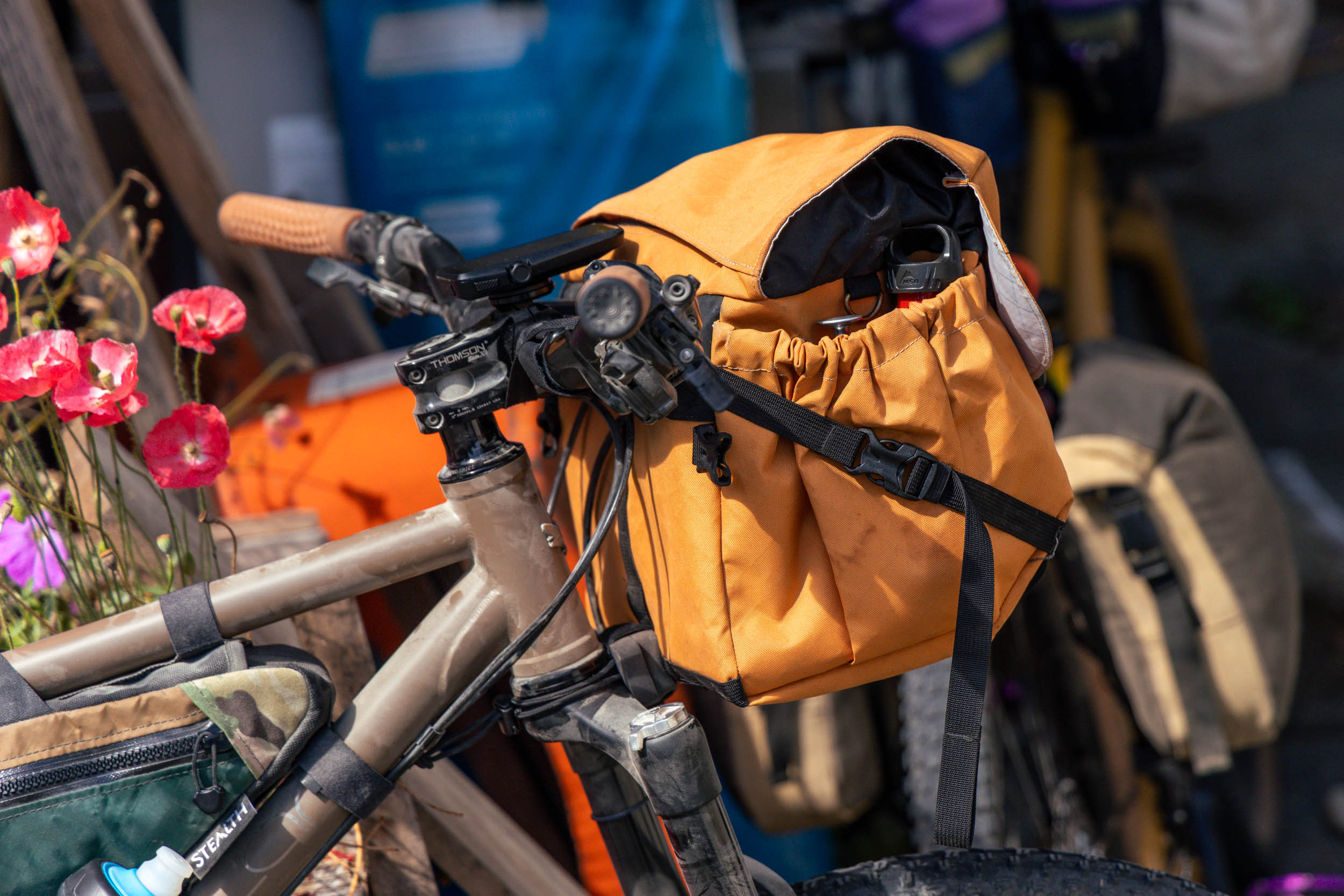
The Mega Bar Bag weighs just under 880 grams, making it a touch heavier than both my small and large BXB Piccolo, which weigh 726g and 780g, respectively. It’s over double the weight of the CamelBak M.U.L.E. and Rambler Bags Roll-Top, a touch heavier than the DITW XL Bar Bag Lucas tested, and 300 grams heavier than the Swift Industries Zeitgeist. All that said, the Mega Bar Bag is the only bag in this category with a 3D aluminum internal structure, thus replacing a rack and offering an impressive amount of structure and stability.
Emily’s Thoughts
Finding the right handlebar bag sometimes feels like the Goldilocks principle for me. I look for something that’s not too big so that it won’t shift around, and not too small, as I barely have any framebag space as it is. The Mega Bar Bag has been a nice “just right” bag this summer, as it comfortably carries all of the odds and ends I can’t fit into other spaces on my bike.
I typically like to cram all of my sleeping gear and clothes into my rear bag, avoiding any contact with smelly things, as well as heavier and awkward items that fit my small frame bag. I keep all the odds and ends I want accessible during the day in the front bag. This can range from swim gear, to lunch and snacks, to a hat, to my Kobo reader, to my prism kite. On our scouting trip for the Alberni Bam Bam, the bag was a catchall for extra layers, sunscreen, a camp towel, snacks galore, and anything else that wouldn’t fit in the other smaller spaces on my bike. I will take most setups over a roll bag on the front. I change my mind a lot throughout the day, and I want to be able to access to more sunscreen or a different layer. Unpacking and repacking a roll bag is not something I enjoy, and I quickly become annoyed; my setup will promptly go from dialed and tight to loose and floppy. With the Mega Bar Bag, access is quick and easy. I love the side pockets, where I typically put a mini first aid kit and sunscreen, and the big slim zipper top pocket, which has become a new home for my camp hat and my precious Kobo reader—if I can’t fit my e-reader on my bike somewhere, I likely don’t want to go on the trip at all.

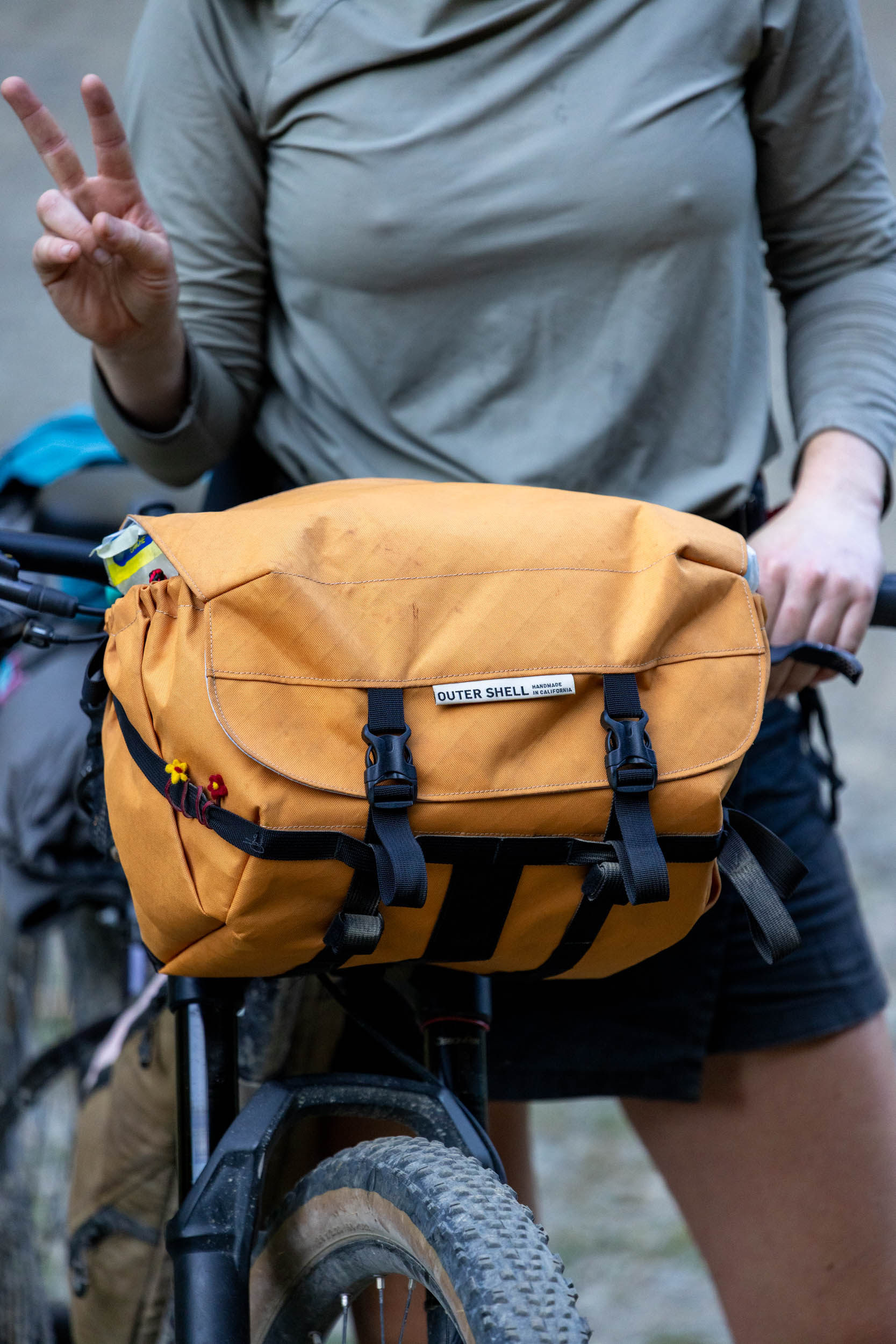

I agree with Miles that the bag is super stable, and that having the anti-sag strap around the stem, in addition to big tightening straps on the sides, keeps things tight and sturdy. This bag accompanied me on smooth gravel roads and chunky downhill quad trails, and I never noticed anything coming loose or flopping around. The strap system took some getting used to, and I found myself misclipping the side buckles onto other buckles on the bag, rather than the stem clip, after hunting around for lunch or other things throughout the day. It would take me a few kilometres to realize that the stem clip strap was not actually connected to anything (but it never went anywhere!).
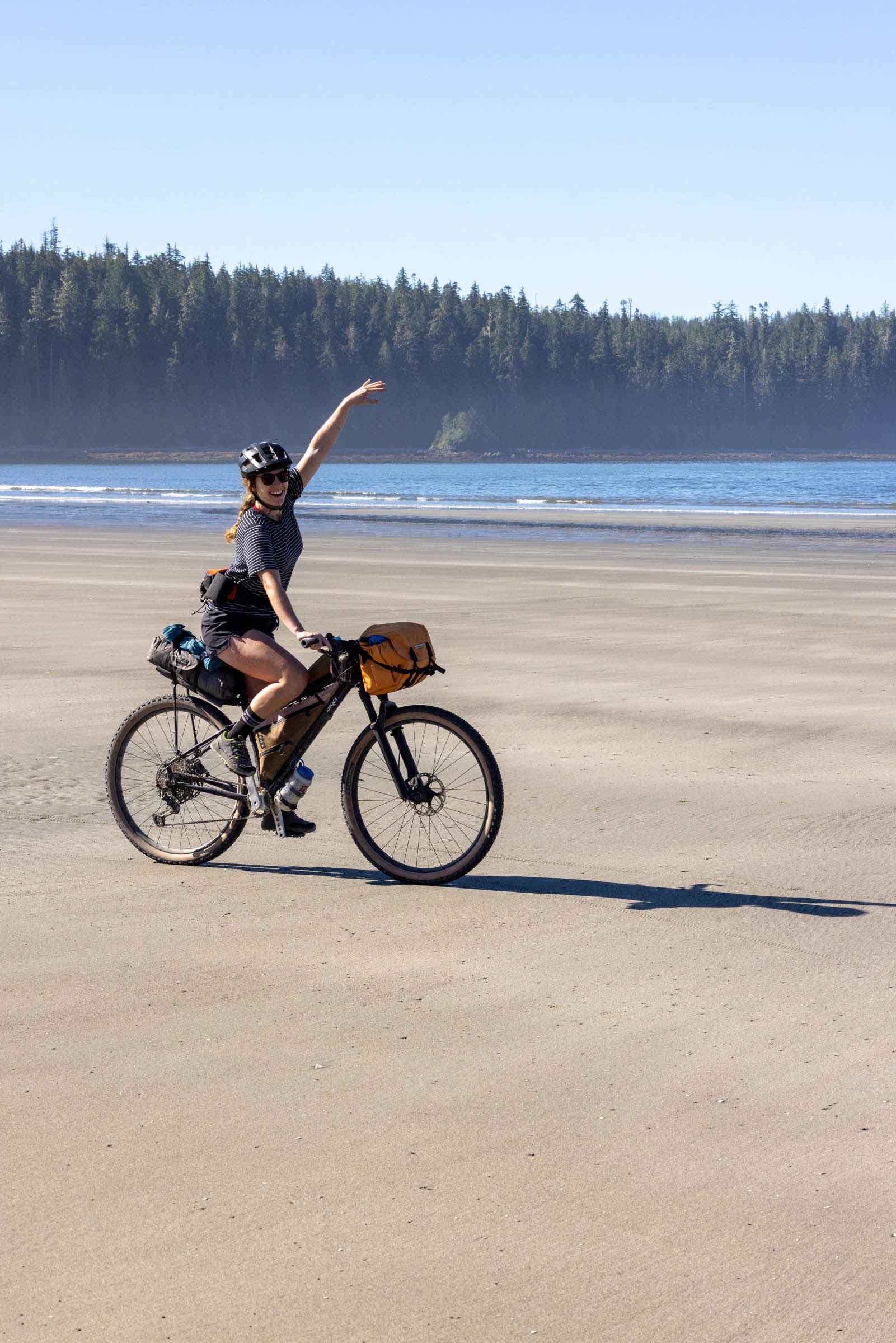
After using the Mega Bar Bag on our week-long trip in July, I also used it to scout the Slow Coast route solo a week later. The stability and size are pros for me, in addition to the fun summer colour. It fit my medium Esker Japhy well and didn’t require any creative moves to keep it off my front tire, even with my front suspension open. I mostly used this bag on gravel-focused trips, with some fun trails in between, but would likely opt for a narrower bag or different setup if a ride or trip was more singletrack-heavy, such as the prototype Buckhorn front bag I used on the Monumental Loop. As of now, I can’t really see my front tire with the Mega Bar Bag installed, and being able to see my tire on higher-consequence trails brings more confidence during my ride.

- Capacity: 10.6-18.5L
- Material (as tested): Marigold EcoPak, Aluminum Frame
- Weight: 878 grams
- Place of Manufacture: California, USA
- Price: $280-$310 USD
- Manufacturer’s Details: OuterShell.com
Pros
- Internal aluminum frame provides vertical and lateral stability and structure, which limits movement and bouncing
- External side pockets and zippered top pocket are spacious and functional
- Nine different color/fabric options to choose from
- Handmade in California, USA
- Capacity hits a sweet spot for a do-everything bag, but it might be a little small for longer, more remote bikepacking trips, unless paired with other bags or small panniers
- Rock-solid attachment, even on rough terrain
Cons
- Anti-sag strap over the handlebar isn’t very clean and might get in the way of other straps or accessories
- Height might require a rack, support, or bolt-on struts on smaller frames with limited tire clearance
- Not waterproof, but highly weather-resistant thanks to high-quality materials and EcoPak liner
- Deep profile restricts sightline of front tire
Wrap Up
Outer Shell consistently designs some of the best, well-thought-out bags in the game. From the first bag I reviewed, over seven years ago, to now, I’ve always been impressed with the care that goes into each design. Nothing they produce is rushed to market; if improvements are found, they integrate them into future updates, and they always seem to find new ways of doing things. The Outer Shell Mega Bar Bag aligns with everything else I’ve used from them, and it’s a good example of what sophisticated 3D-modelling (in both the sewing and internal frame) can achieve. It offers best-in-class stability and structure, it’s big enough to bikepack with without feeling overkill for daily bakery runs, and all the different straps, webbing, pockets, and sleeves are functional and serve a purpose.
I’m getting nitpicky here, but I’d prefer to see a slightly wider version that’s not quite as tall to make room for tent poles. The total depth is also almost just as long as the bag’s height, creating a box-like shape that restricts the sightline of the front tire. As someone who regularly rides root-covered trails and through rock gardens, I’d prefer a slightly shallower profile to be able to see more of the trail ahead. Although that’s coming from someone who prefers flat bars over drop bars, so I understand why Outer Shell landed on these dimensions from a one-size-fits-all approach.
Further Reading
Make sure to dig into these related articles for more info...
Please keep the conversation civil, constructive, and inclusive, or your comment will be removed.