

 Mountain Bike (MTB)
 Gravel Bike
 All-Terrain Bike (ATB)
 Fat Bike



Wolf Tooth Pedals Review: CTRL + ALT + DEL




Wolf Tooth just dropped a trio of SPD-compatible pedals (CTRL, ALT, DEL) with a slick party trick: tool-simple, adjustable Q-factor for a dialed stance on any bike. Neil tested the CTRL and ALT trail and XC pedals and came away impressed. Find our full Wolf Tooth pedals review for ride impressions, specs, and pros/cons here, plus a back-to-back comparison with Shimano SPDs.
PUBLISHED Oct 9, 2025
What’s the one component you expect to work flawlessly—and rarely think about? Pedals. Wolf Tooth just launched a new line of SPD-compatible options, and in this video I’ll show you what’s new, how they feel on the bike, and who they’re for. Dive into the full Wolf Tooth pedals review video below, featuring the CTRL and ALT trail and XC SPD pedals. Or, scroll down for the written version with specs, pros, and cons.
Aptly named CTRL, ALT, and DEL, the new lineup of Wolf Tooth pedals may take you down memory lane if you’re of the right age. Many of us know that trio as the Windows shortcut that pulls up the dreaded Security screen. As someone who grew up on PCs and has used a Mac for the past decade, those names send me straight back to childhood—hammering the keys when a game like StarCraft froze. The commands are as iconic and dependable as those memories, making the naming clever and fitting.


Wolf Tooth’s new pedals use Shimano’s SPD standard—short for Shimano Pedaling Dynamics—introduced in 1990 after patents filed in 1989 for the spring-loaded retention and recessed two-bolt cleat. Those patents have long expired, which is why so many “SPD-compatible” pedals exist today. Shimano effectively set the clipless template, and the basic design still defines what most of us use.


Personally, I’ve been on SPDs for as long as I can remember. I flirted with Time in 2014, but nothing has matched the consistency of SPDs. Modern clipless shoes also make more sense than ever for bikepacking—supportive on the bike, practical off it.
It makes sense that companies like OneUp and Wolf Tooth would build around SPD: it’s reliable, proven, and already widespread. Many riders already own SPD cleats, and Shimano recently added the CL-MT001—designed with bikepackers in mind—thinner, more tapered, and better for walking. With the original SM-SH51 you typically toe in, step down, and twist to release; the CL-MT001 lets you toe in, step straight down, or roll your heel in first—handy when you’re on and off the bike all day.

I’ve only just installed Wolf Tooth’s cleats, and they mirror Shimano’s closely—I can’t tell a difference. The upshot: both CL-MT001 and SH51/56 cleats work great with Wolf Tooth’s new pedals. If you already have those cleats, the transition should feel seamless—more on that soon.

Wolf Tooth Pedals Specs
Wolf Tooth launched three new SPD-compatible pedals today. I tested the CTRL and ALT, so I’ll focus on those, but the DEL is worth a mention—it’s a quirky, one-sided, low-stack design developed with input from pro gravel racers. Not exactly our lane, but if you want an ultra-light, minimal interface, it’s one to watch.


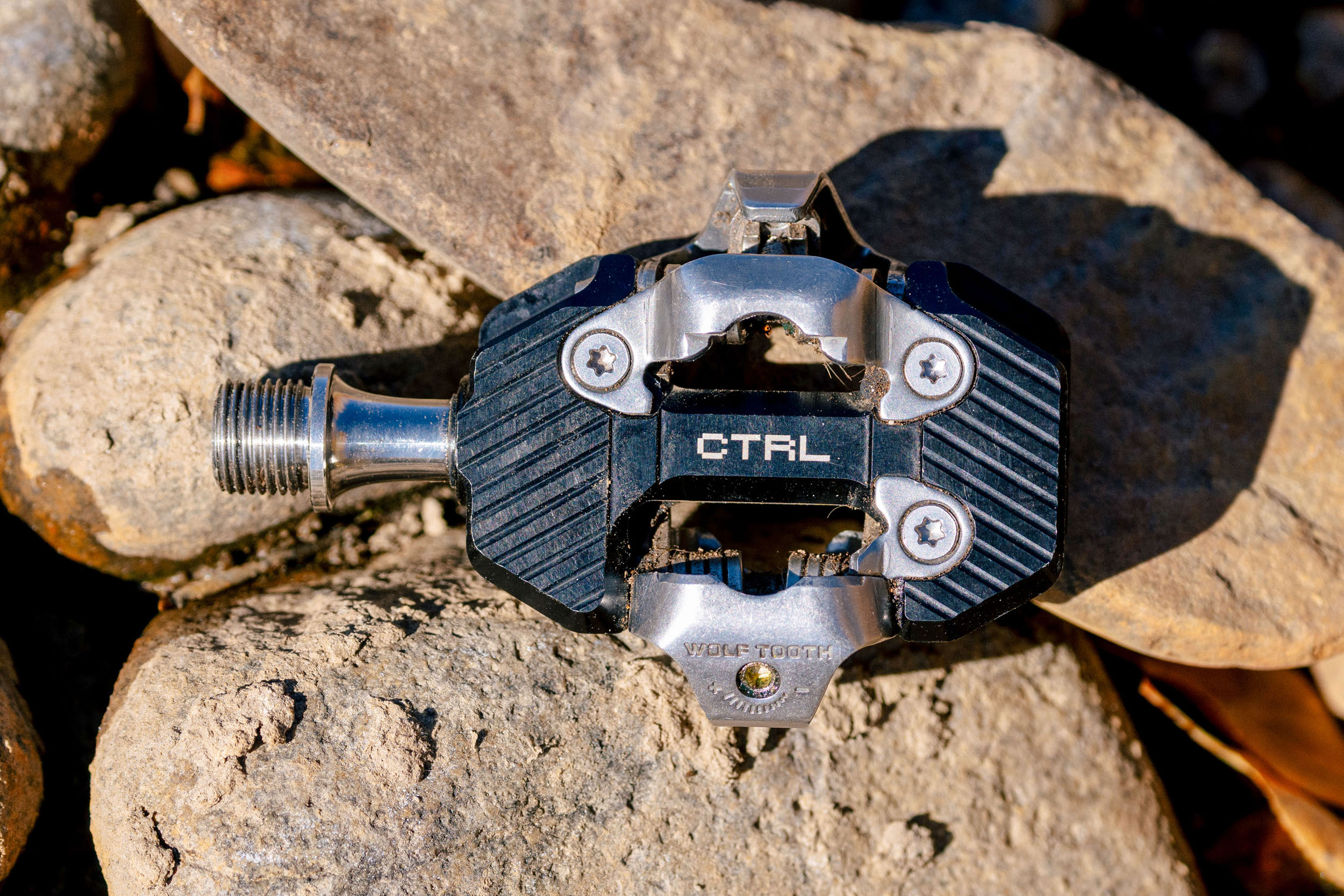
The ALT is their XC option: double-sided, 295g per pair, with a 15mm body and a surprisingly generous platform for the category. The CTRL targets trail use and is a bit more distinctive than most peers—327g per pair, the same 15mm body, and an even larger contact patch for shoe support. Instead of surrounding the mechanism with cages and pins (common on trail pedals for unclipped stability and strike protection), Wolf Tooth keeps the design clean. The standout across all three models is a user-adjustable Q-factor system that lets you set axle length to 51, 55, or 59mm (measured from spindle end to pedal center).

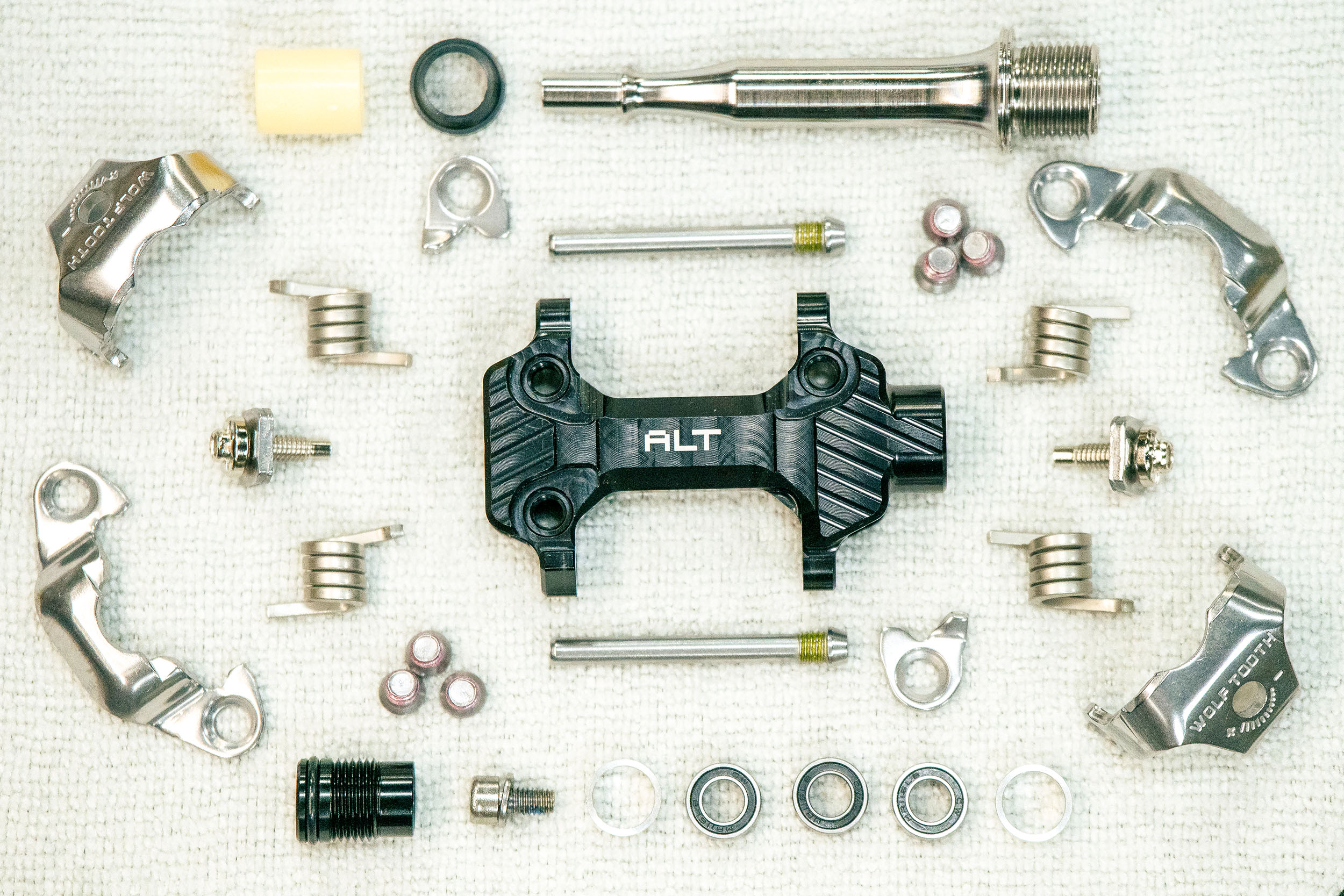

Construction is stout: stainless-steel axles and bindings, aluminum bodies. Hardware is sensibly chosen—T15 for the bindings, a 3mm hex for release-tension adjustment, 6mm to separate spindle from body, and 8mm to remove the pedal from the crank. Wolf Tooth machines the bodies and axles in-house (as with their flats); springs, bolts, bearings, and stamped stainless bindings are sourced overseas where the manufacturing makes sense.
Adjustable Axles
What really sets these pedals apart is how quickly you can change axle length—and therefore Q-factor. I’ve swapped spindles before, but I’ve never been able to adjust stance this easily. It’s handy for fine-tuning fit across different shoes or bikes and saves you from buying alternate spindles or aftermarket parts. All Wolf Tooth models ship at 55mm, but you can switch to 51mm or 59mm in about five minutes with basic tools.


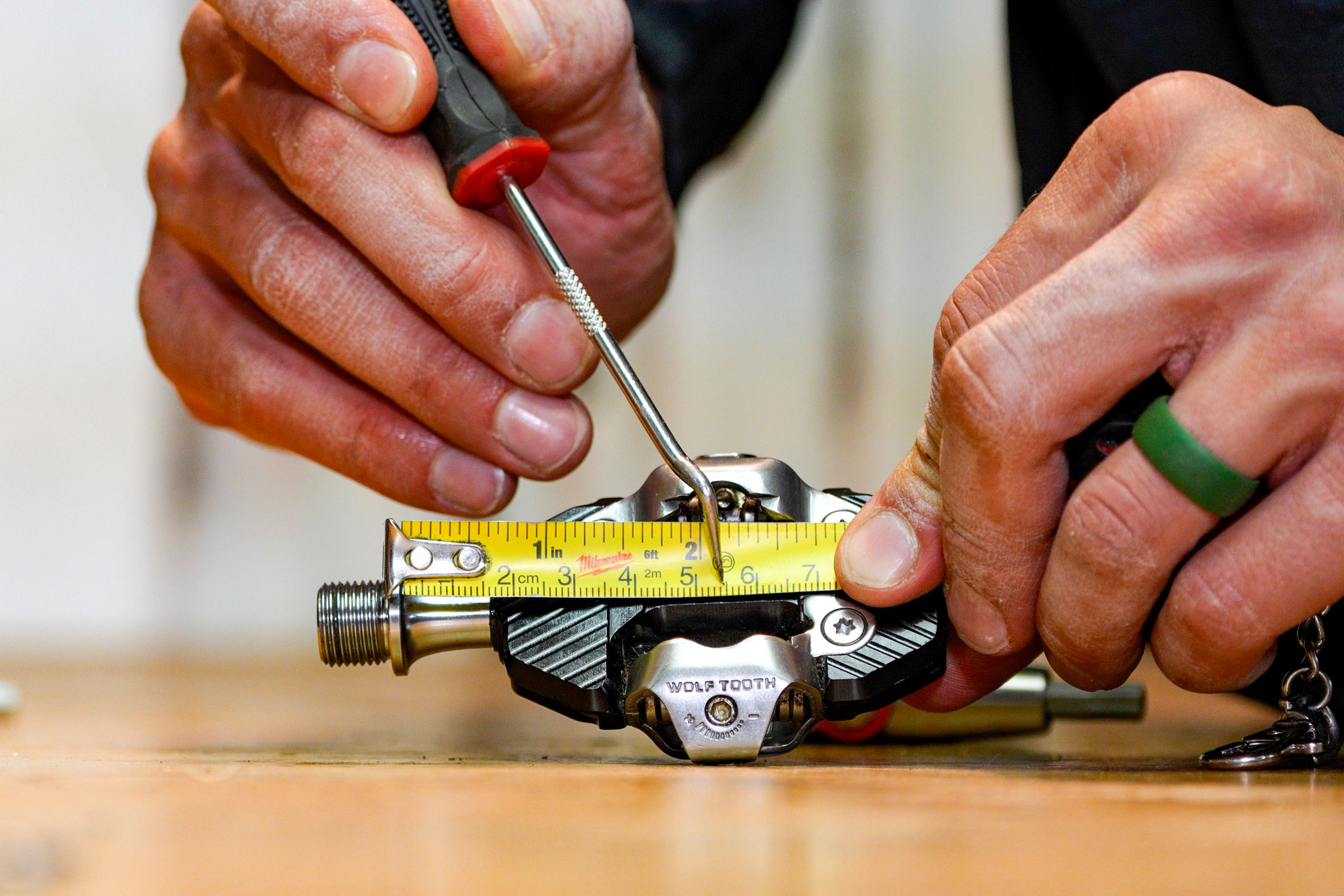

To adjust Q-factor: remove the end cap with a 6mm hex. Use an 8mm on the axle end and a 3mm on the small bolt inside the body to separate the body from the spindle. Note the threads: the right pedal’s axle bolt is left-hand threaded (turn clockwise to loosen), and the left pedal is right-hand threaded (turn counter-clockwise). Once the bolt’s out, the axle slides free. The bearings and spacers usually stay put, but you can push them out with the 6mm—this is a good time to re-grease or replace the three bearings if needed.

Re-stack the spacers and bearings to set stance width: for 51 mm, place both spacers inboard (before the bearings); for 55 mm, put one spacer on each side of the bearing stack; for 59 mm, place both spacers outboard (with the bearing against the spindle). I tried all three and recommend experimenting—it’s very quick. If your shoe rubs the crank, a wider setting solves it fast. For my cleat position, the stock 55 mm feels spot on.

Wolf Tooth Pedals vs. Shimano SPDs
I’ll have a full head-to-head trail pedal video in the coming months—I’m still testing a few—but here are some early takeaways on how the new Wolf Tooth pedals differ from the competition.
First, Wolf Tooth prioritized shoe-to-pedal contact. I didn’t realize how much this matters until I rode two sets back to back. Compared to Shimano’s XTR M9200, the ALT’s larger platform delivers a more planted feel and slightly better power transfer—though shoe shank stiffness still plays the biggest role. Body thickness is another key difference: both the ALT and CTRL are 15mm tall. That 1.5mm advantage versus the M9200 can be the difference between a clean stroke and a rock strike, though the M9200’s smaller platform creates more clearance around the edges, which can help reduce strikes in some situations.


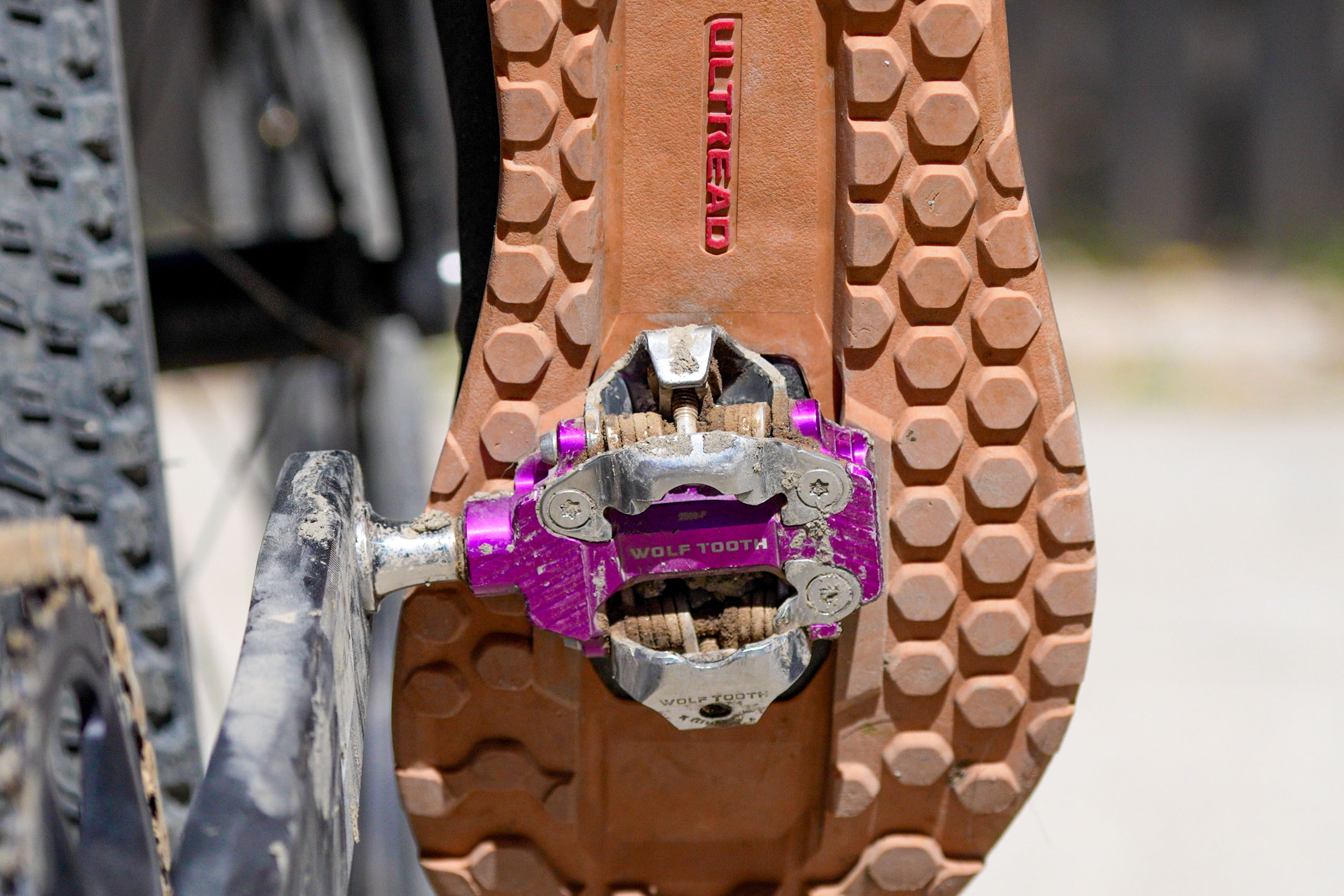


On feel, clipping in and out of the Wolf Tooth pedals is excellent—nearly indistinguishable from Shimano SPDs in a blind test, which is high praise. Tension adjustment with a 3mm hex is simple, though the clicks aren’t as defined as Shimano’s. The standout feature remains the adjustable axle length; you won’t change it often, but having 51/55/59mm options adds real fit value. Finally, weight: Wolf Tooth clearly chased grams. The ALT weighs 295g (vs. 319g for Shimano PD-M9200 XTR), and the CTRL is 326g (vs. 439g for the new XTR M9220 without pins). Shimano’s cages and pins add mass—and give more stability when unclipped and extra protection for the mechanism—while Wolf Tooth’s cleaner design saves weight but leaves a bit less “emergency” footing if you pop out on a descent.
On the Trail
I haven’t logged tons of hours on each model individually, but I’ve put a few hundred miles on the Wolf Tooth pedals collectively and I’m thoroughly impressed so far. I’ve ridden plenty of Shimano over the years and only recently started branching into SPD-compatible alternatives; a bigger comparison is coming, but the fact that I have no real complaints about how these perform is a great sign. Pedals should just work, and between the entry/exit feel and easy tension adjustment, these do exactly that.

If anything, the Wolf Tooth pedals give me a better sense of the bike. That’s part of why I’ve been leaning toward trail pedals more often: a larger platform gives your foot more leverage to react to obstacles, shift weight, and move the bike side to side. The difference between a traditional XC pedal and the ALT is subtle, but stepping up to the CTRL—even on a gravel bike—added a surprising amount of control I didn’t know I was missing. Without the aggressive cages you see on other trail pedals, it doesn’t look out of place, either. It almost feels like cheating, the confidence bump is that real.


Conditions-wise, they’ve been flawless in the dry. I haven’t had true peanut-butter mud yet, but in semi-muddy situations they still released and clipped in without issue; functionally, I can’t tell a difference from my Shimano XC pedals. You still need a couple of solid stomps to punch through the gunk, and the slightly narrower axle and relieved center section may even give mud more room to clear.
One note after plenty of miles: the axles still spin with a bit of resistance off the bike. You don’t feel it while riding, but both the CTRL and ALT have a slight drag by hand. I’m not sure if it’s inherent to the system or if it will ease with more time, but it’s worth mentioning—I rechecked the inner bolt torque and it’s to spec. Personally, I like a pedal that “floats” freely when you spin it, and most of my Shimano sets break in that way after ~20 miles.
- Model/Size Tested: Wolf Tooth CTRL and ALT Pedals
- Actual Weight: 295 grams (ALT), 327 grams (CTRL)
- Place of Manufacture: MN, USA with Parts from Taiwan/China
- Price: $219.95 at Wolf Tooth
- Manufacturer’s Details: Wolf Tooth
Pros
- Adjustable Q-factor is a nice touch
- Quality feels great, similar to Shimano pedals
- A larger platform gives me a better feel of the bike
- Right to repair makes them 100% rebuildable
- CTRL pedal doesn’t look silly on a gravel/drop bar MTB bike
- Available in multiple colors
Cons
- Fairly expensive and no affordable models
- The lack of cage on CTRL reduces temporary footing real estate
- ALT pedals still don’t feel broken in after about 200 miles
- Changing tension does not feel as solid as Shimano’s system
Wrap Up
Overall, I’ve really enjoyed these pedals. Between the quick axle-length adjustability, the emphasis on shoe-to-pedal contact for better control, and the lower weight than many peers, it’s hard not to argue with what Wolf Tooth has built. I’m especially fond of the CTRL—it delivers, yes, more control across all my bikes, not just trail rigs. The naming, subtle branding, and color options don’t hurt either.
The new CTRL + ALT + DEL pedals are available now at your local shop or Wolftooth.com for $219.99. That prices them a bit above Shimano’s XTR M9200 and below the M9220. Keeping all three Wolf Tooth models at one price point feels sensible, though a lower-cost version with fewer features would be welcome—especially with solid XT options running about $80 less. For now, they come in black and ultraviolet purple with more colors on the way. And like all Wolf Tooth products, they carry a right-to-repair promise: every part is replaceable, keeping broken pedals out of landfills and extending their life—one of the smartest parts of the design.
Please keep the conversation civil, constructive, and inclusive, or your comment will be removed.