

 Mountain Bike (MTB)
 Gravel Bike
 All-Terrain Bike (ATB)
 Fat Bike


Hudski Dualist Review: Joy Machine



Having developed a strong connection with Hudski Bikes’ flagship model over the last four years, Miles was thrilled to hear that a sequel to the Doggler was on the way: the Hudski Dualist. Curious to see how this unique aluminum do-it-all bike compares to the Doggler, he put it through its paces over the past few months to figure out if it’s the ultimate ATB or if there’s still room for improvement. Find his Hudski Dualist review here…
PUBLISHED Aug 13, 2025
Additional photos by Logan Watts and Tom Powell
Responses like “Isn’t that just a flat-bar gravel bike?” or “That’s just a rigid ’90s mountain bike” are a dime a dozen when brands release their take on flat-bar all-terrain bicycles. And, in some cases, they aren’t wrong. Over the last several years, we’ve seen a surge of flat-bar do-it-all bikes and flat-bar gravel bike conversions that aren’t so different from the mountain bikes of yesteryear. Depending on the terrain you ride, that might be fine. But for anyone who considers steep descents, punchy climbs, singletrack, rocky riverbeds, gravel roads, and pavement to be part of the all-terrain umbrella, what defines a modern ATB might look a little different.
I believe Grant Petersen and Rivendell have used the phrase “If it ain’t longer, it’s wronger,” and that’s precisely what I think has been missing from the latest ATBs trickling into the market. My hot take is that a proper all-terrain bicycle should not only handle everything you want to ride, but also excel at it. Is that too much to ask?
Doggler to Hudski Dualist
When I stumbled upon Hudski Bikes on Instagram in 2020, I was fascinated by their take on the modern ATB. The Hudski Doggler debuted as a category-bending rigid bike, offered in three builds: city, gravel, and mountain. Each model had the same aluminum frame and carbon fork, a 1×12 drivetrain, hydraulic brakes, and a dropper post. The only components that differed between the builds were the tires, wheel sizes, and handlebars. The best part? It came in at just $2,000 for a complete build.
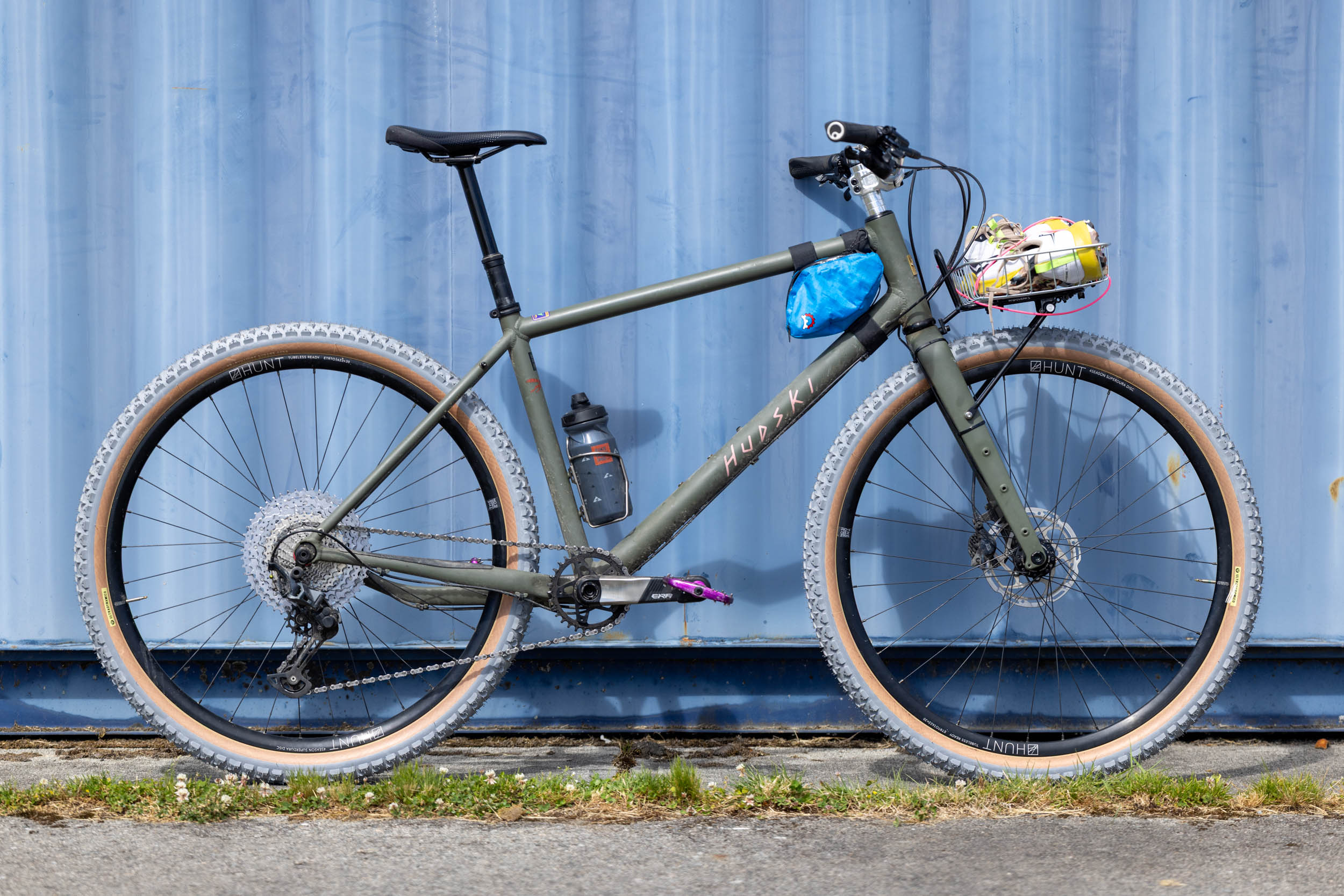
I jumped at the opportunity to test the Doggler, riding it almost exclusively for several months before sitting down to write my review. To summarize, it exceeded my expectations as an aluminum all-terrain bicycle. The build kit was dialed and affordable, most of the specs were exactly what I want from a bike in this category, and its balanced ride quality was comfortable on a wide range of surfaces.
However, as always, there was room for improvement. Finding the ideal wheels—non-boost with a Microspline freehub and a 30mm internal width—was nearly impossible at the time, and the combination of flat-mount and post-mount hydraulic brakes was an awkward fit. Hudski has released some minor updates to the Doggler since its launch, tweaking the geometry, but otherwise, the Doggler has always been a high-speed sport utility tourer that has the ability to serve a multitude of use cases.




After my review, I promptly purchased the Doggler I was testing and chose to ride it over other bikes I should have been testing when I scouted the 1,000-kilometer Tree to Sea Loop on Vancouver Island. To say I was sold on the Doggler platform would be an understatement. It’s the bike I ride most often, whether I’m commuting, riding gravel, or exploring new dirt-touring style routes. I find myself thinking, “‘Why wouldn’t I just ride my Hudski?” regularly.
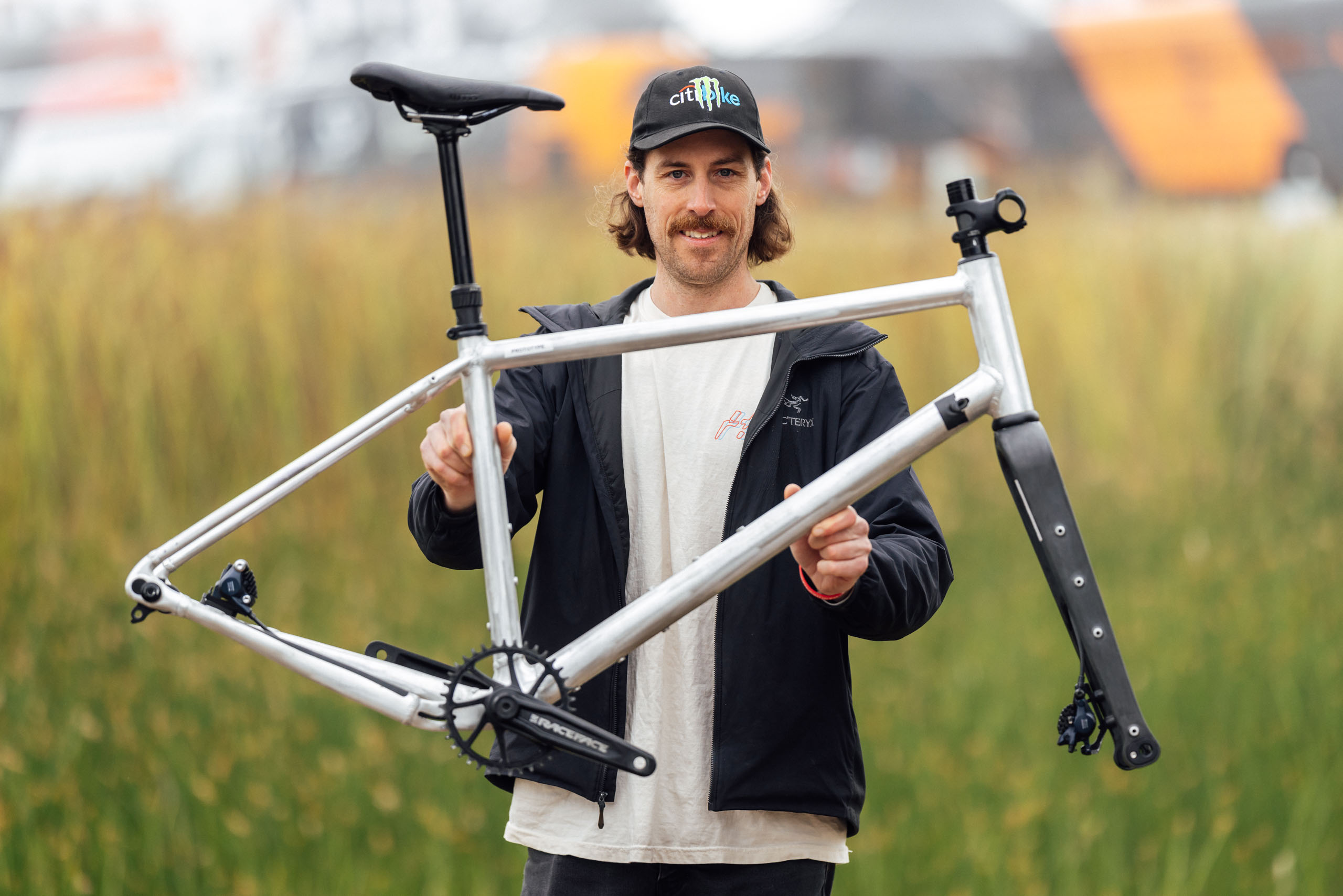
So, when Brian and Will of Hudski Bikes started sharing details on their new model, I became a little obsessed. I learned as much as I could about the latest model by pestering Brian. I eventually got to see a prototype in person while scouting the Sun Valley High Country Loop in Idaho in 2023 and again the following spring during a quick visit to Hudski headquarters in San Rafael, California. At that time, they hadn’t decided on a name for the new model, but Hudski confirmed that it wouldn’t just be a new Doggler. Their whiteboard had some potential names written down, including: Rizzard, Lasso, TerraDynamica, and Dualist. The Hudski Dualist was officially unveiled at Sea Otter 2024, which Logan covered in great detail. This spring, pre-orders for the Dualist opened, and just last month, stock arrived from Taiwan. Customers have now started to receive their bikes.
Yin, Yang, and Dualism
The name “Dualist” seems very fitting for this bike. It represents the dualism between gravel bikes and mountain bikes, but rather than being divided, as dualism often signifies, it represents a symbiotic relationship between the two. In reality, perhaps “yin and yang” is a more accurate way to describe the Dualist—opposing forces that are interconnected and interdependent, forming a dynamic system together.
I’m not going to pretend like I have the slightest understanding of mind-body dualism or Chinese philosophy, but it’s easy to see where Hudski is coming from. Almost everything in the cycling industry suggests that there are gravel bikes and mountain bikes, and the bikes that look most similar (but are, in fact, very different) to the Dualist are urban or commuter bikes. The age-old question that appears on many of our route guides, “Can I ride this on a gravel bike?” creates a divide that can be confusing for those new to bikepacking.


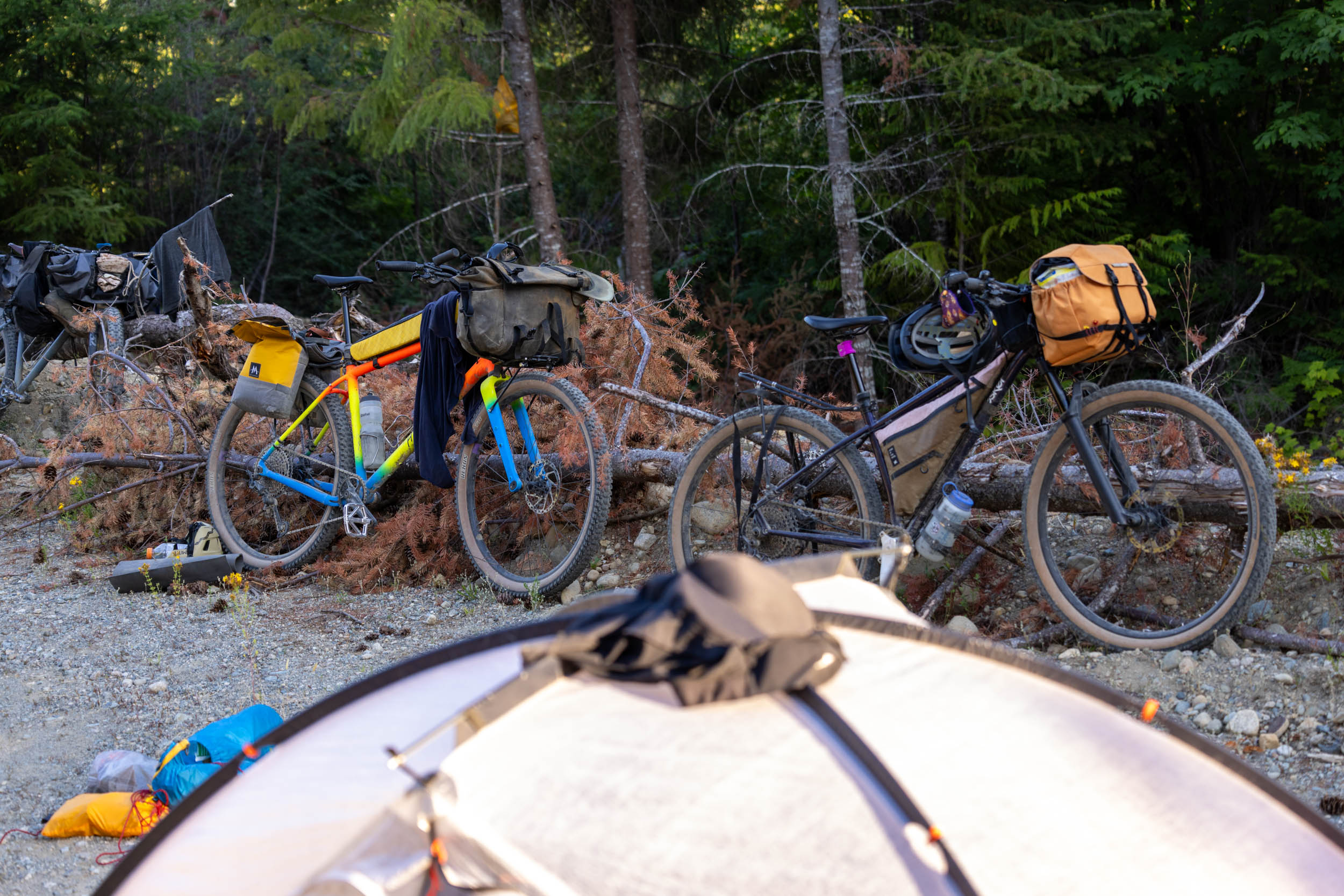
I recently saw an introduction to bikepacking course being offered here in British Columbia, and it stated in the FAQs that it is “not suitable for mountain bikes.” Having recently scouted a seven-day, mixed-terrain gravel route on Vancouver Island—with six of eight riders on mountain bikes—I’m willing to suggest that the “mountain bike” platform is arguably more capable, more comfortable, and better suited for bikepacking than most gravel bikes. In the end, there is no perfect bike for all scenarios, but there are a few that do a damn good job of filling the gap between gravel and mountain bike. Traditionally, bikes that don’t fall into a specific category are difficult for consumers to understand, and that’s the beauty of the Hudski Dualist.

Dualist at a Glance
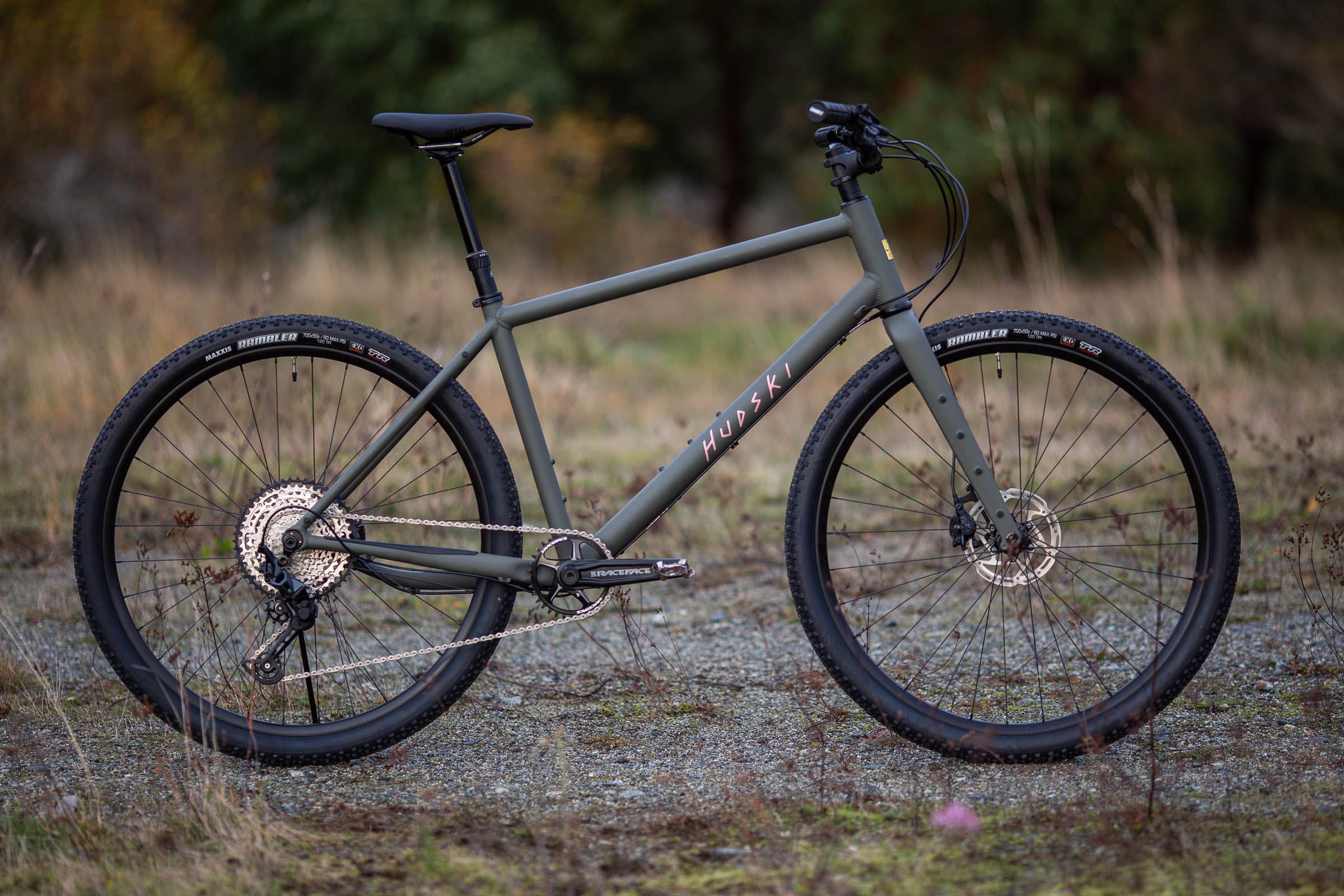
The Dualist is the same do-mostly-everything gravel/rigid mountain bike as the Doggler, but as mentioned above, there are a few significant updates that increase its overall versatility. To start, the Hudksi Dualist now features boost hub spacing and post-mount brakes, making it much easier to use most mainstream mountain bike wheels and brakes. Paired with increased tire clearance—up to 29 x 2.5” or 27.5 x 3.0”—it’s now possible to swap over a mountain bike wheelset to get rowdy or narrower modern gravel wheels for speed.
Perhaps the most interesting features of the Dualist are what inspired its name. It has a completely redesigned carbon fork with a flip-chip dropout. Riders can alternate between a 54mm or 44mm offset for slightly more agile handling, increased stability, or for different styles of loading. Hudski also developed a reversible rear dropout that provides two chainstay length options (435mm or 450mm), which will also tweak the bike’s handling characteristics. Run it in the shorter position for zippy, high-speed gravel rides and trails, or lengthen the rear end for long hauls and loaded bikepacking. The tire clearance maxes out at 29 x 2.4” with the rear dropout in the short position. In reality, the stock 29 x 2.4” Rekons measure out closer to 2.5” wide, and both the frame and fork have plenty of clearance. I mocked up a 29 x 2.8” tire in the front, which fit with about 7mm of clearance on the top and sides. I think it would be safe to say that most fast-rolling 29 x 2.6” tires would fit front and back.



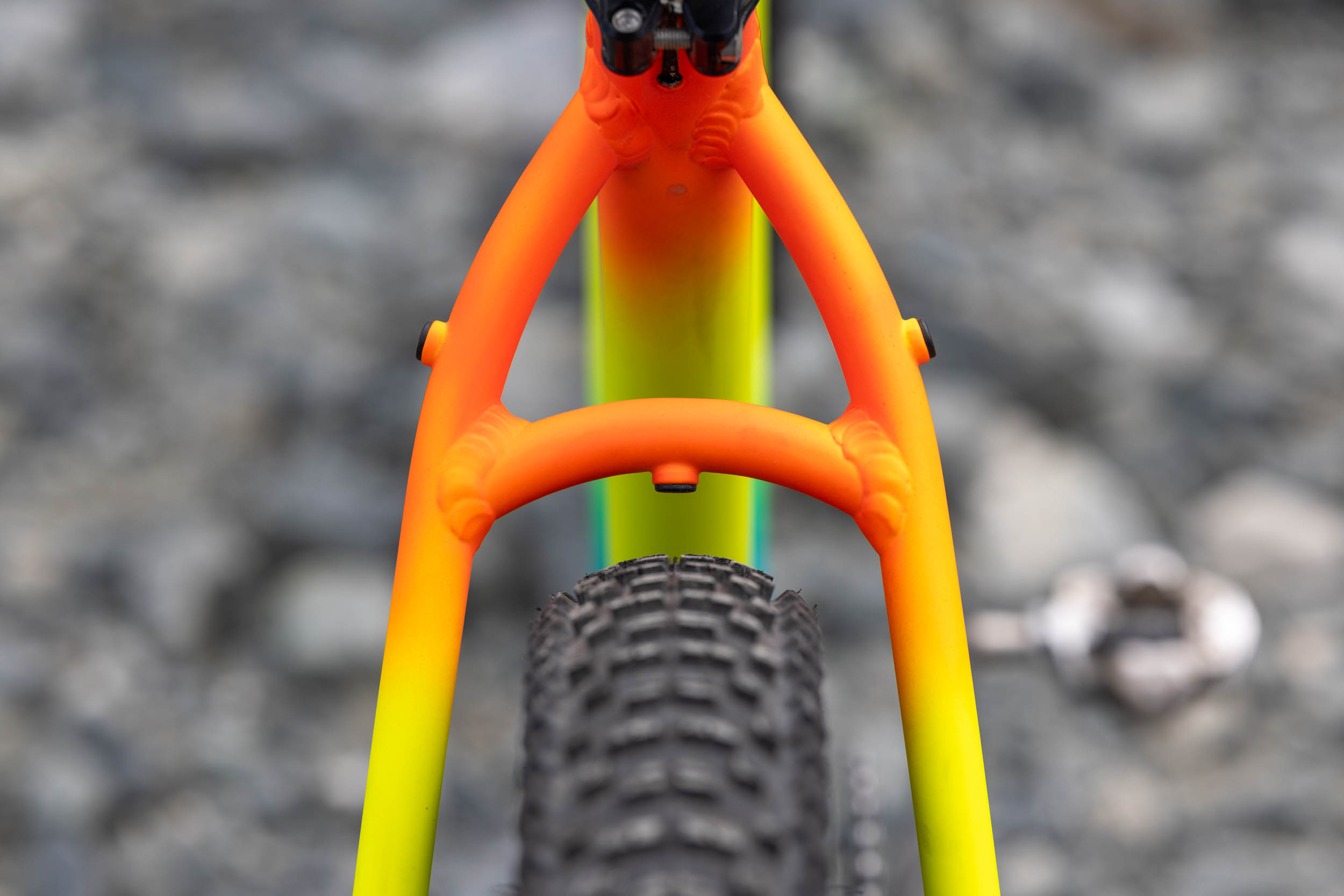
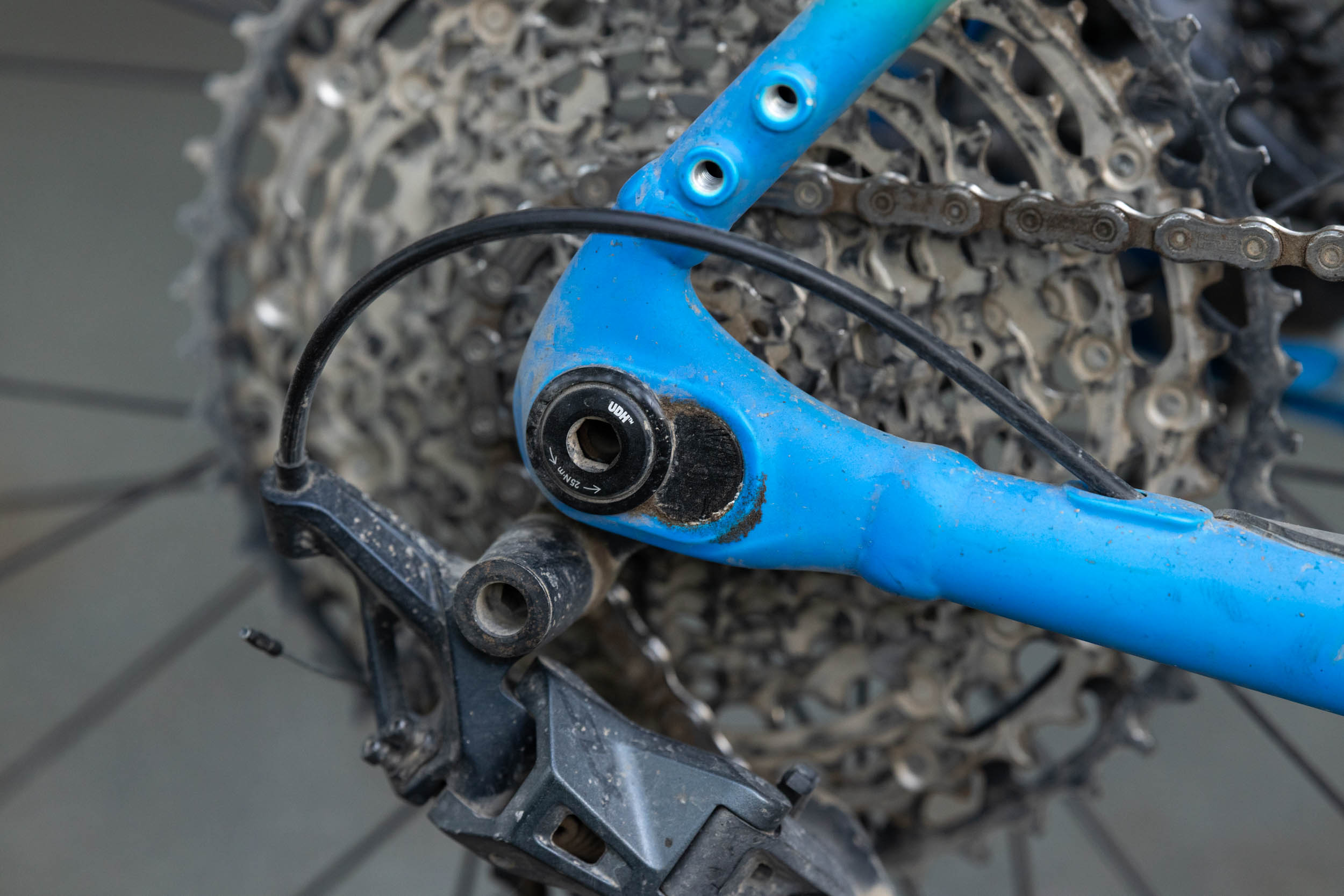
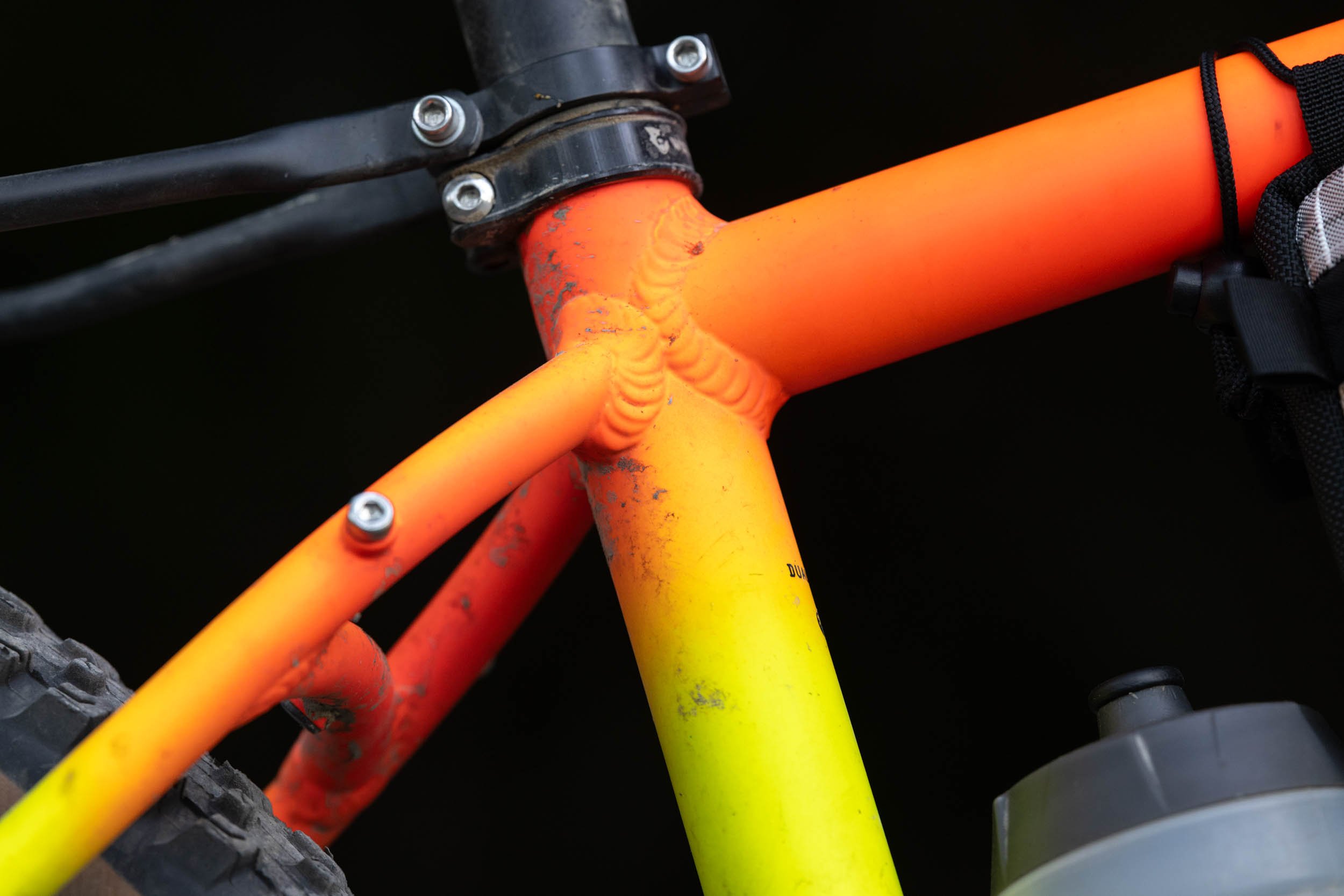
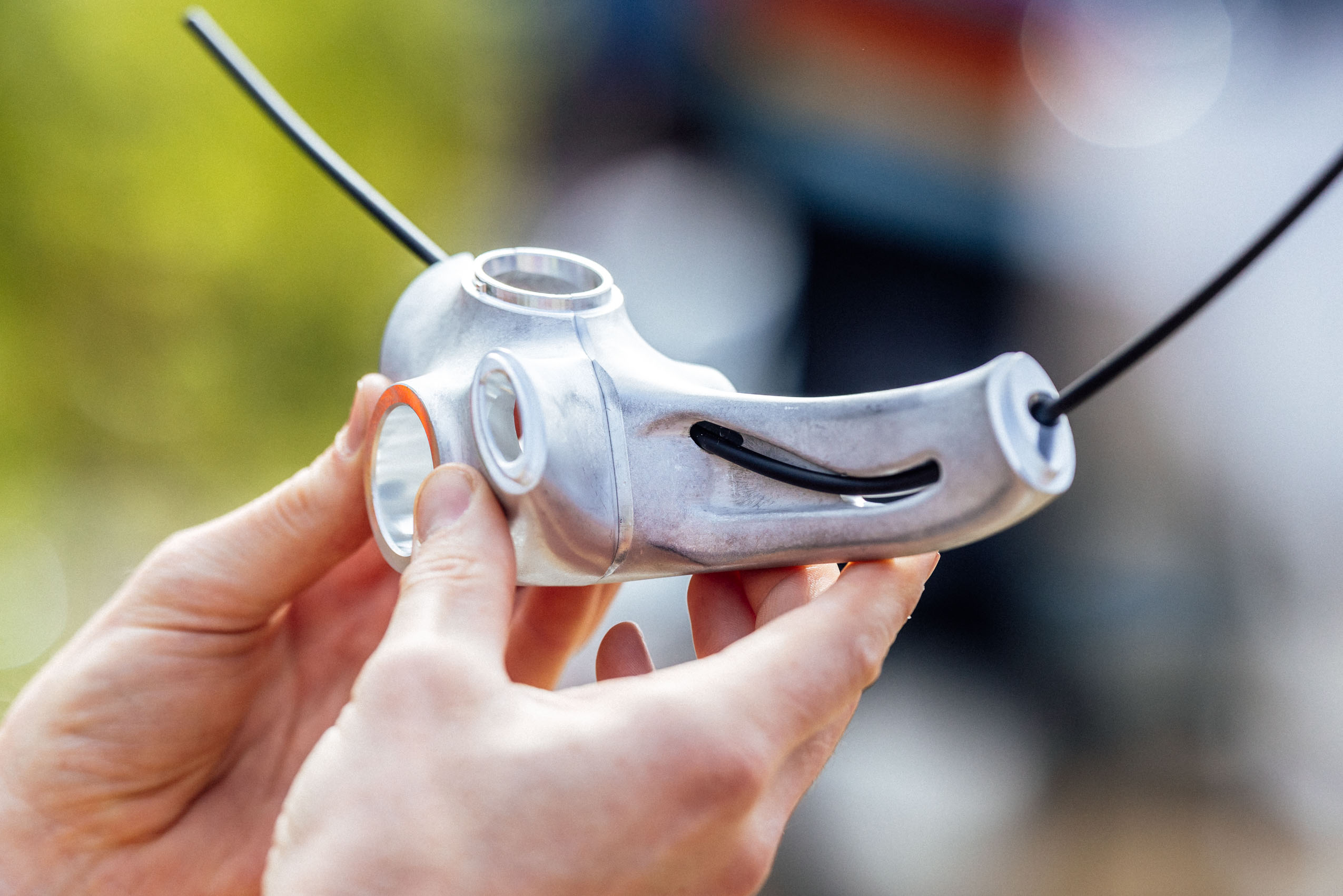
Love it or hate it, the Dualist now features fully internal cable routing, made possible via a custom-forged bottom bracket shell. In short, the two-piece clamshell bottom bracket, main tube joints, and yoke are all one hollow part. The new design helped with cable routing and increased tire and chainring clearance. There’s even a sneaky little cutout on the driveside chainstay yoke where you can see the rear derailleur cable routing.
Other specs include a 38T max chainring size, a threaded 73mm BSA bottom bracket, a 31.6mm seatpost diameter, and post-mount 160mm rotors. The frame now uses SRAM UDH-compatible dropouts, but due to the position of the dropout, you’d need to detach the derailleur to remove/charge the battery on AXS-style derailleurs when using the short dropout position. It’s nice to see a full suite of mounting points, including three-pack mounts on the fork legs, mounts under the downtube, and bosses for racks and fenders. The Dualist’s long front end and relatively tall head tube leave ample room for a full, half, or wedge-style frame bag.
To celebrate Rockgeist taking frame bag orders again, I purchased a stunning wedge-style bag made from a flashy Ultra VX40 Silver fabric with some neat colorful webbing stripes. It’s a massive bag, bigger than most full-sized frame bags, and the wedge design leaves a perfect little grab handle on the top tube. Emily’s size medium also has more frame bag space than any bike she’s owned, and she’s eager to get a bag of her own eventually.


Those who consider techy singletrack to be part of all-terrain riding will be pleased to hear that Hudski tested the Dualist to ISO mountain bike standards. The frame and fork are not only built to withstand the abuse and forces of actual mountain biking, but they will have no problem handling the extra weight of bikepacking bags, gear, and racks.
First Impressions: Long and Laid Back
Having come to appreciate the stability and capability of longer geometry, I opted for the extra-large Dualist. Coming from the large Doggler, which had a noticeably shorter, comfort-oriented fit, I was eager to achieve a fit closer to the modern mountain bikes I’ve been riding with a short stem, long reach, and comfortable bars. A comparison between the two shows 38mm more reach, 53mm more stack, and 62mm more wheelbase. The numbers aren’t quite as substantial when comparing the latest Doggler (which received a few geometry tweaks) to the Dualist, but there’s no question that the Dualist got bigger in more ways than one. The Dualist’s reach isn’t far behind some of the longest hardtails I’ve tested, including the Sklar Tall Tale, Revel Tirade, and Chromag Surface Voyager. However, its short stem and 16° backswept bar offset that length for a comfortable all-day riding position.


Since I’ve been using a slightly longer stem on my Doggler recently, the XL Dualist with the stock 50mm stem provides a very similar riding position. I feel balanced in the middle of the bike, not perched on top, but sporty enough to handle fast-paced gravel bikes and the occasional technical trail. The stock build comes with Hudski’s middle-of-the-road Longhorn bar, with a 16° backsweep and 50mm rise, and this feels like a natural choice for all the riding I’ve done. I think the only time I wanted to try their 27° backsweep version was during my route-scouting trip on Vancouver Island, where I may have preferred an even more relaxed riding position for back-to-back days. On the other hand, I also rode the Dualist at a 60-kilometer mixed-terrain gravel/XC race earlier this summer, and I think the 10° Longhorn bar would have helped create an even sportier riding position. Since the stock build kit is so well-rounded, it’s easy to play around with the cockpit setup and tire/wheel combination to create the Dualist of your dreams.


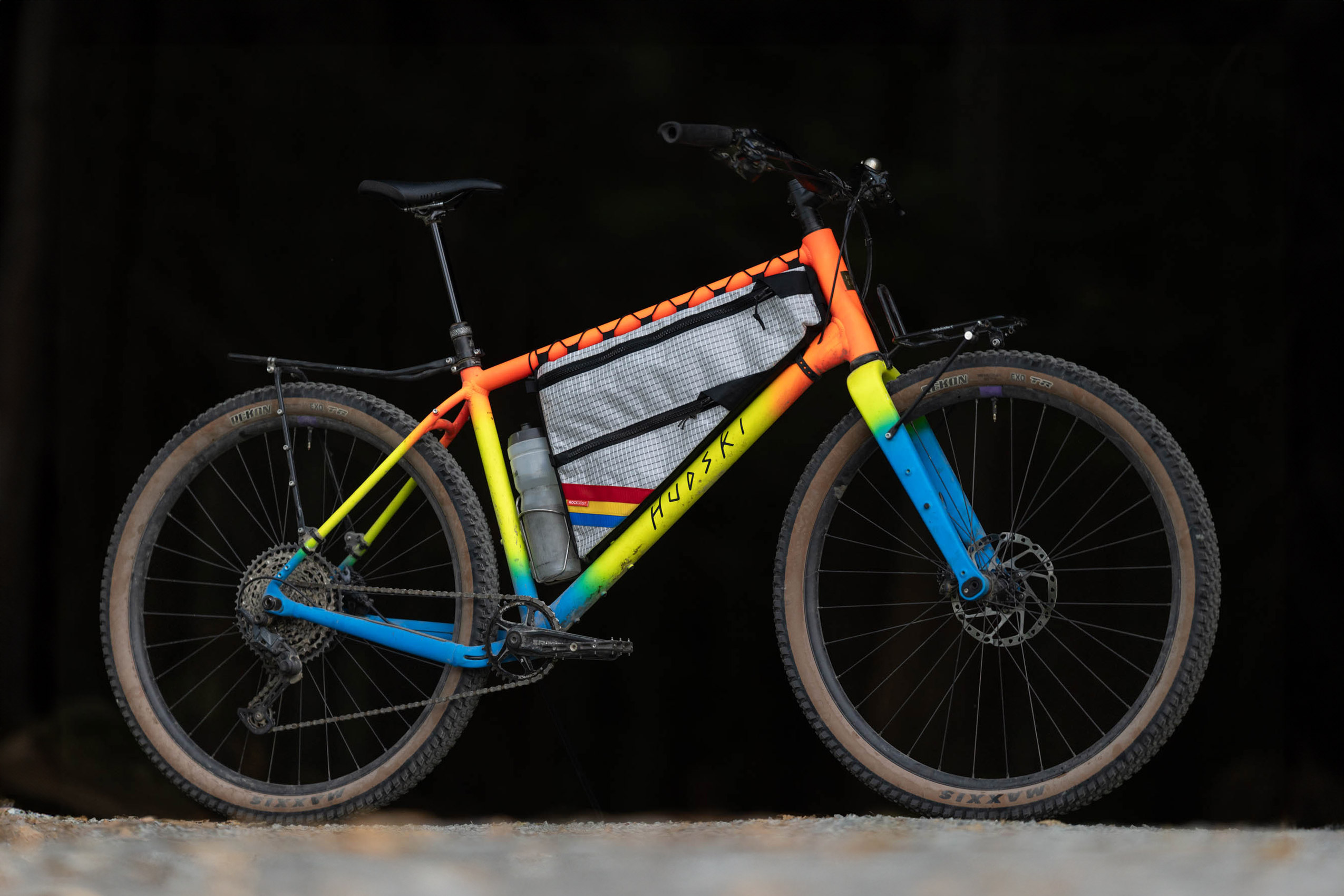
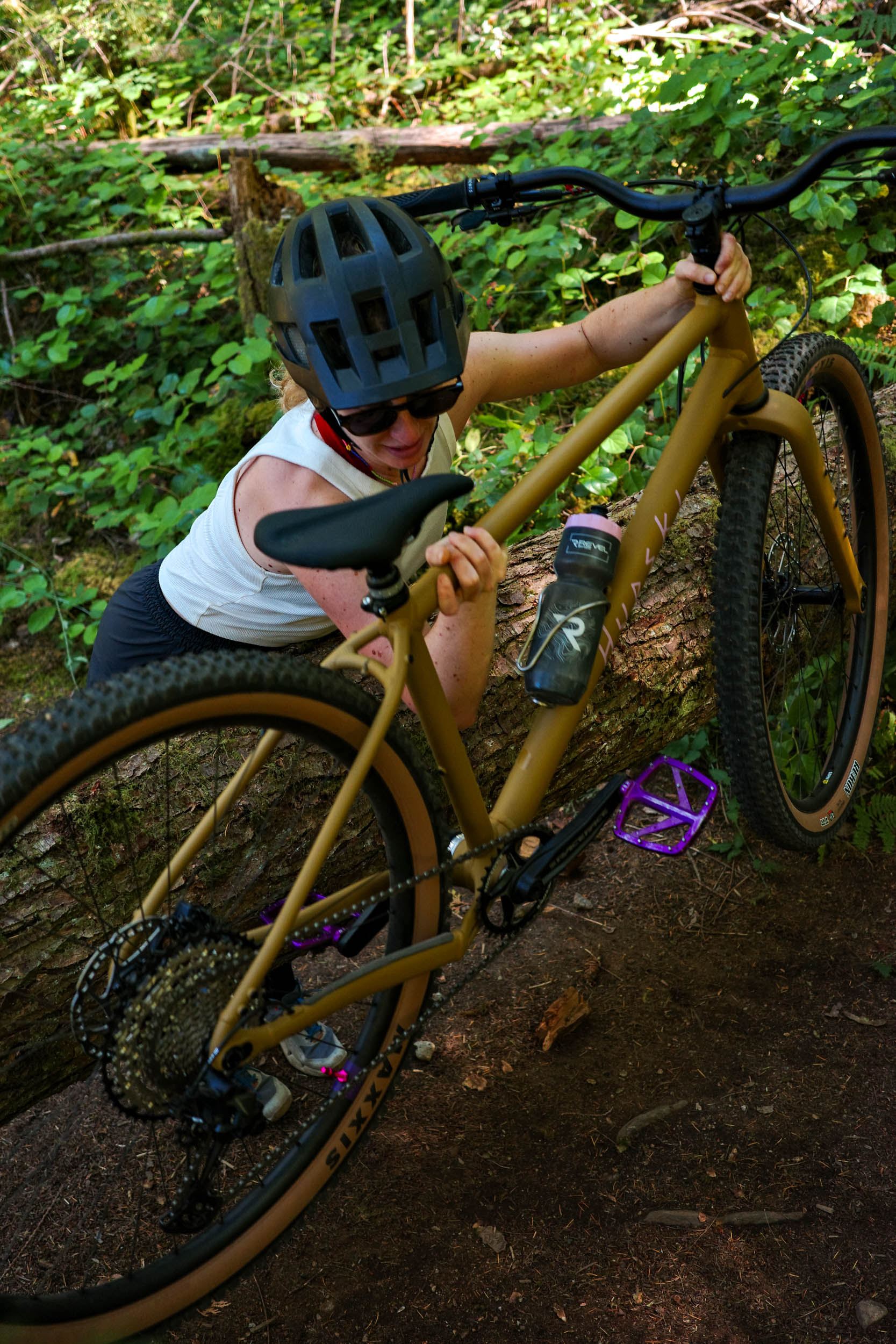
Thanks to its 6061 aluminum frame and carbon fork, the Hudski Dualist is still incredibly lightweight. The stock extra-large complete build I’ve been riding weighs just over 26.5 pounds (12 kilograms), which saves you around four to six pounds compared to the Kona Unit X, Surly Bridge Club, Bassi Coyote, or Tumbleweed Sunliner, all of which are made of steel. I’m not too concerned about weight usually, but when it comes time to carry it up some stairs or lift it over a fallen tree, I’m not complaining. Comparable aluminum bikes are scarce. Most lean far closer to the gravel bike category with limited tire clearance, shorter front ends, and more affordable build kits. The Kona Unit X is the closest comparison I could find in terms of geometry and mountain bike-inspired specs, and it remains an absolute steal at $1,699. However, the Dualist ramps things up with a slightly higher-end build kit and a dropper post, and it shaves four pounds thanks to its aluminum/carbon construction. The $800 Marin Muirwoods is another bike that has unexpectedly similar geometry, although it’s not quite as long. However, the build kit is incomparable, and I doubt its steel frame meets ISO mountain bike standards.

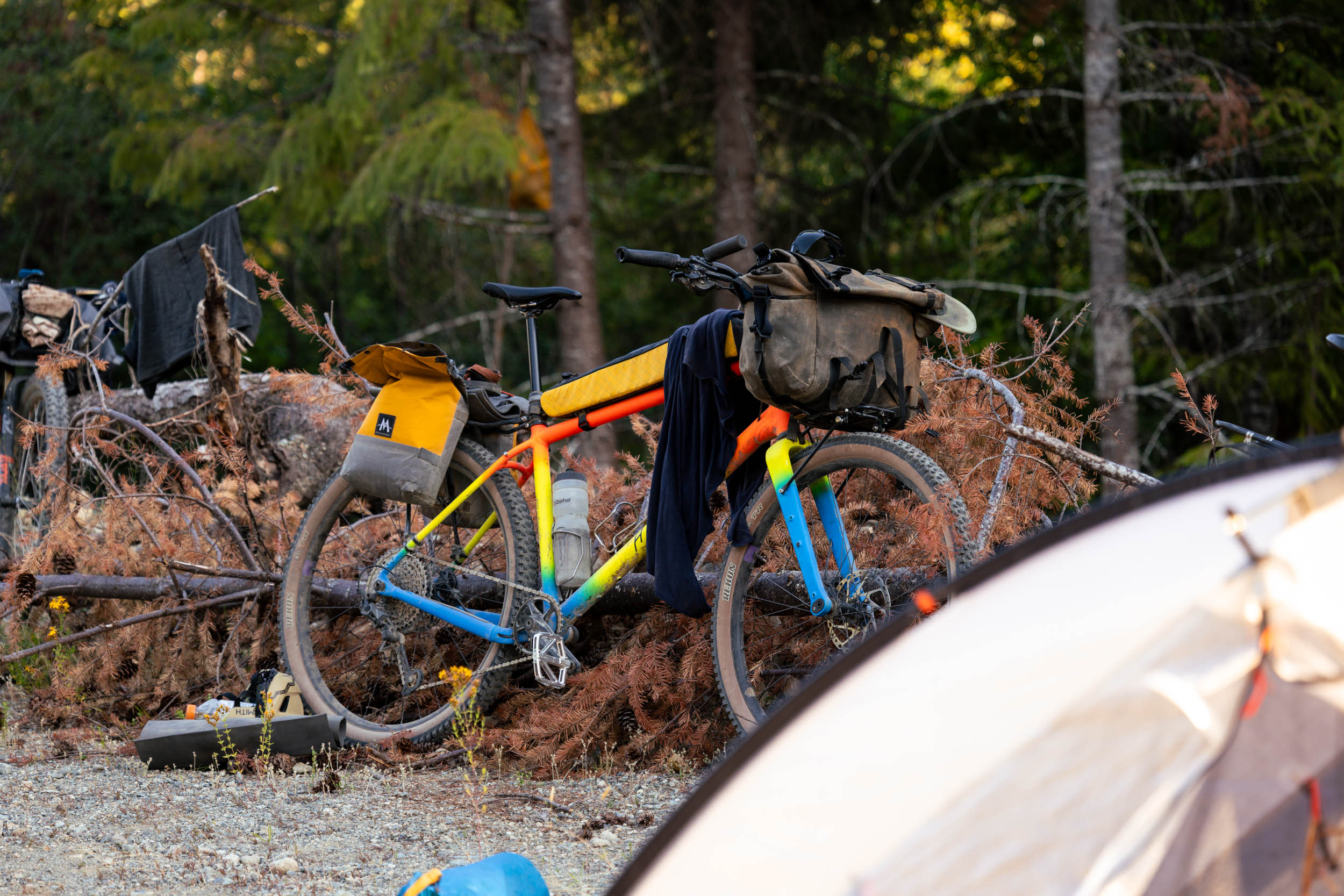
Looking back at our frame material survey, people clearly prefer steel over aluminum, but modern aluminum has come a long way. It isn’t just reserved for budget bikes anymore. Regardless of whether or not aluminum bikes are actually harsher or stiffer than steel ones, I think an important factor is that there just simply aren’t that many mid-to-high-end aluminum bikes that fall into the all-terrain bicycle category. The Dualist truly exists in a category created by Hudski. Having ridden my Doggler well over 3,000 kilometers in the last few years, including plenty of loaded bikepacking, and I’m approaching 1,000 kilometers on the new Dualist, I’m sure that well-designed modern aluminum bikes have the potential to be just as comfortable as steel, titanium, or carbon ones. Still, after riding some high-end steel bicycles, such as the Mason RAW I tested a few years ago, which is made from some of the highest-quality steel tubesets available, I can say that the Dualist really can’t compare with the RAW’s compliance and comfort. It’s also about double the price of the Dualist, so it’s a difficult comparison to make.

Versatility: A New Angle
What increases a bike’s versatility is open to interpretation. It’s easy to get caught up in the nice aesthetics, care-free branding, and thoughtful component selection, but if the geometry and frame specs aren’t there, then everything else falls to the wayside. I think Hudski nailed most of these with the Doggler, but as mentioned earlier, there was room for improvement. They could have updated the hub and brake mount specs and left it at that, but they still found ways to improve the bike’s geometry, and in doing so, its versatility.
The key angles have remained nearly the same. The Dualist has a 67° head tube angle (67.5° on the Doggler), a 74° seat tube angle (same as the Doggler), and a 70mm bottom bracket drop across the size range, which is about 6mm less than the Doggler. The Doggler’s chainstays were fixed at 450mm, while the Dualist has a flip-chip for your choice of 435mm or 450mm. The front end of the bike is around 20mm longer, increasing the overall wheelbase when compared to the Doggler. However, a longer head tube reins in the reach, which has only increased by about 5mm. All things considered, the Dualist is a very similar beast to the Doggler.
Hudski Dualist Geometry
| Size | Small | Medium | Large | X-Large |
|---|---|---|---|---|
| Reach | 415 | 440 | 470 | 495 |
| Stack | 570 | 595 | 620 | 645 |
| Head Tube Angle | 67° | 67° | 67° | 67° |
| BB Drop | 70° | 70° | 70° | 70° |
| Chainstay Length | 435/450 | 435/450 | 435/450 | 435/450 |
| Seat Tube Angle | 74° | 74° | 74° | 74° |
| Eff. Seat Tube Angle | 74.5° | 74.5° | 74.5° | 74.5° |
| Wheelbase | 1087 | 1140 SWB / 1165 LWB | 1180 SWB / 1205 LWB | 1226 SWB / 1241 LWB |
| Front Center | 638.7 | 714/724 | 754/764 | 790/780 |
| Head Tube Length | 125 | 164 | 190 | 218 |
| Top Tube Length | 571 | 586 | 621 | 652 |
| Seat Tube Length | 405 | 420 | 450 | 480 |


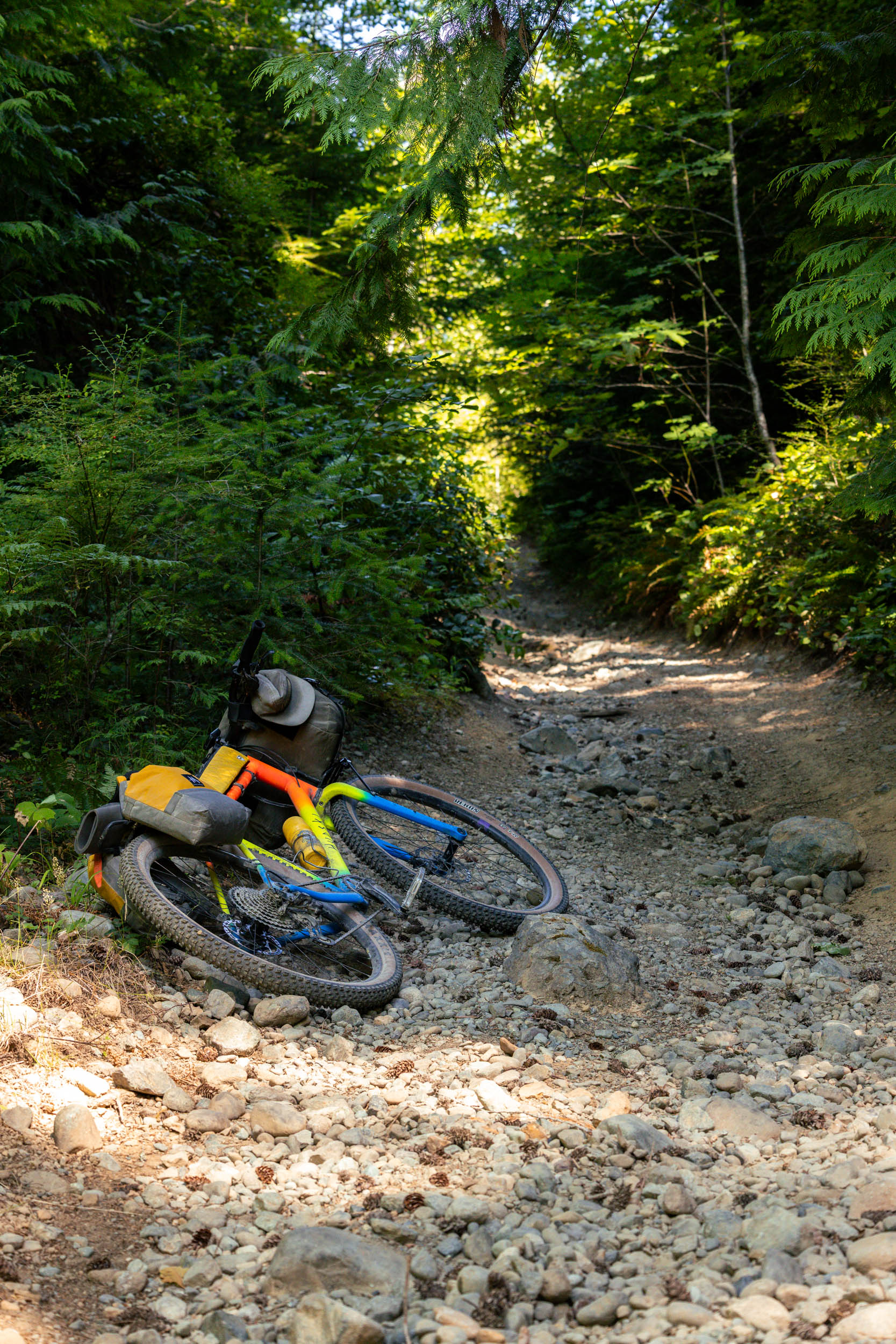
I credit the Dualist’s long wheelbase for its stability and comfort on mixed terrain. Its stability really stood out during a recent route-scouting trip on Vancouver Island, when I was barreling down a chunky old doubletrack section filled with fist-sized rocks and rutted-out ATV tracks. I considered slowing down to reduce the risk of losing control and crashing, but instead, I let off the brakes and let it go. With the two flip-chips in the longest position, the Dualist glided effortlessly over the rubble below, riding more like a hardtail mountain bike than a rigid ATB. At the bottom of the descent, Skyler from Mica Cycles, who was riding an Esker Japhy with front suspension, commented on how fast I ripped through that section. I responded, “Man, I love this bike!”
In its longest form, the Dualist has a predictable ride quality that is more reminiscent of a modern hardtail or downcountry full-suspension than any rigid bike I’ve ridden, but that’s not the only form it can take. At a 60-kilometer mixed-terrain race this summer, I switched the front dropout into the 54mm position, left the rear dropout at 450mm, and replaced the stock 29 x 2.4” tires with faster-rolling 29 x 2.2” Ultradynamico Mars Race tires. I also took the opportunity to ditch some more weight and ran some new We Are One carbon wheels and a fancy machined Garbaruk cassette. The build weighed around 25 pounds, but more importantly, the new fork offset and tires were noticeably faster. This setup positioned my weight further toward the front of the bike while increasing the trail and straight-line stability, which felt great when hammering after skinny-tire drop-bar gravel riders during the race. Even the slight decrease in tire size and rolling resistance resulted in a noticeable improvement in ride quality when speed was the objective.


I’ve swapped between my Doggler and the Dualist a few times recently, and despite offering a similar ride style and fit, the Dualist feels stiffer. The front end of my Doggler has a fair amount of visible flex, mainly through the steerer tube and fork, but the Dualist doesn’t flex in the same ways. It’s difficult to pinpoint precisely what has changed, but I have found myself running lower tire pressures to accommodate the stiffer frame. When you find that sweet spot, the Dualist has the potential to be comfortable on long rides while remaining incredibly agile and zippy. It’s a great example of the benefits of a non-suspension-corrected frame. To accommodate a shorter rigid fork, the Dualist has a longer head tube, which means there’s more room inside the main triangle for bags and bottles. The steering also remains responsive and free of unwanted flex, which can be a problem with longer suspension-corrected forks, such as the Bassi Coyote I reviewed last summer. You could run a 40mm gravel suspension fork on the Dualist, but you’d be limiting yourself to ~29 x 2.0” tires.
Gone Bikepacking: Hardtail vs. Hudski
Despite getting along with the Dualist, I don’t see it replacing my love for a modern hardtail mountain bike. Many of the bikepacking routes I enjoy are full of technical singletrack and rough doubletrack, and I find them more enjoyable with front suspension. I think Hudski took the best aspects of these hardtails (minus the fork) to create a wonderfully versatile bike that can be ridden in almost any terrain, as long as you’re okay with a bit of type-two fun now and then.
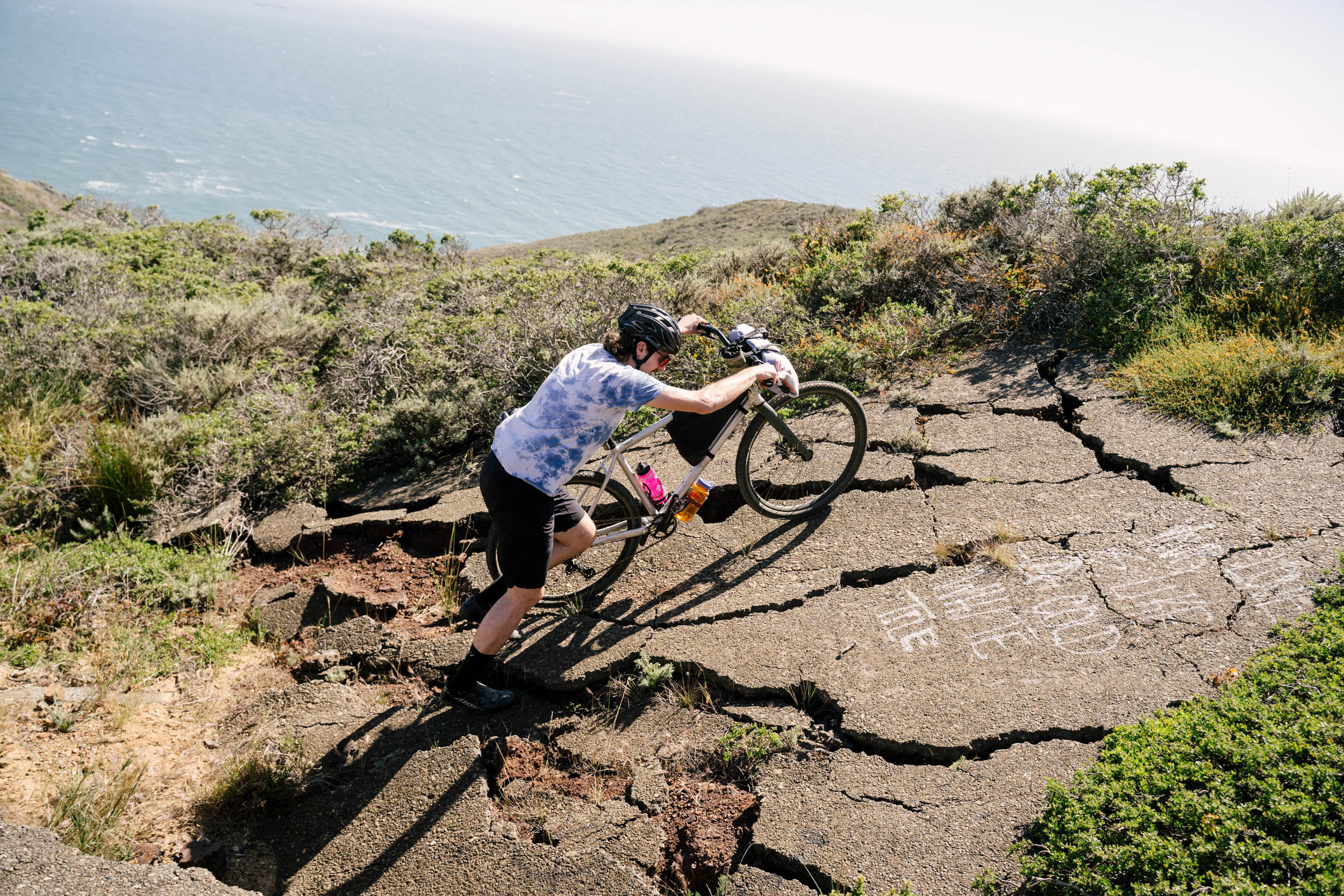
The Hudski Dualist is my commuter, gravel bike, and all-terrain discovery vehicle, and it can linger into mid-travel hardtail territory when needed. It might not crush steep singletrack descents as confidently as a hardtail, but with smart line choices and slightly less speed, it will undoubtedly come out on the other side. Even “gravel” riding in coastal British Columbia usually means unmaintained roads, rough doubletrack, and the occasional ATV trail, so I’m far happier riding a rigid mountain bike like the Dualist instead of a traditional drop-bar gravel bike.

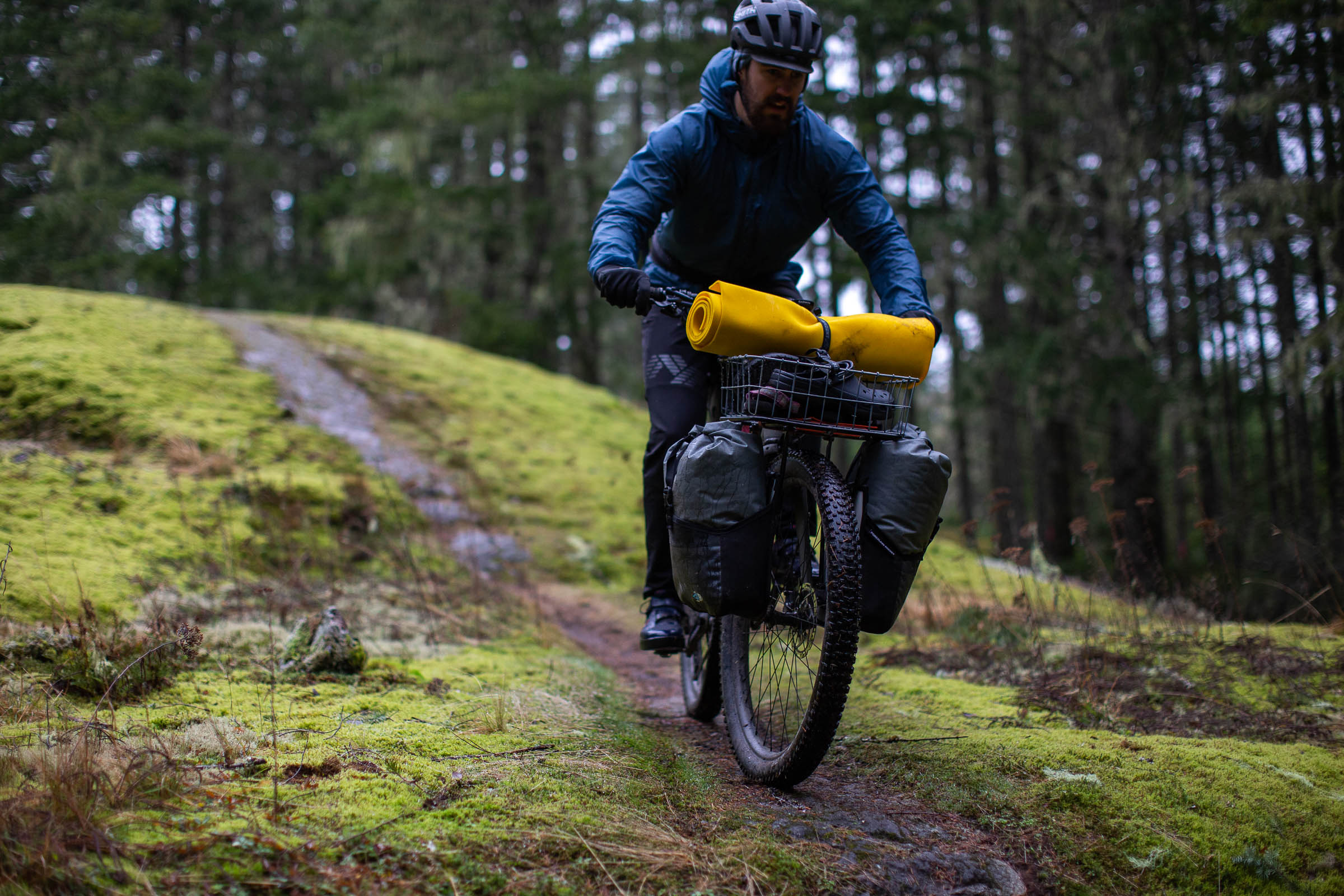
The specs and angles that make the Dualist so versatile also make it a very capable bikepacking rig. The stability of a long wheelbase is particularly handy when you eventually load the bike up with bikepacking gear; the massive main triangle leaves plenty of room for bottles and a frame bag across the entire size range, and there are enough mounts to bolt on whatever cages or racks you want to run. It has a balanced ride quality that feels sporty enough to tackle most technical terrain and zip around on gravel roads, yet it remains sufficiently upright to look around and enjoy the scenery. The non-suspension-corrected frame maintains tight steering, even with a front rack and a large handlebar bag.
Hudski has an entire blog post dedicated to the decision to stick with a non-suspension corrected frame, and I appreciate how Hudski ambassador Evan Christenson sums it up. “Why did some other companies design suspension-corrected rigid bikes, and we didn’t? Well, simple, because we make decisions and stick to them. Other companies say ‘Ehhh, uhhh, I dunnooooo, maybeeeee they’ll want to pay $1,000 for a heavy suspension fork that won’t make their life any better?’ We are confident. We know what we want and we don’t mess around with the silly stuff in the middle, where indecision makes everything worse.”


It’s great to see a build kit that aligns with Hudski’s intentions for the Dualist. Solid components come stock on the Dualist, which includes a PNW dropper post, a nice PNW dropper lever, single-pistoned Shimano brakes, a 1×12 Shimano drivetrain, and Hudski’s own aluminum 27mm internal width rims. The fact that I rode the stock build, aside from a tubeless setup on a 450-kilometer scouting trip and had zero mechanicals speaks volumes about the overall quality of the bike. Sure, it’s possible to upgrade the wheels or shed a pound or two, but the stock build is fantastic and ready to take on whatever wacky rides you want to take on. The new complete build is $400 more than the original Doggler, and I would love to see a slightly more affordable Dualist based around a Shimano Cues drivetrain and some different parts, offering a $1,500 to $1,800 complete build. As it is, a $2,400 bike isn’t absurdly expensive, but it might not be affordable enough as someone’s first real bike, for example.
Hudski Dualist Build Kit
- Frame: 6061 Aluminum Alloy Dualist
- Fork: Hudski Dualist Carbon
- Bottom Bracket: RaceFace Cartridge BB
- Crankset: RaceFace Ride crank, 32T chainring
- Brakes: Shimano SLX M7100 Brakes
- Brake Levers: Shimano SLX M7100 Levers
- Rotors: Shimano Deore M6100 180/160mm
- Rims: Hudski Panoramic, 27mm internal, welded
- Hubs: Shimano HB-TC500/Shimano FH-TC500
- Spokes: Sapim 2.0-1.8-2.0
- Tires: Maxxis Rambler 700 x 50mm or Maxxis Rekon 29 x 2.4″
- Derailleur: Shimano SLX M7100 12-Speed
- Shifter: Shimano Deore M6100 12-speed
- Chain: Shimano SLX M7100
- Cassette: Shimano 10-51 SLX 12-speed
- Handlebar: Hudski Longhorn 16
- Stem: Hudski Shortie, 40mm (S/M) 50mm (L/XL)
- Dropper Post: PNW Range Dropper
- Dropper Lever: PNW Range Lever
- Grips: PNW Loam grips
- Saddle: WTB Deva saddle
- Headset: Sealed cartridge bearing headset
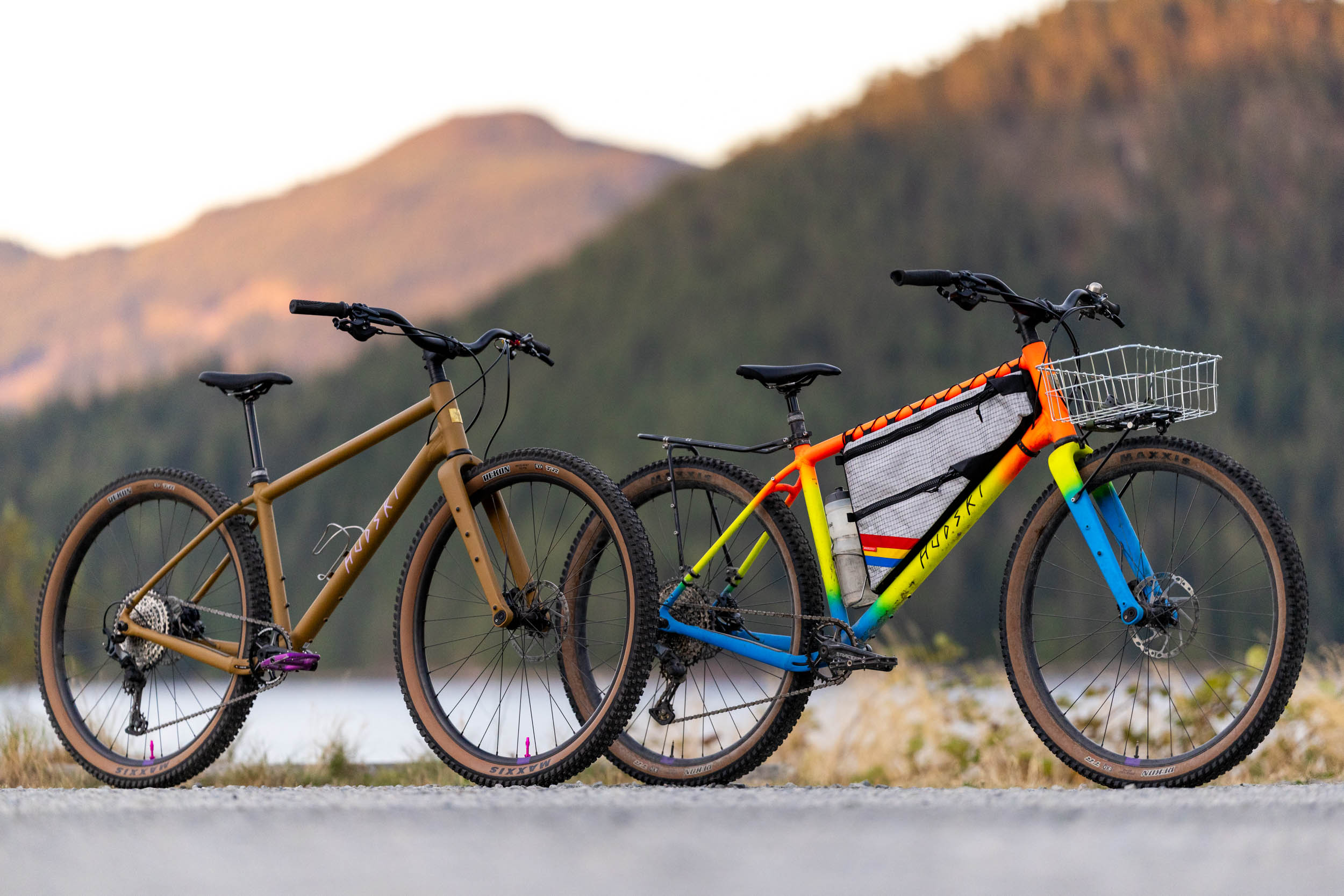
Although my test bike came partially built/packed from Hudski in California, I received Emily’s Dualist from Taiwan this past weekend, which gave a better sense of how customers will get their bikes. For those who are wondering, the complete medium Dualist weighed in at 25.9 pounds (11.7 kilograms). Complete bikes are packed in two boxes: a frame kit and a wheelset. The framekit requires minimal assembly, with most components already installed, aside from the handlebars and derailleur. The wheelset comes ready to ride with rotors and cassette installed and tubed tires in place. Hudski also sells optional tubeless kits, which include valves and sealant; the rims come pre-taped.
After a quick floor pump tubeless setup, I only really needed to adjust one brake caliper, bolt on the derailleur (the chain comes pre-installed), and attach the handlebars. It’s great to see a properly built bicycle, with very minimal adjustments needed before riding. It’s the type of bike that even a relatively new rider could assemble, which could be a great confidence booster when buying a new bike. Your local bike shop could get it rolling quickly as well. The Hudski team has been working closely with the factory in Taiwan to ensure the bikes are built and assembled correctly. Brian visited the factory in person this spring and identified several improvements that have enhanced the quality and consistency of the builds, and it shows.



Getting Your Dualist
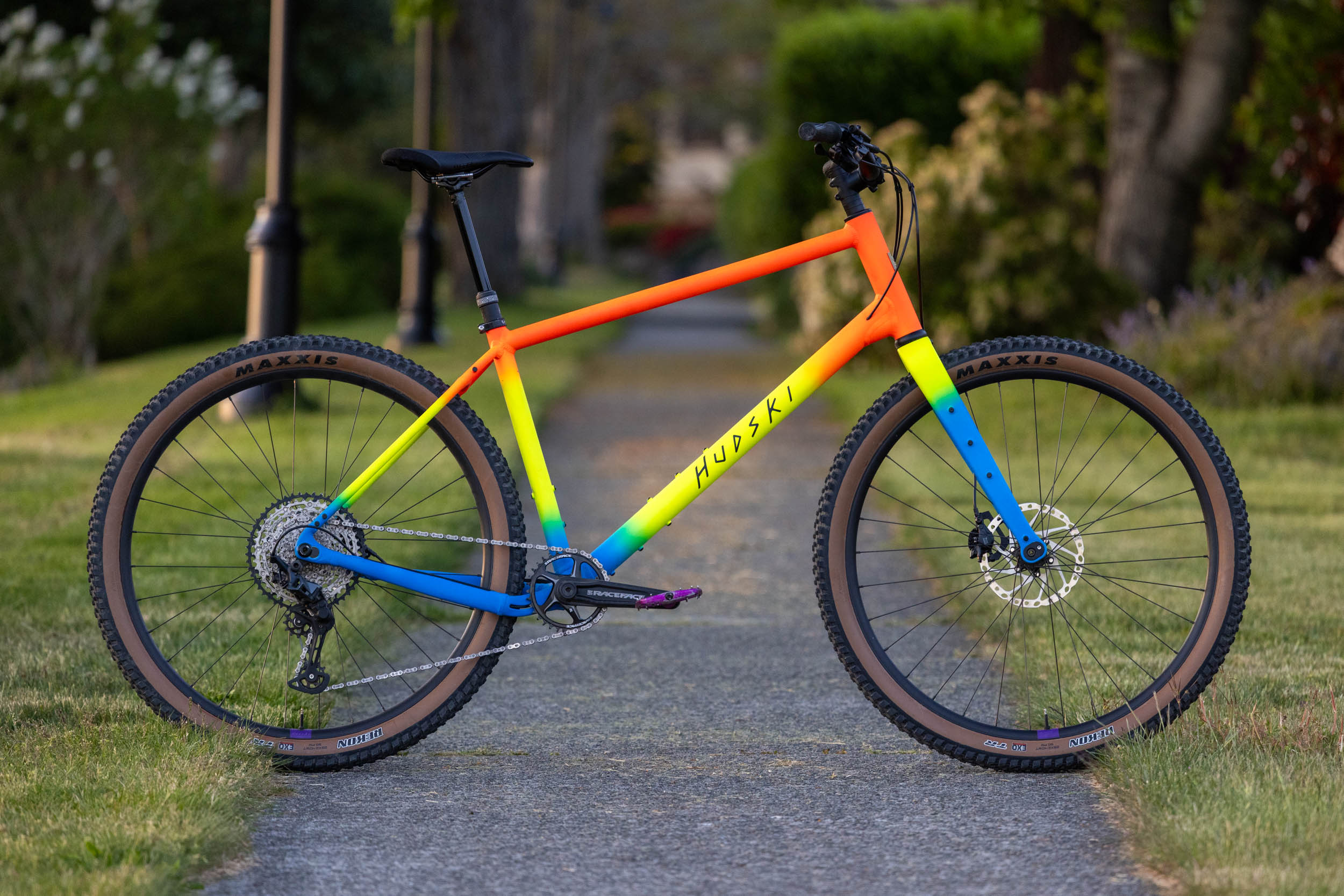
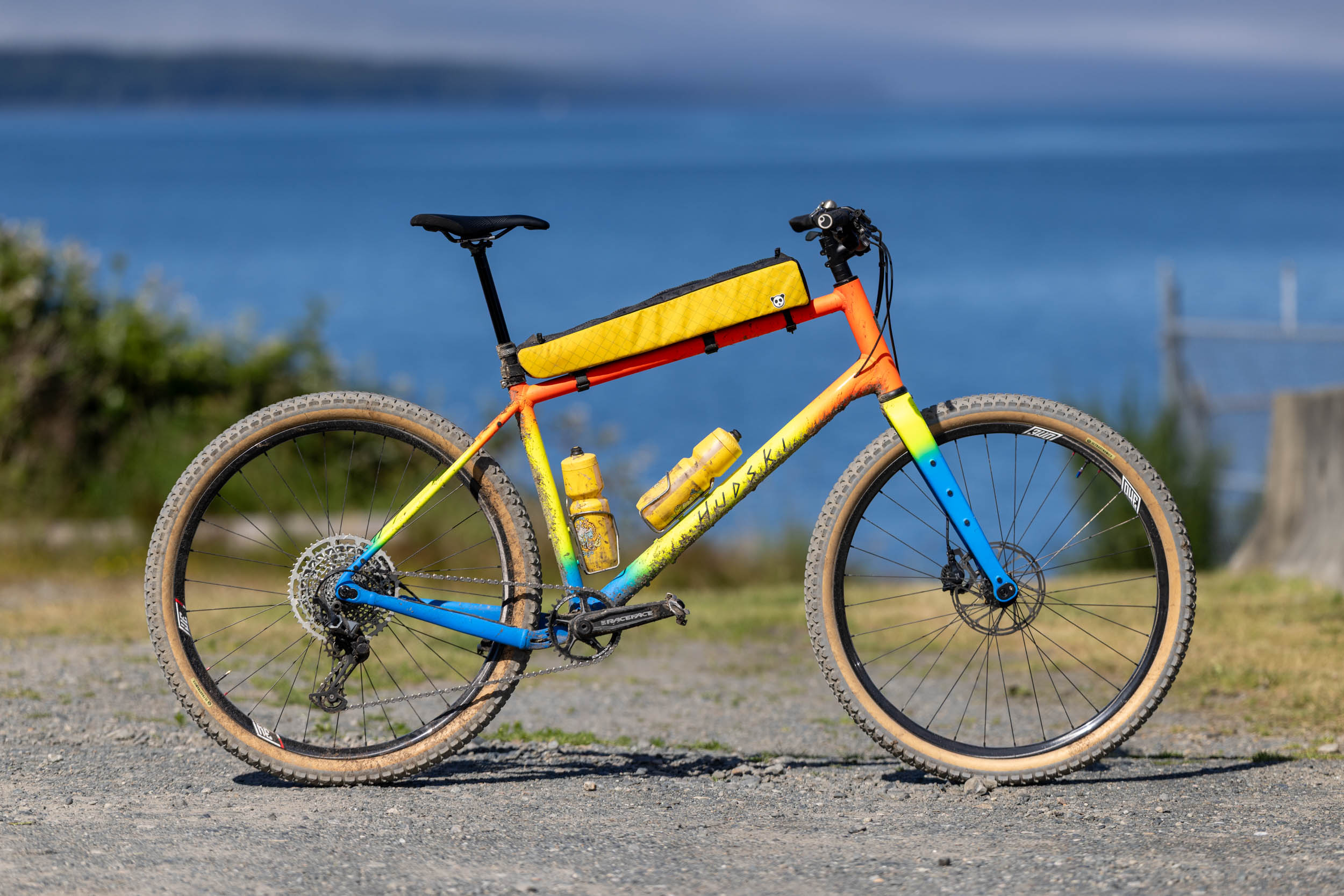
I appreciate how simple Hudski has made the purchasing process for the Dualist. It’s a matter of selecting your preferred color: Nevada, Rococo Gold, or Eggplant, and then simply choosing what tires you want: either 700 x 50mm Maxxis Ramblers or 29 x 2.4” Maxxis Rekons. All other components, including Hudskis rims, remain the same regardless of the selected tires. The frameset option includes the frame, fork, headset, and hardware, and it’s available in the playful tri-color fade color pictured here. The production version has a new UV-protective clear coat that slightly darkens the colors compared to my version, but Hudski promised me it’s still “very bright.” I was a little worried that the loud paint job would be distracting for a review, but the number of times kids and adults alike stopped me to say, “That’s a really cool bike,” made it all worthwhile. Thankfully, it’s not just the paint job that makes the Dualist look cool.
Hudski Dualists are available online directly through Hudski’s webstore, and they ship worldwide. They have partnered with bike shops across the US to act as service centers where customers can ship bikes to be built. Bikes can also be picked up in person at Hudski headquarters in San Rafael, California. There are a select number of dealers in Canada, including our friends at Dismount Bike Shop in Toronto, who will have a small batch of bikes available next week.


- Size Tested: XL
- Actual Weight (XL): 26.5 pounds (12 kilograms) with 29 x 2.4” tires
- Place of Manufacture: Taiwan
- Price: $2,400 USD
- Manufacturer’s Details: HudskiBikes.com
Pros
- Took the Doggler platform and improved it with boost hub spacing, post-mount brakes, more tire clearance, and updated geo
- Plenty of clearance for 29 x 2.4” or 27.5 x 2.8” tires and two stock tire size options is great to see from an all-terrain bicycle
- Well-specced build kit doesn’t fall short and is ready to tackle pretty much anything
- Flip-chip dropouts are easy to use and provide real geometry changes some folks will feel
- Lightweight aluminum frame and carbon fork, with complete builds in the ~26 pound range
- Perfect blend of a comfortable all-day riding position and long, singletrack-friendly wheelbase
- Plenty of mounts for cages, racks, and gear, and a massive main triangle for framebags
- Lovely aesthetics and color options, including the wild frameset-only tricolor fade I’ve been riding
Cons
- $400 more than the original Doggler and difficult to properly compare against any other hybrid, gravel bike, or mountain bike
- A more affordable Cues build would be fantastic to see
- Front end is slightly stiffer than Doggler, so dropping tire pressure is important for long-term comfort
- Direct to consumer (aside from a few dealers in North America) means limited local shops to pop into to check it out in person
- May or may not not be direct replacement for a hardtail mountain bike or gravel bike, depending on your priorities
Wrap Up
If Hudski’s goal with the Dualist was to create a bike that exploits the dualism between gravel bikes and mountain bikes, then they knocked it out of the park. It’s not just one thing that creates the Dualist’s unwavering versatility but the sum of everything combined. It’s the long wheelbase, rigid design, modern mountain bike specs, tire clearance, and thoughtful build kit that leave very little room for improvement. If you’re the type of rider who wants to commute on the same bike you’ll be bikepacking on, and day rides often include gravel roads, doubletrack, and the occasional stretch of singletrack, then the Hudski Dualist should be at the top of your list. There are more affordable hardtails and gravel bikes out there, but the Dualist offers a unique set of specs and features that set it apart from anything else like it—because there aren’t many.
Although the Dualist won’t replace a downcountry full-suspension mountain bike or hardtail for rallying down singletrack, it does a damn good job of pretty much everything else. In my eyes, it’s the epitome of what a modern all-terrain bicycle should look like, and I’m surprised that it still exists in a category of its own. Some steel ATBs are similar, but Hudski has carved out their little niche category by focusing on a lightweight aluminum frame and a bike they want to ride.
To summarize, the Hudski Dualist is a joy to ride everywhere I’ve been, which includes new places on Vancouver Island, riding for ice cream, my first bike race, scouting routes, and fully loaded for a week-long bikepacking trip. These days, a bike that makes me smile gets my nod of approval, and the Dualist does just that.
Further Reading
Make sure to dig into these related articles for more info...

Please keep the conversation civil, constructive, and inclusive, or your comment will be removed.