


 Mountain Bike (MTB)
 Gravel Bike
 All-Terrain Bike (ATB)
 Fat Bike





TRP EVO 12 Drivetrain Review: Underdog Story




Three years ago, TRP stepped up to the plate against SRAM and Shimano with an entirely new groupset aimed at mountain bikers, addressing reported issues with its original drivetrain. Miles spent the last year using the complete TRP EVO 12 drivetrain on his Starling Murmur to see whether it can truly stack up against the two biggest players and if early reviews still hold true. Find his thoughts and detailed review here…
PUBLISHED Nov 18, 2026
In 2023, TRP released its EVO drivetrain series, available in both 12-speed and 7-speed options, with the latter aimed at downhill riders. With most people using Shimano or SRAM drivetrains, TRP had its work cut out for it if it hoped to compete with the industry’s biggest names.
Some elements of the EVO 12 group carried over from the original TR12 drivetrain released in 2020. Unfortunately, TR12 had mixed reviews, with several online publications claiming the higher price point didn’t match the performance. Nic spent time using the TR12 drivetrain on the Ritchey P-29er he reviewed and echoed these reports, saying it shifted inconsistently despite several mechanics trying to fix it. Thankfully, TRP listened and went back to the drawing board with the EVO 12 system. In my eyes, this shows TRP’s commitment to the long uphill battle to compete with Shimano and SRAM.

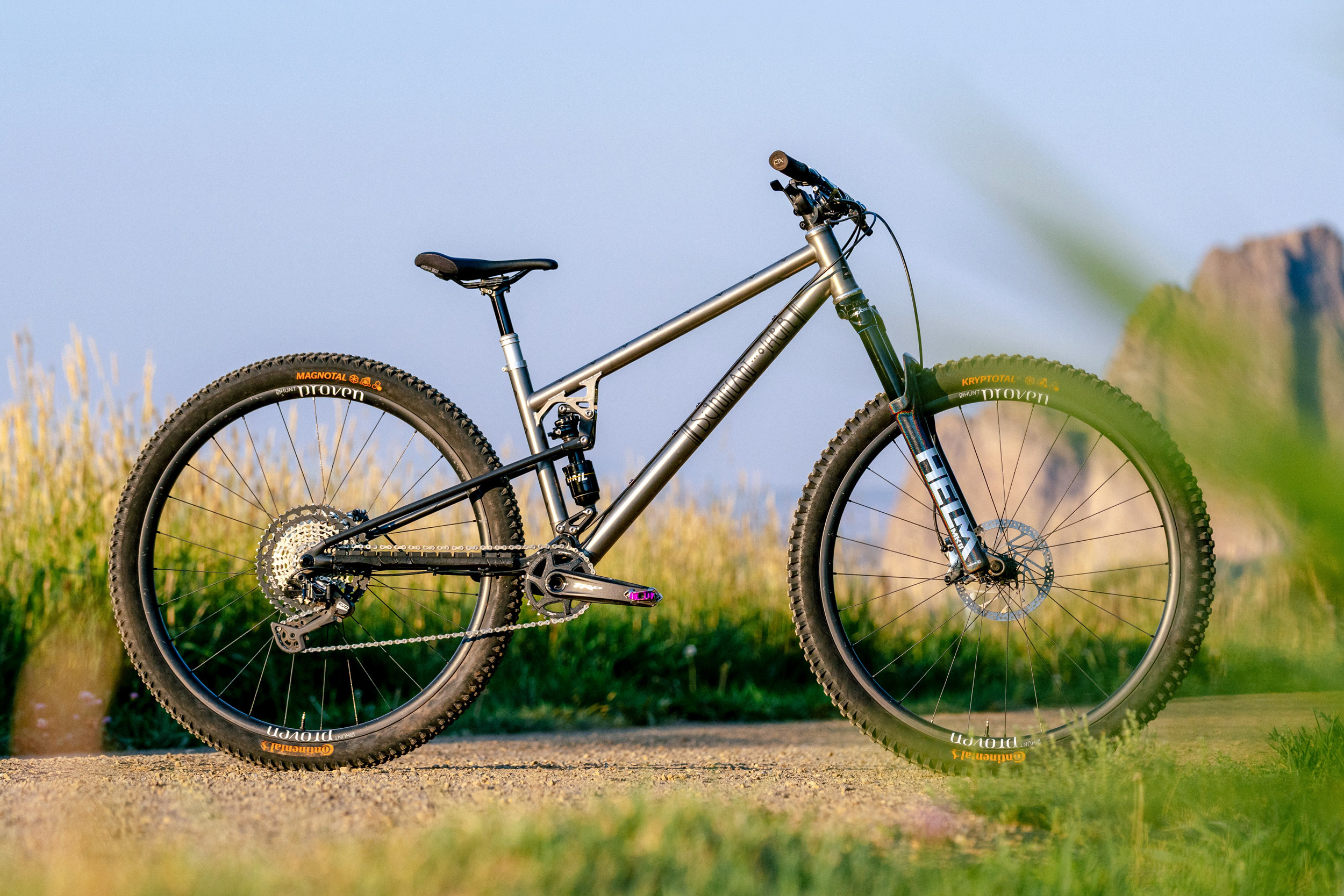
Over a year ago, I got my hands on a complete TRP EVO 12 groupset, complete with cranks, a derailleur, a shifter, brakes, and rotors. I had a few potential bikes to test the system on but eventually decided to build up a Starling Murmur as my all-season, all-winter trail bike for the steeper, more technical trails around my home on British Columbia’s Sunshine Coast. In the winter, our trails are sloppy and loamy and wreak havoc on components. In the summer, they get blown out and dusty, finding ways to sneak into all the places where dirt shouldn’t go. I’ve thrown a lot at the bike and spent embarrassingly little time maintaining it. I could have easily thrown on a tried-and-true drivetrain, but curiosity got the better of me, and I figured the heavy-wear, minimal-maintenance approach would make for a great testing environment.
EVO 12 Overview
The TRP EVO 12 groupset is made up of nearly everything you need to pedal and brake. It includes the 10-52T EVO 12 cassette, EVO 12 derailleur, EVO 12 shifter, EVO 12 chainring, EVO 12-speed chain, EVO 12 carbon or alloy cranks, and several bottom bracket options to suit various frame specs. They also offer three levels of EVO brake systems, with the top-end EVO 12 Pro brakes designed around a four-piston caliper rated for downhill, enduro, and eMTB use. Most components are available in gold or black colorways.
According to TRP, the shifter’s cable pull is proprietary, so they strongly suggest using the shifter and derailleur together rather than mixing and matching with other brands. It’s largely a closed system, so once you go TRP, you’re stuck making a loud political stance against the two biggest players. In terms of overall compatibility, the TRP EVO 12 derailleur uses a standard hanger-style that should work with virtually any mountain bike. Another important spec is that the EVO 12 cassette is only compatible with Shimano Microspline freehubs, which could mean added expenses if you’re coming from an XD cassette.


As for comparisons, the EVO 12 groupset lands comfortably in the mid-to-high tier of mechanical drivetrains. SRAM X01 and Shimano XTR are the closest competitors in terms of price, weight, and performance. The prices and weights below reflect the alloy TRP crankset; switching to the carbon cranks would add $200, putting it in line with X01 Eagle.
12-speed Mechanical Weights
| Group | EVO 12 | X01 Eagle | XTR | Deore XT | GX Eagle |
|---|---|---|---|---|---|
| Derailleur | 300g | 286g | 241g | 360g | 300g |
| Shifter | 125g | 116g | 130g | 97g | 122g |
| Crankset (32T ring) | 628g | 462g | 541g | 588g | 635g |
| Cassette | 327g | 373g | 376g | 463g | 453g |
| Chain | 234g | 239g | 269g | 279g | 244g |
| Totals | 1614g | 1476g | 1557g | 1787g | 1754g |
12-speed Mechanical Pricing
| Group | EVO 12 | X01 Eagle | XTR | Deore XT | GX Eagle |
|---|---|---|---|---|---|
| Derailleur | $252 | $235 | $274 | $170 | $128 |
| Shifter | $109 | $105 | $137 | $85 | $46 |
| Crankset | $246 | $415 | $550 | $200 | $138 |
| Cassette | $439 | $455 | $410 | $195 | $219 |
| Chain | $43 | $75 | $69 | $46 | $34 |
| Totals | $1088 | $1285 | $1440 | $696 | $565 |
TRP EVO 12 Derailleur
The TRP Evo 12 derailleur uses a horizontal parallelogram shift path, meaning it moves only left to right, unlike the traditional (or slant) parallelogram, which travels at an angle alongside the derailleur. Brands like TRP and microSHIFT say a horizontal parallelogram offers a more stable chain for better shifting in rough terrain by isolating vertical movement, but in reality, it’s difficult to distinguish between the two main styles.


The derailleur has a carbon-fiber outer cage, 12T and 14T sealed-bearing jockey wheels, and an oversized cable pulley that wraps the shifter cable toward the pinch bolt. Although most of the derailleur’s main body doesn’t disassemble for repair or replacement, TRP offers replacement parts, including the inner cage, B-plate and mounting hardware, a clutch replacement kit, jockey wheels, cable pulley, and other small parts.
The big gold lever at the top of the derailleur is called the Hall Lock lever, which essentially locks the upper pivot, or B-pivot, in place to eliminate unwanted derailleur movement and chain slap, creating a quieter, crisper drivetrain. It’s a legit piece of tech and makes a huge difference in how the derailleur moves. Although modern, high-end derailleurs are already pretty quiet, it adds an extra layer of silencing. It makes a big difference when it’s time to remove the rear wheel, letting the derailleur pivot out of the way.

The lower lever is a dedicated cage release that provides the same functionality as SRAM’s derailleur cage lock, but it does so by releasing the cage tension entirely from the derailleur. It works by pre-loading the lever slightly to release the cage pin, and then the entire cage so it can swing forward. This is only used to help remove the wheel, and while it’s not as intuitive as SRAM’s version, it works well once you get the hang of it.
The TRP EVO 12 derailleur also has an internal clutch system to help reduce excessive cage movement. Unlike Shimano’s clutch system, which relies on a friction band to reduce movement of the lower half of the derailleur, the EVO 12 uses a unidirectional, instant-engagement, roller-bearing system. Three tiny 1.5mm screws hold the cover in place under the big EVO logo, and a second pair of 1.5mm screws holds the clutch packet in place. With those removed, the clutch pops right out for cleaning and re-greasing, and the larger screw in the center of the clutch lets you tweak the clutch’s tightness.


After a year of regular use, I’ve been happy with the derailleur’s performance. The various tools designed to reduce cage movement and noise are noticeable, keeping both chain and derailleur noise at a minimum. I ride my Starling exclusively on rowdy, often steep downhill trails that do a good job of exposing loud, clunky drivetrains. The Evo 12 derailleur wasn’t one of those. I wouldn’t say it’s quite as quiet as SRAM Transmission drivetrains, but it’s not far off.
TRP EVO 12 Shifter
The EVO 12 shifter is a standard thumb-lever shifter with a few tricks. On the rider-facing side, a small switch lets you choose between a single upshift and up to five shifts with a single, sweeping lever push. I’ve mostly kept it in multi-shift mode, as I like being able to quickly jump up into higher gears when approaching an unexpected climb or feature, but having the option to switch quickly is a nice touch.


Carried over from the previous TR12 shifter, the upshift lever has 40 degrees of forward and backward adjustment (+/- 20 degrees) to dial in its position. It ended up being really helpful for my setup. My downshift lever was in the perfect position, but I used the upshift adjustment so I didn’t have to reach so far with my thumb. The shifter is compatible with SRAM MatchMaker brake levers, which can free up space on your bar and provide additional side-to-side adjustment. The clamp has two mounting holes, providing even more side-to-side adjustment.


The TRP EVO 12 is one of the most ergonomic shifters I’ve used. I love the concave shape of the downshift lever, which provides a really positive, secure feel. The upshift lever feels slightly larger than SRAM or Shimano levers, and despite not having any additional grip or rubber on the lever, like XT shifters, I haven’t missed a shift. It has an impressively light action that feels anything but clunky or hard, though I sometimes miss the satisfying mechanical feel of a Shimano shifter. All things considered, the TRP Evo 12 shifter felt great and shifted accurately. Since shifter feel is somewhat personal, it’s a bummer the cable pull doesn’t work with Shimano or SRAM, as I could see folks wanting to bring their own shifter but take advantage of the EVO 12 derailleur and its wealth of features.
TRP EVO 12 Cassette
The EVO 12 cassette is manufactured using a hybrid steel/alloy construction. The top two cogs are made from a single piece of 7075 aluminum, and the rest are made from forged steel. Everything is bolted together, and replacement sections aren’t available for separate purchase. As mentioned earlier, the EVO 12 cassette is only compatible with Shimano Microspline freehubs. Those who regularly swap wheels and cassettes will appreciate the one-piece design, as it slides on and off with less effort than loose clustered cassettes.


The 10-52T gear range is right on par with SRAM and Shimano’s 12-speed offerings. The jumps are slightly unusual, with 11T, 13T, and 15T toward the low end, and a 44T before the jump up to 52T. I’ve always found the jump from 42 to 52T a bit much, which is what SRAM uses, so something closer to Shimano’s 45 to 51T step is preferred.
The cassette itself weighs just 327 grams (11.5 ounces), which is on the lighter side when compared to other 12-speed mountain bike cassettes, but that weight (or lack thereof) comes at a price. It’s fairly pricey at $439 USD, which is toward the top end of big-brand mountain bike cassettes.
Evo 12: 10-11-13-15-18-21-24-28-32-36-44-52T
SRAM Eagle: 10-12-14-16-18-21-24-28-32-36-42-52T
Shimano XTR/XT: 10-12-14-16-18-21-24-28-33-39-45-51T

TRP supplies the EVO 12 groupset with a somewhat basic KMC 12-speed chain. Although TRP says the cable pull is proprietary—so the shifter and derailleur must be used together—there seems to be no real reason users can’t use chains from SRAM or Shimano. I haven’t experimented with other chains, but I’ve read reports online of people using non-T-type SRAM chains with great results. I ran this by TRP, and they explained the EVO drivetrain “was designed and optimized around KMC chains for the best overall performance,” but you can use a Shimano chain, and it performs best when paired with a Shimano cassette.
TRP EVO 12 Crankset
The Evo 12 Crankset is available in carbon or alloy. The carbon version is available in two lengths: 165mm or 170mm. The alloy version I’ve been using comes in three lengths: 165, 170, and 175mm. Neither version includes a chainring, but TRP offers a CNC 7075-T6 aluminum alloy chainring in three tooth counts: 30T, 32T, and 34T.


The alloy crankset I’ve been running uses a forged aluminum, two-piece construction with a 30mm spindle and a Race Face Cinch-style direct-mount chainring. The chainring is held in place using a lockring, tightened with an ISIS Drive bottom bracket tool. A preload adjuster on the non-drive-side crank arm is used during installation to remove play. Otherwise, it’s a pretty straightforward component.
My only complaint is that the TRP logo on the outside of the crank arm started rubbing off almost immediately after I started using them due to my shoe rubbing, but that’s by no means a deal breaker. I also prefer bolt-on chainrings, instead of direct mount, but for the type of riding I’m doing on this particular bike, it has been fine.
Overall Performance and Findings
No matter the conditions, the TRP Evo drivetrain remained predictable and crisp. Over the last year, the entire system has been exposed to dust, dirt, and mud, which can often hurt shifting quality, but the combination of a strong clutch, the Hall Lock Lever, and high-quality construction seems to keep everything running smoothly.
As a daily rider on a non-bikepacking bike, I see no problem switching from Shimano or SRAM to TRP, since you can order replacement parts through your local bike shop or online from TRP. For bikepacking, because of the proprietary cable pull, I’d be less confident relying on it when replacement parts aren’t as easy to get. That said, I’ve thrown more at the EVO 12 drivetrain than most bikepacking trips would, including a few crashes and awkward tumbles, and I haven’t had to replace or repair anything yet.


It helps that TRP is also slowly becoming more mainstream; it’s increasingly common to spot TRP brakes out on the trail, at least locally. One can only hope the momentum continues, and brands like TRP, microSHIFT, and Box Components keep putting pressure on the big guys. In my experience, the EVO 12 drivetrain performs at a level comparable to XTR and X01-level drivetrains, and it feels like a noticeable upgrade over XT and GX.
After roughly 500 kilometers, my chain checker shows the original KMC chain still has plenty of life. The standard black/silver chain is $43, which is right in line with XT/GX-level chains. Some online reports say KMC chains don’t last as long as Shimano or SRAM chains, but I don’t have enough mileage to weigh in yet. The black/gold chain costs $80 if you really need your drivetrain to match but otherwise offers no benefits.


In the photos below, you’ll notice minor wear on the two largest cogs on the cassette, which isn’t surprising since they are made of aluminum to save weight. It would be awesome if brands like TRP sold replacement clusters, especially since the two clusters bolt together and can be removed easily. I popped the cover off the derailleur’s clutch earlier this week after some more sloppy riding here in the PNW, and I was pleased to find it clean and well-greased.


- Model Tested: TRP Evo Pro 12-Speed
- Weight: 1,614 grams
- Place of Manufacture: Taiwan
- Price: $1,088 USD (currently on sale for $885)
- Manufacturer’s Details: TRP Cycling
Pros
- High-quality construction and clear attention to detail
- Predictable shifting, ergonomic lever feel, and reasonably quiet operation
- Major upgrade over TR12 drivetrain
- Good value for the price
- Hall Lock does a great job at reducing derailleur movement
- Cage release knob is effective and unique
Cons
- Proprietary cable pull between shifter and derailleur means the shifter and derailleur are locked in together
- Limited availability of replacement parts
- Shifter feel won’t be for everyone, especially coming from Shimano XT/XTR
- Competing against XTR/X01-level drivetrains is a bold move
Wrap Up
It’s a big ask for anyone to stand up to Shimano or SRAM. Shimano has a century of drivetrain manufacturing under its belt, and SRAM has four decades. TRP was founded in 2006 and launched its first mountain bike drivetrain just six years ago. It almost feels unfair for less experienced brands like TRP to compete, but then again, everyone loves an underdog story.
I don’t think anyone expected much from the TRP EVO 12 drivetrain after the launch of the reportedly less-than-impressive TR12 a few years earlier. It might not be quite as crisp as your go-to drivetrain, and the proprietary cable pull is limiting, but everything else I experienced over the last year has been overwhelmingly positive. The combination of the Hall Lock, instant clutch, and predictable shifting makes a capable drivetrain that has been used in some of the worst conditions imaginable. I hate to admit it, but I keep waiting for something catastrophic to happen, though it never comes. I’d love to see a Deore/GX-level drivetrain from TRP, maybe an OEM-spec, which would get TRP in front of more people, but the EVO 12 system is a promising first step.
Further Reading
Make sure to dig into these related articles for more info...

Please keep the conversation civil, constructive, and inclusive, or your comment will be removed.