

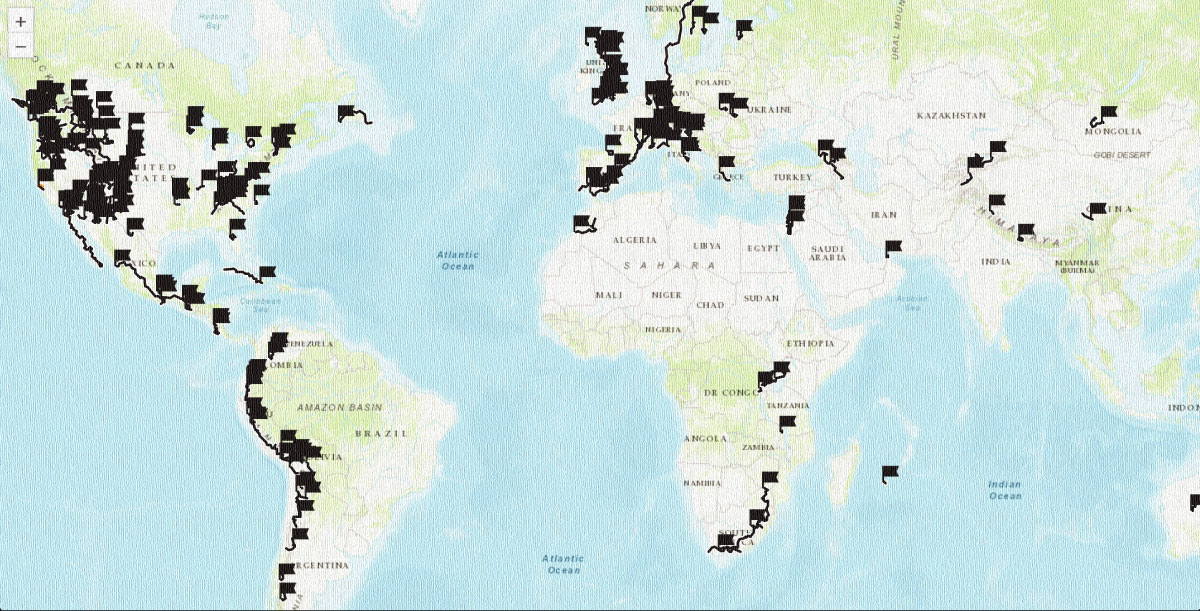
 Mountain Bike (MTB)
 Gravel Bike
 All-Terrain Bike (ATB)
 Fat Bike


El Mundo Paramo: Amongst Frailejones and Old Renaults

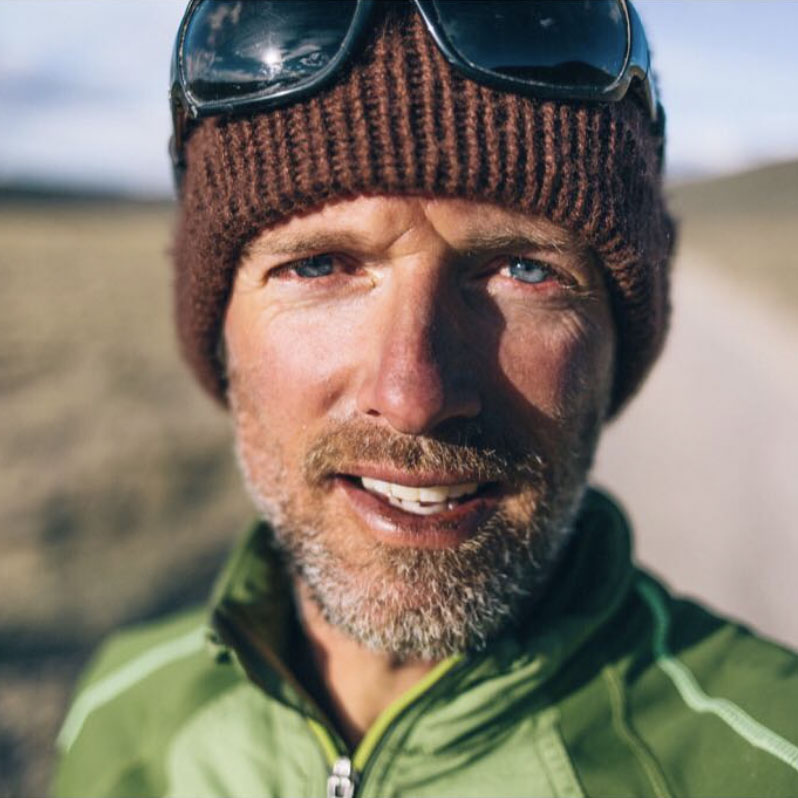
As a follow-up to their last Colombian journal entry, Cass and Emma head north of Bogotá to ride two of the site’s popular routes, Páramos Conexión and Oh Boyacá! After fabulous encounters and 35,000 meters of climbing, they wonder to themselves, “Can anywhere be as good as Colombia for dirt road, mountain touring?” Find out here…
PUBLISHED Mar 23, 2026
In my last Colombian journal, which you can read here, I detailed a day-by-day journey around Chingaza National Park. Despite being January—an oft-cited month when a forecast of sunshine is a sure favourite—the weather wasn’t on our side for this 300-kilometre loop, to put it mildly. But even though we were drenched most days, it didn’t stop us from loving almost every moment of it. Scrub that. Every moment of it. Rain be damned!


Thankfully, since that first bone-soaked week, the weather took a more favourable turn. After treating our bikes to much-needed repairs in Bogotá’s cycling quarter, we were ready to set off again. This time, we’d be connecting a version of the Páramos Conexión with Oh Boyacá!, two bikepacking routes available here on the site. The former provides, as the name suggests, a páramo-infused exit from the capital and a way to link bikepackers to northerly rides, whilst the latter skirts the edge of Cocuy National Park in the Sierra Nevada del Cocuy, set within the Cordillera Oriental and the northeastern sector of the country. As it happens, this wouldn’t be my first time riding in Boyacá. Back in 2011, I rode across Colombia as part of a longer journey from Alaska to Argentina, but this particular zone within the state, one of the shiniest of jewels in Colombia’s rugged mountain crown, was closed to outsiders at the time. Reluctantly, I had to skip what I knew would have been a Boyacán highlight. Since then, I’ve harboured a desire to return. Finally, after almost 15 years… here I was!


Both routes offer fine examples of Colombia’s páramo. In fact, a core reason we settled upon the country as our destination to bikepack this winter was to experience its high-elevation tundra, which Emma, ever the botanical illustrator, hoped to paint, and I planned to photograph. On paper, this largely featureless expanse might not be an obvious choice for a cyclist who has likely climbed dutifully for hours to get there, given that the páramo is often wet and misty, and rewarding views are never guaranteed. Indeed, the páramo is very likely to present itself in the form of abstract landscapes, more a moodboard than the classically photogenic Andean panorama we might imagine.

But this mood! This vibe! I’m quite certain the ethereal páramo encourages deeper reflections and subtler feelings than South America’s more obvious picture-postcard mountainscapes. And, once this likely wet and probably exhausted cyclist is introduced to its inhabitants, the frailejón—a plant so distinct and bizarre that besotment is inevitable—the páramo transcends to next-level allure and enchantment. Imagine the finest mist you can. Then, picture these tiny droplets intricately collated by an army of succulents covered in spongy, hairy leaves that persuade each and every one of them to fall to the ground, in turn providing the tastiest of drinking water for much of Colombia’s mountain population. In doing so, this inclement weather, often a cause of dismay to the travelling cicloturista, becomes a celebration of one of planet Earth’s more esoteric forms of water production. To the point, even, that it feels quite ridiculous to begrudge the páramo of its complete and absolute love for moisture, no matter how damp and cold you may feel at the time. Set amongst acres of tussocky grassland and dotting the mountainsides in head-shaking numbers, these long-necked H2O factories are so important to Colombia’s water table that you’re not allowed to even touch them, let alone uproot one as a keepsake.

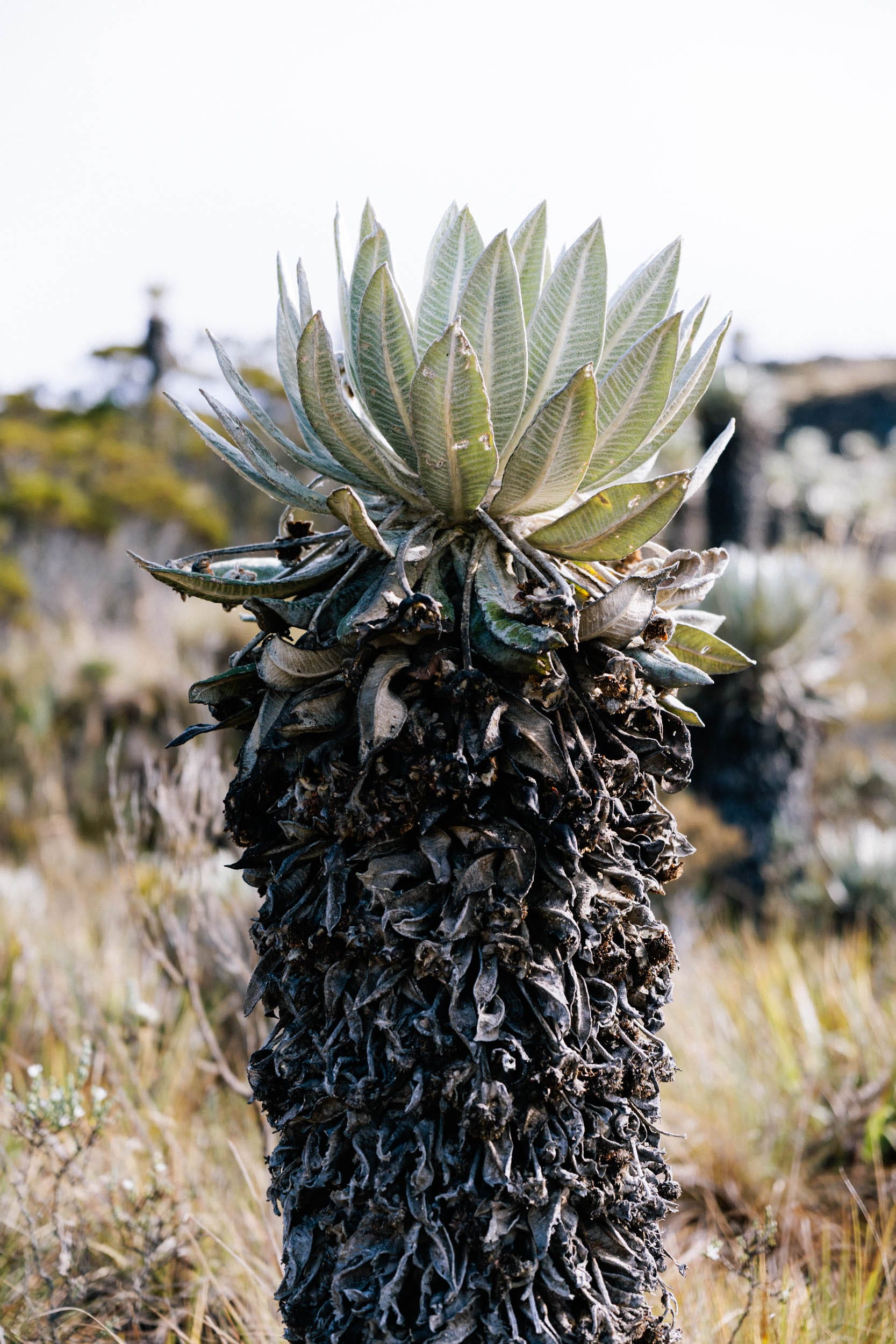
If and when sunshine does pierce the clouds and gently dapple this numinous landscape, the light that permeates is so exquisite that the whole experience—even being wet, bedraggled, and soaked to the bone, as we’d been on many occasions thus far—makes complete sense, and could only ever be that way. Indeed, all you can do is try to stop yourself from racing around with your camera, and simply absorb and appreciate that páramo feeling, without the need for photographic evidence. After all, it will never quite show up the way you felt and remembered it.
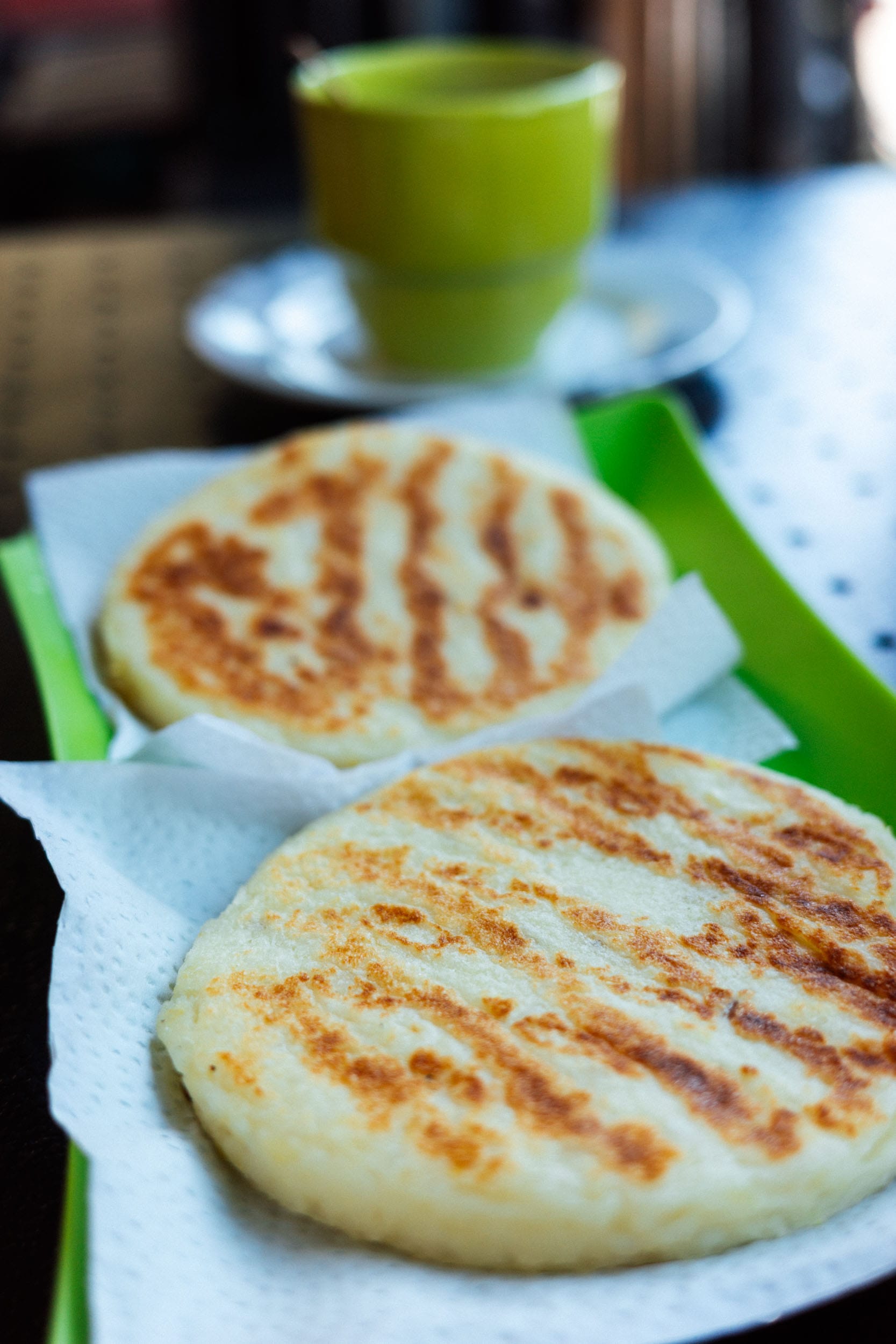
Clearly, this incorporeal páramo can become something of an obsession. But there are a host of other good reasons why Colombia makes such a wonderful country to explore by bicycle, as exemplified by these two routes. In my first post from our first week in Chingaza National Park, I touched on the rich bike culture across the country. Aside from the Sunday Ciclovía in the city itself—where 120 kilometres of city streets are closed to traffic, each and every week, to be claimed by cyclists of all shapes, sizes, and persuasions—we palpably felt this love of cycling on the day we left Bogotá. We’d stopped at a collection of roadside cafés renowned amongst roadies for their corn arepas, a Colombian street food staple. A tell-tale clutch of featherweight bicycles, their tyres like razor blades next to our own, were leant up outside the line of establishments, from which women heckled at passing cyclists, ushering them urgently towards their particular kitchen. At one table, two well-dressed, lycra-clad men scoped out our oversized, muddy setups and asked us about our plans. Like us, they had ordered combos, another cyclist’s favourite, in which bread and cheese are broken up into pieces and plopped into a cup of piping hot panela water.


We explained our route and intentions. “Te felicito,” said one, and “Mucha fuerza,” said the other with an air of solemnity, placing his hand on his heart. Both seemed visibly moved by the scope of the trip, as if imagining the long, noble climbs that lay ahead of us, the breathtaking views that would likely touch our soaring spirits, and the undeniable challenges that would be wrought upon our mortal bodies. Combine this raw passion for the essence of competitive cycling—the physical and visceral struggles between man, mountains, and the elements—with all the evidence we’d seen for the popularity of bicycles as transportation, and Colombia really is a country that gets what you’re doing. And, because of this, I believe there’s a joy to touring here that’s matched only by other parts of the world where cycling is revered and celebrated, like Italy or France.
And, just as it is when crossing Europe’s iconic Alpine cols, this is especially evident when it comes to riding in Colombia’s Andes. Its tortuous climbs are as much a Colombian staple as any arepa, and the Páramos Conexión begins with one especially stout example, at least for those riding in a northerly direction. It crested our first swathe of tropical alpine tundra—the Páramo de Monquebtiva—where, after we’d stopped to snack and stare intently into a panorama of classic nebulous mist, we were lucky enough to spot an Andean spectacled bear, the only kind that’s endemic to South America. It was standing on its hind feet at the time, and it watched us just as we watched it. What a way to begin a ride… and where’s that 400mm telephoto lens when you need it?


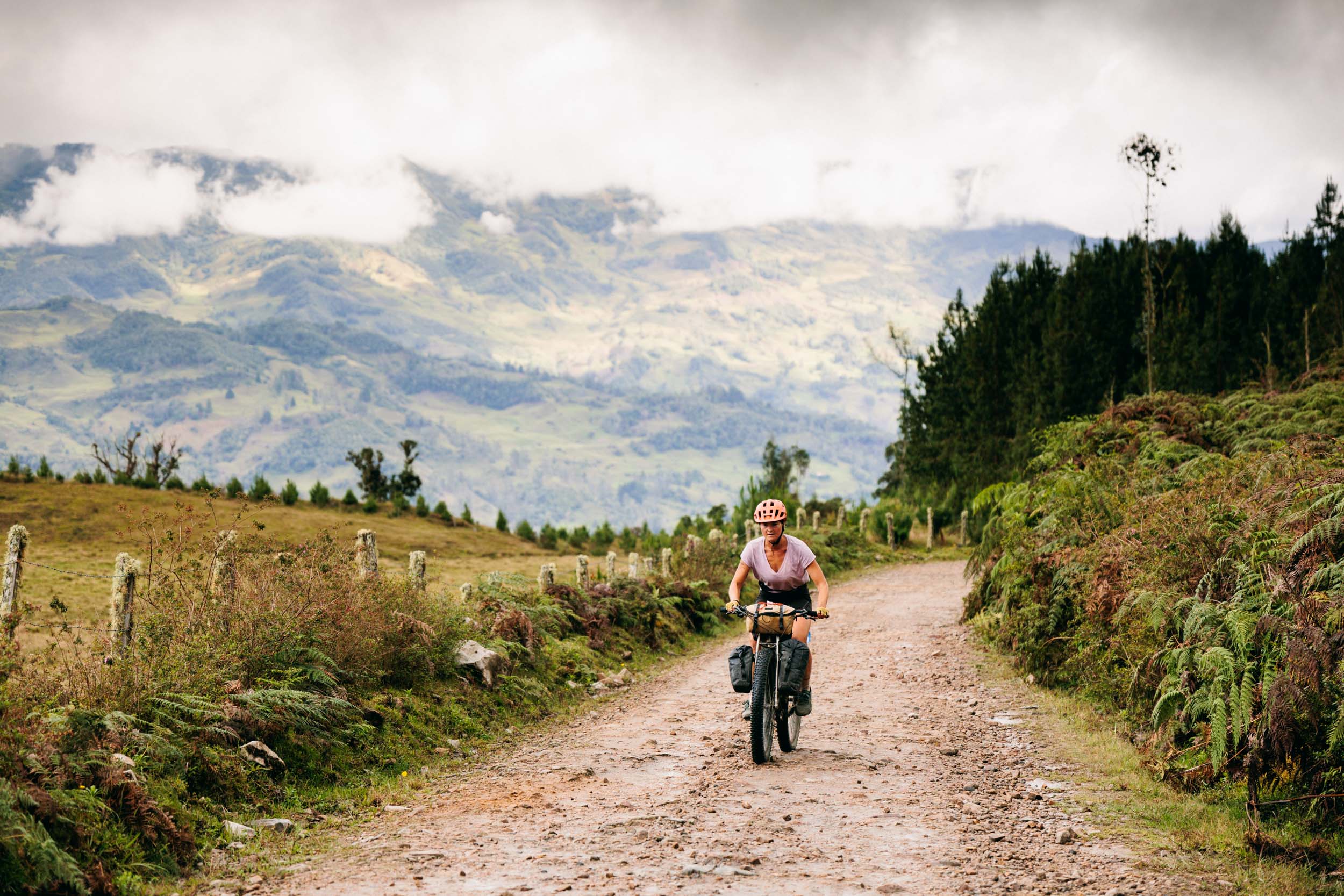
But it was the sheer variety of off-pavement terrain in this region, like the ensuing descent to the rambunctious little tropical settlement of Gachetá, that really stood out. As we left the misty wisps of the high-elevation tundra, we spiralled down through warm, damp pockets of air, following a road usurped by giant ferns that reached out to touch and tickle us. With a change of topography came a change of road texture. Initially, it was hardpack dirt, then gravel, delighting us with the snap, crackle, and pop of stones spat out by our tyres.

And always unpaved! Just like me, my bike’s always happiest when it’s away from asphalt, which is why we get on so well together. Loaded with plump panniers and gargantuan tyres, it felt perfectly suited to the terrain at hand, incredibly capable and inherently comfortable. I found myself gazing proudly upon it, wondering if life could get any better than riding this remarkable freedom machine along the length of the Andes, as I’d done over a decade before.
I looked at Emma and said, “What if we just keep riding? I mean, what’s to stop us? We love our bikes. We have food. We have water. We’ve everything we need and nothing more!”

But, woe is me, we’d have to content ourselves with just one glorious month to criss-cross the country. And, spoiler alert, we cycled almost every day. In past trips, we’ve taken more breaks from the saddle, but Colombia urged us forward and encouraged us to keep moving. Emma summed it up well in the way she broke down our typical day. “There’s the morning ride. The middle-of-the-day ride. And the afternoon ride.” Sounds like a dreamy tour… where do I sign up?


In Gachetá, we feasted, pre-ride, on a plate stacked high with comida coriente, in a restaurant catty-corner to the town’s bus stand—often the best spots, despite the incessant honking and beeping. It was run by a smiling man in a shirt printed with avocados, who presented his dish of the day with the flourish of a head waiter. He even cleared a space for our bikes and reeled off all the famous climbs in the area, as frequented by Colombia’s champion cyclists.
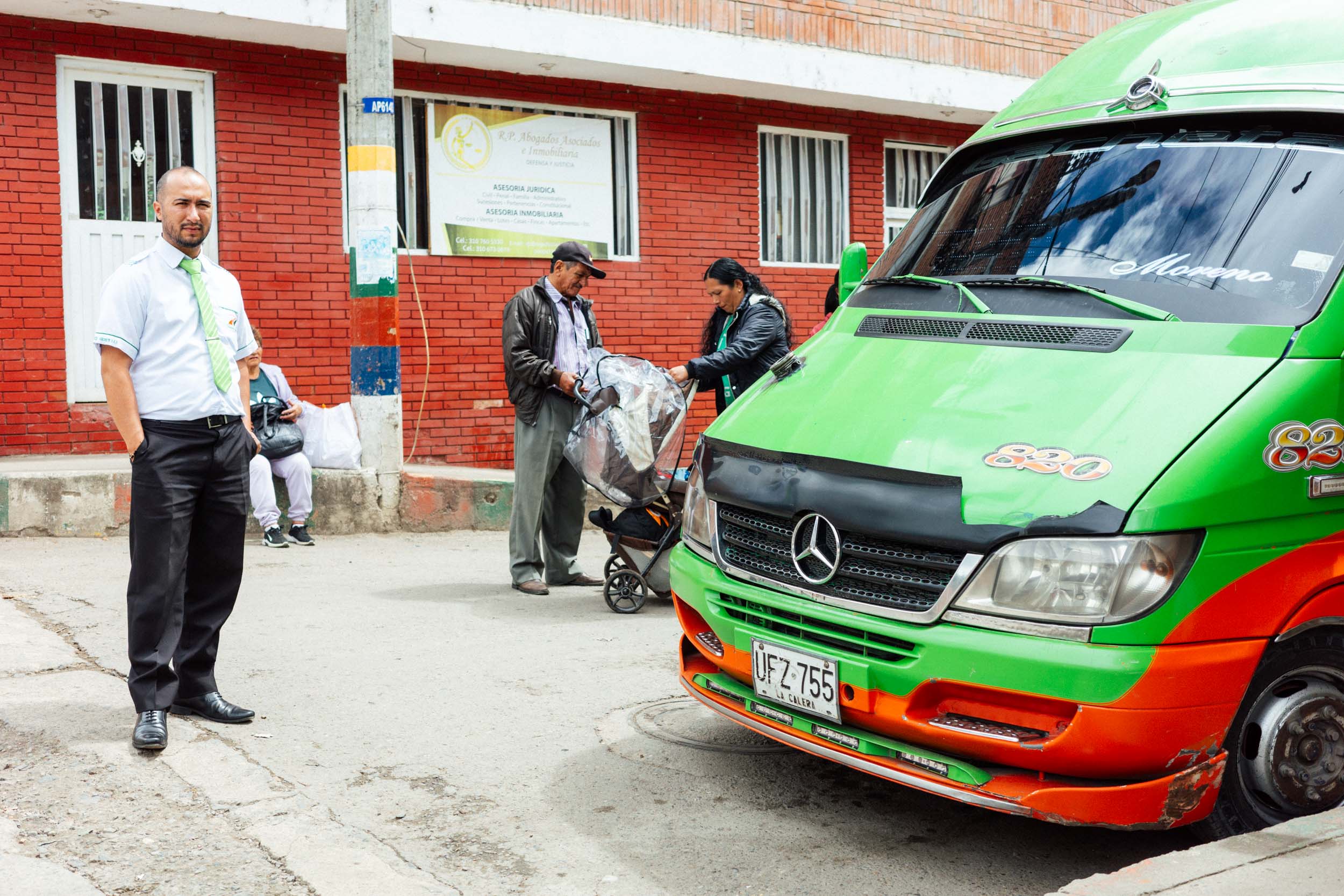

From Gachetá, we pedalled onwards to Manta, a small community where coloured umbrellas hung over the main square, and where men in cowboy hats watched Emma roll into town, beers in their hands and a clutch of empty Aguilas to their sides. Then, in what was to become a pattern for the next couple of weeks, we dropped down towards the valley floor, traced a river, and then started everything all over again.


After a brief stint on the highway, somewhat incongruous with our experiences so far, we were back on gravel for a climb that would gain 2,000 metres of elevation in a distance of just 35 short kilometres. After all the rain we’d had in our first week, it was an unexpectedly sunny day, so we paused halfway up to picnic in the shade. Just as we were finishing up, a lady approached us and invited us to her home. Knowing how much climbing we had ahead, at first I was a little reluctant to get sidetracked. But I’m so glad she insisted. Weaving our bikes between dozing dogs and free-range chickens, we were offered fermented sugar cane juice—a kombucha of sorts—and our panniers were filled with blackberries and apples, too.


In the interests of honesty, the páramo that we crossed at the top of that second monster climb was a little sad and depleted compared to others that we’d seen. In some parts of Colombia, potato fields have encroached ever higher into the tundra, and the frailejón population has been impacted, sadly.


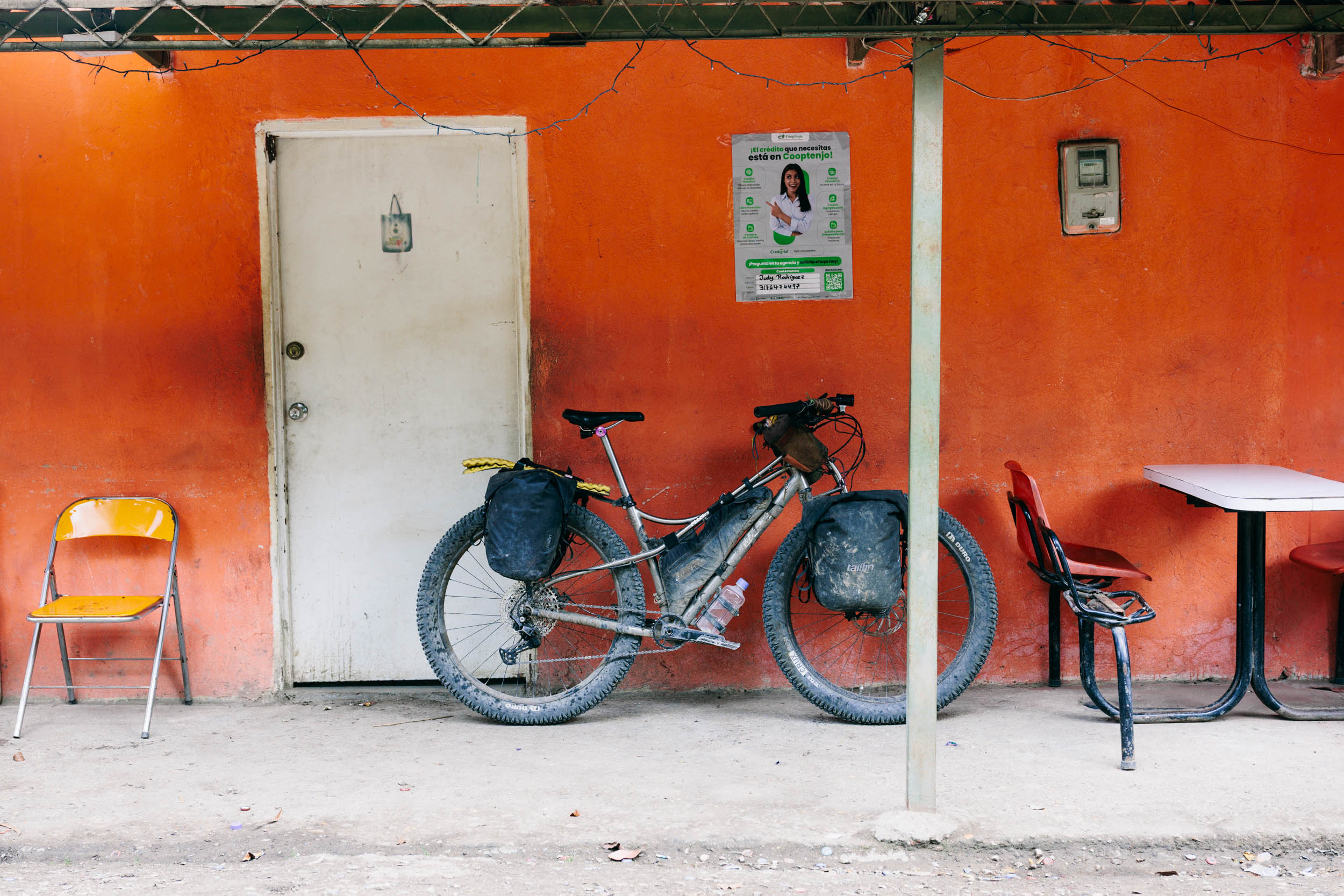

The light, however, was beautiful, and a large glass box, depicting a religious scene, added a sense of ceremony to the occasion, though it did remind me of Roald Dahl’s Charlie and the Great Glass Elevator. Aside from that, the excitement of the day included being chased by a three-legged mutt, spotting a chihuahua on the dashboard of a milk lorry, and passing a local farmer on a mountain bike, riding in Wellington boots and a wool poncho.


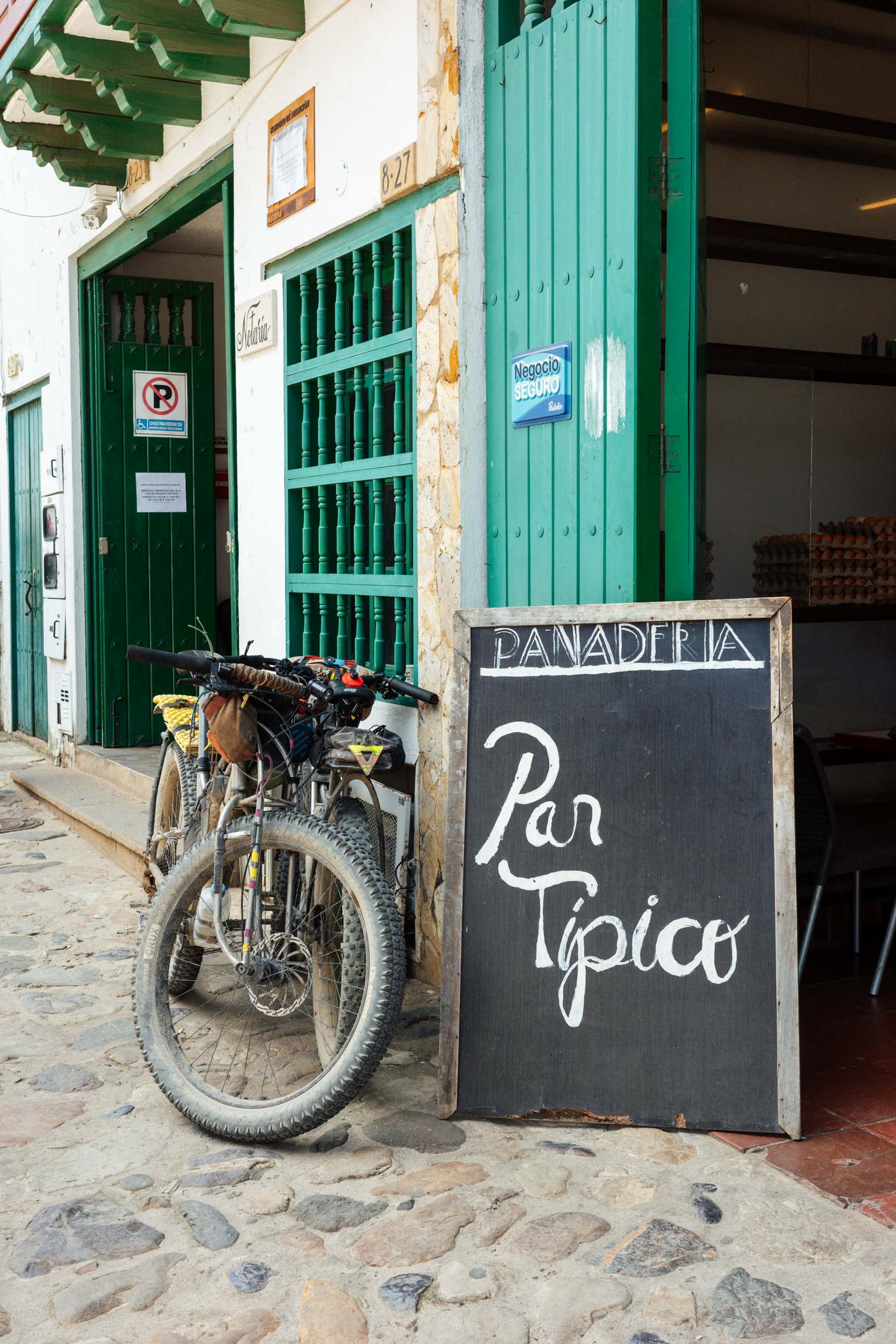
From Villapinzón, we peeled away from the Páramos Conexión to follow a tangle of rural dirt roads across the valley floor, avoiding a series of open coal mines that now blight the area and the dusty truck traffic they bring, as reported by bikepackers before us. As much as I prefer high-mountain riding, rural town life in Colombia is invariably lively. Plus, it’s a guaranteed source of panaderías and coffee shops, to which we availed ourselves with regularity. Again, bicycles of every form could be seen, whether unlocked and leant up outside panaderias or against sidewalks. A few had SPD pedals, tell-tale signs that their owners were likely serious cyclists, like Hermando in Lenguazaque, who flagged us down and showed me phone photos of some of the local loops. I promised to return one day and join him on a ride.


Not that valley riding means much respite from Colombia’s infamously rugged terrain, because after overnighting in Guachetá in a budget hotel that featured the most beautiful, patinaed floral tiles, we were climbing again, this time in a far drier and more barren desertscape. A faint scratch of a dirt road led us to the impressive Monasterio La Candelaria. This goliath 17th-century structure, a Colombian national monument resplendent with palms, auracarias, and stone walkways, is encircled by tall, handsome walls that partition it from the arid landscape around. Even more remarkably, they’re completely blemish-free, particularly from handlebar scuffs, I noticed as I carefully leant up our bikes for a celebratory picnic photo.

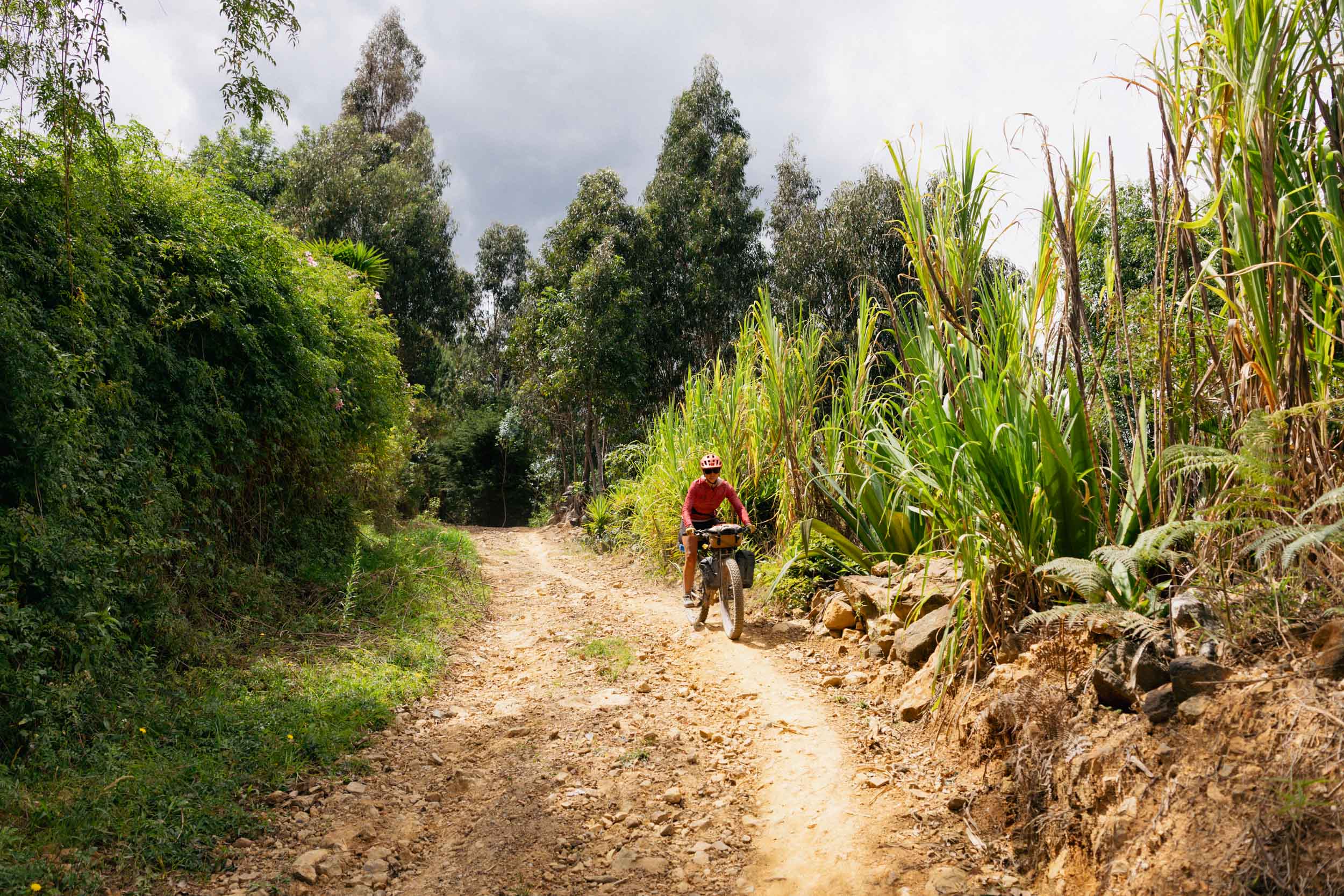


Beyond this shady enclosure, we climbed once more towards the midday sun, sweat beading in our eyes. Villa de Leyva lay in our squinted sights, a national monument since the ‘50s and a popular colonial town that’s busy at the weekends with city folk from Bogotá. Still, the town’s popularity is completely understandable, not least because its perfectly preserved cobbled square is said to be the biggest in South America. To a backdrop of big blue skies and rolling hills, it’s a showcase for 400-year-old Spanish colonial architecture, characterized by white-washed walls and terracotta-tiled roofs. Plaza Mayor is so vast that one needs only walk towards the middle to have photo-bombers shrink to indistinct detail.



Villa de Leyva also marked the beginning of Oh Boyacá, our next bikepacking route, and the gateway to El Cocuy, which you may recall served as our initial reason for travelling to Colombia. From the get-go, this route did not disappoint. Initially, it crossed into Santander briefly before striking more deeply into Boyacá, via a broad, verdant, remote valley. As we pedalled northeast, mountains tightened to either side, and the scenery grew more dramatic once again, until we were craning our heads up towards steep and craggy clifftops where waterfalls flowed.


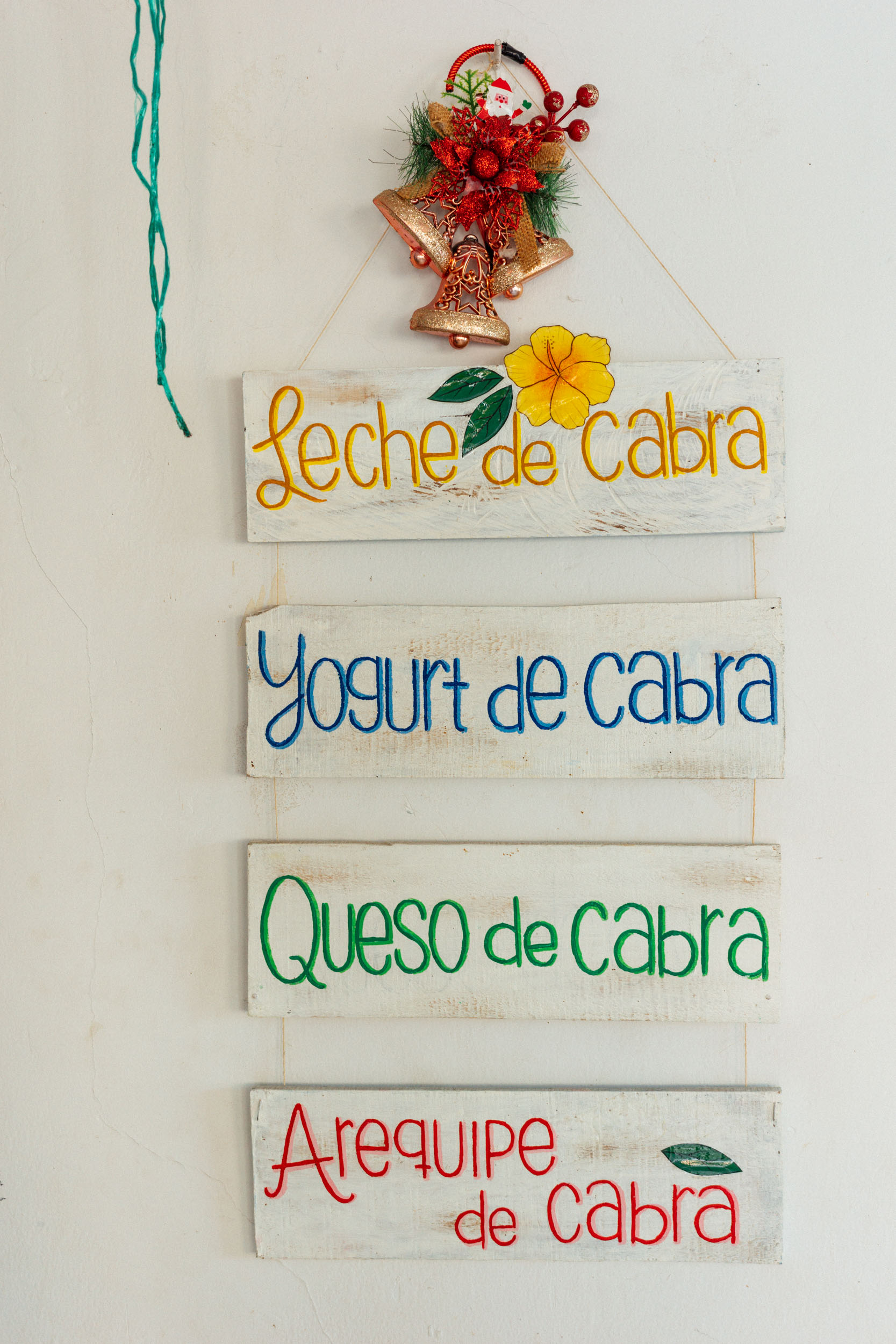

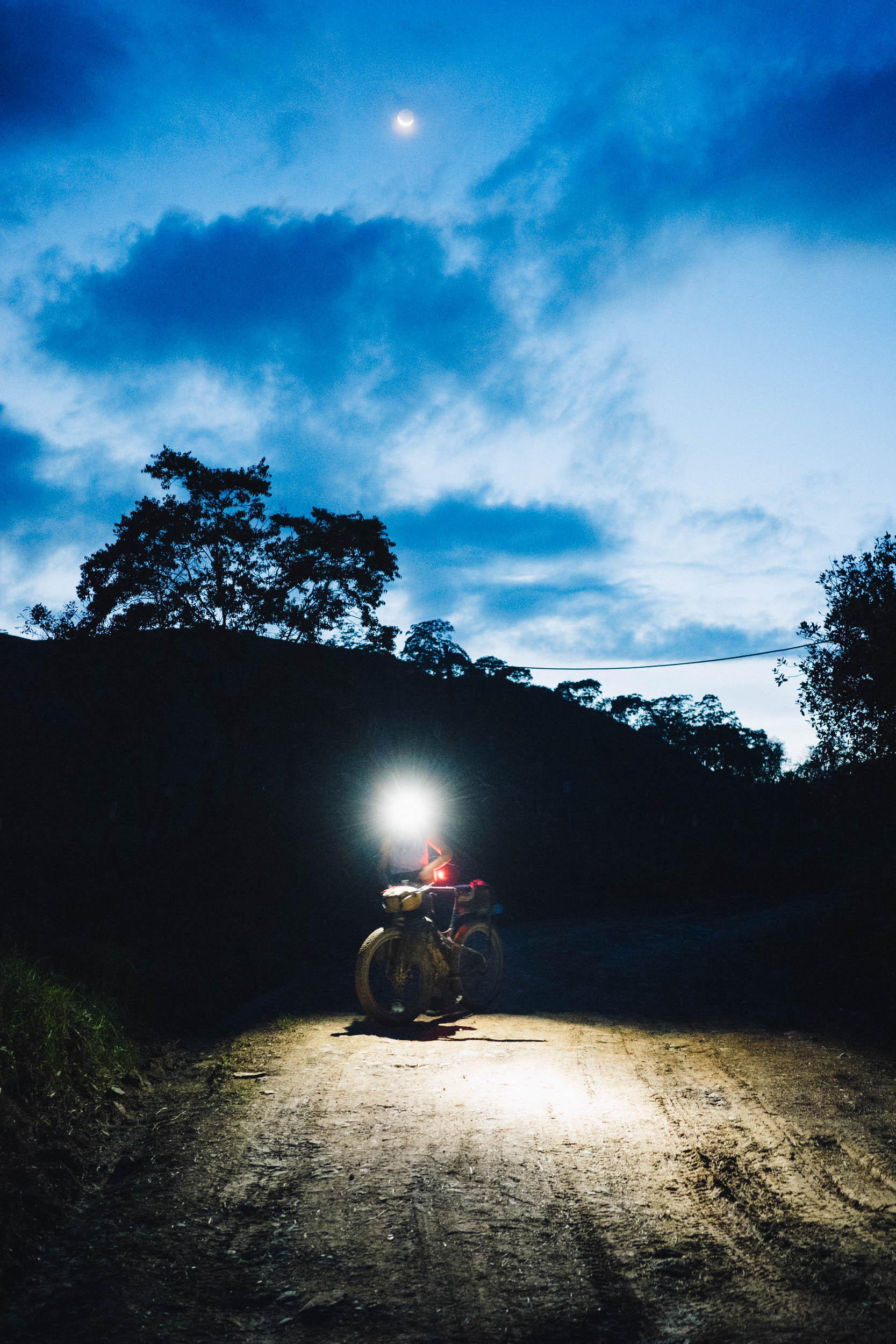
Between sprawling ranches, marked by metal milk jugs at the roadside awaiting daily collection, motley collections of dogs vied for our pats and scratches. The villages were small and quiet. In one such settlement, La Palma, we entered a store for a round of cold Ponys, a Colombian barley drink generally tucked in amongst the Aguilas, only to exit with goat’s milk yoghurts. We guzzled them down in the late afternoon heat, watched by a dog and a parked horse. This fresh elixir would fuel for another 700 metres of climbing and the final 30 kilometres of the day. We’d set our sights on reaching a recommended camping spot, Tincavita, even if it meant riding under the veil of darkness. But even in darkness, Colombia is full of quirks, especially of the divine kind.


On our loop around Chingaza, you may recall that we’d passed a perfectly preserved, 50-year-old Daihatsu truck inside a huge glass shrine. Here, just as our eyes were adjusting to the night, we approached a bend in the road, and Jesus lit up—or at least, a figurine in a glass case, activated by a motion sensor, did—causing us to wobble from side to side as His image was seared into our brains.



Palermo, shortly afterwards, fed us ever upwards, towards our beloved tundra once more. But not before we’d admired its colourful murals, one of which depicted two dogs. I’m sure we spotted them loitering outside the coffee shop, in search of scratches.


For reasons I have yet to fathom, this next empty expanse was named Páramo De La Rusia, and it was perhaps our favourite swathe of páramo so far. We zig-zagged our way back up to over 3,000 metres in elevation, where an arepa and tinto stand appeared out of the mist as if by magic. Then, just as this mist was looking like it might become less cloud and more rain, we added a further few hundred metres to our tally, making it the highest point we’d reached so far.


Despite the ominous storm that had by now completely seeped across the sky, I considered our timing perfect. Just as the sun began to set and rain began to fall in earnest, we found a patch of frailejón-free grass just a short bike push along a hiking trail, and we dived into our tent as big droplets fell to the ground and peals of thunder filled the air. Barefoot, we popped out to enjoy the rainbow when the wind died down, marveling at our last-minute find. There are many bikepackers who choose to forgo their camping gear on this particular route, and whilst I see the appeal of travelling light within this mountain topography, we both considered the experience of spending a night amongst a thousand frailejón far too enticing to turn down. And we were especially grateful in the morning, when we were graced with sunshine and fantastic views of so many well-watered succulents.


Once we’d crossed Páramo de Rusia, there was only one direction to go, but a lot of it: down, down, and down. Of course, all this down, did, in turn, connect us to more up, which we reached by fording a river, double-checking our directions with a poncho-wearing horseman splashing his way through. A grass-up-the-middle dirt road guided us towards, yes, you’ve guessed it, another ascent and yet more páramo. In my mind’s eye, at least, here we were cheered on by an especially thick grove of frailejón, each head peeking over the next for a view of our toils, like a crowd of spectators gathering at the finish line of a race. Fittingly, the top also marked the end of a popular local hill climb from Belén, over on the other side of the pass.


In case further evidence of Boyacá’s love of cycling was required, a sign celebrated our achievement and noted our elevation and stats—Yo Corone Alto San José de la Montaña, 3815m—as well as advertising a local coffee shop, appropriately named Alpe d’Huez, and apparently frequented by Nairo Quintana, the Condor of the Andes. Por supuesto, we photographed each other beside the sign, our mouths forming smiles despite the frigid air, as I’m sure many have done before us… including, hopefully, Colombia’s aforementioned cycling legend. The descent was just as impressive as the climb, with the biggest and most sweeping views yet, dropping us over 1,100 metres in elevation on a dirt road that led us straight into the town of Belén.

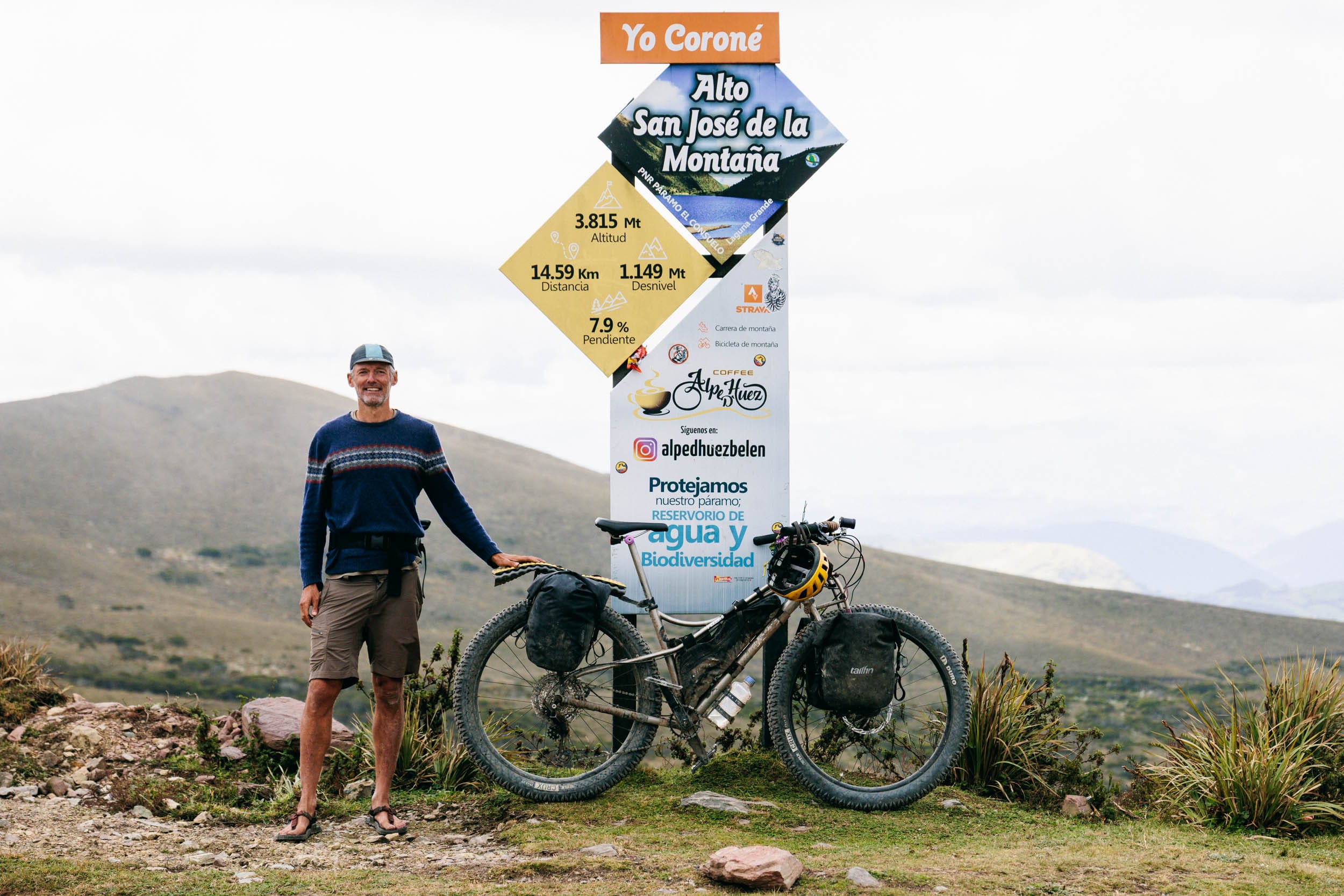


It’s quite possible we would have blasted through—the town’s charm gone unnoticed—had we not been forced to spend the night there in search of a replacement rear brake. Emma’s had begun to spring mineral oil at the top of the last climb, and as our bike computer informed us we still had 13,987 metres of ups and downs to complete the route, it was something we needed to attend to.
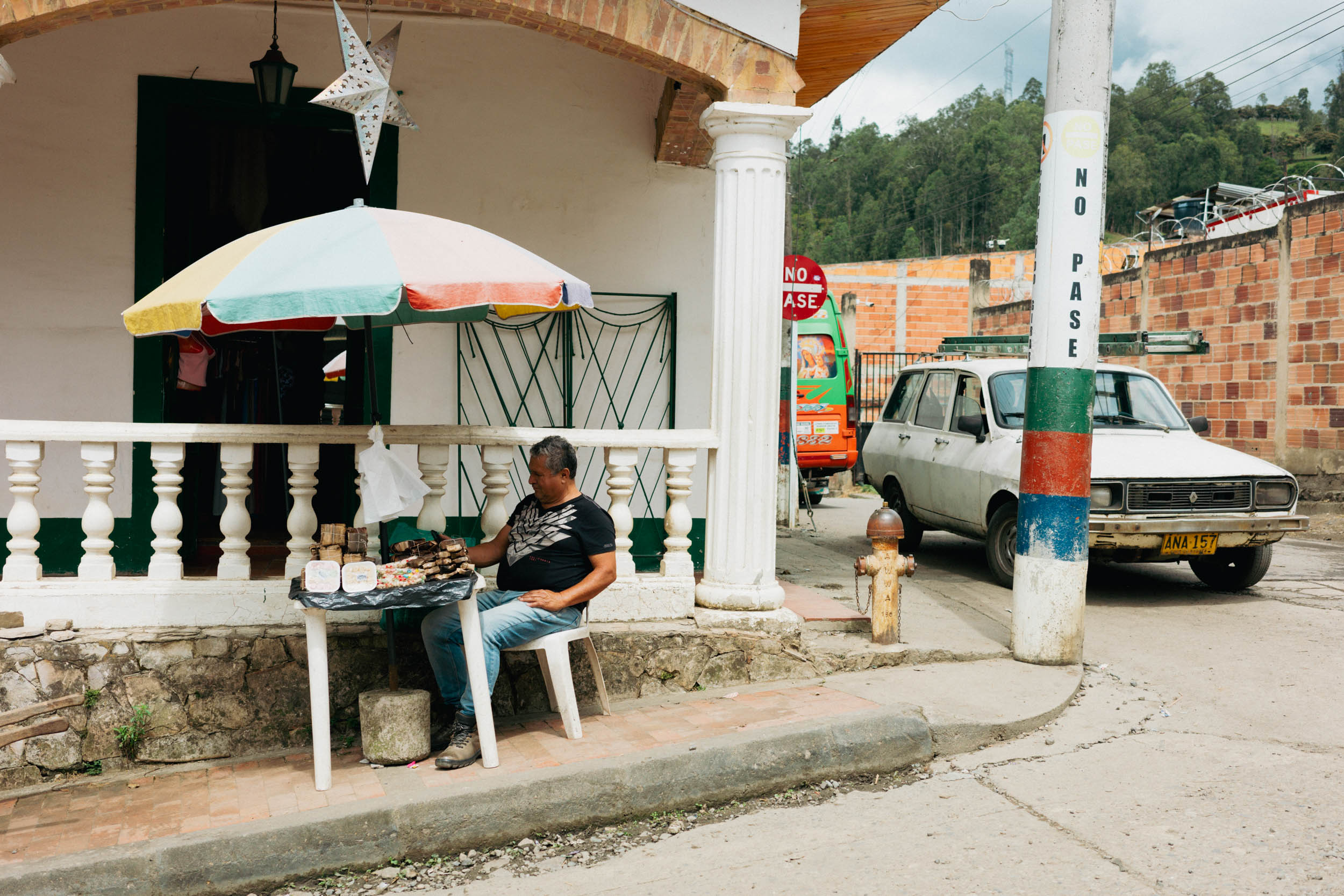
Initially, I was distracted by the number of old French cars that cruised Belén’s streets, each, it seemed, a different colour from the next. Apparently, a Renault factory was established in the neighbouring state of Antioquia in the late 1960s, and these antiquities were the exact same models—Renault 4s, 12s, and 19s—that I remembered from the 1970s of my youth, and a sense of nostalgia had me attempting valiantly to record all that I could.


Then, we focused on the bikes. Thankfully, José Libardo and his small, blink-and-you-miss-it tienda came to the rescue. Complete with a shock of black hair, squared-off glasses, and oily hands, he greeted us with a big smile. And, after rifling through some boxes, he presented us with a few options, including somewhat agricultural mechanicals and some hydraulic ones, too. Despite our modest budget, we decided not to invest in a Chinese-made set of replacement brakes, despite the promising brand name—Himalaya—that cost a suspiciously affordable $25 dollars for both, including rotors. Instead, we opted for an economical Shimano brakeset with big, motorbike-like levers. José insisted on fitting it for us before a small crowd of passing bike friends who’d gathered to chat and observe. What a relief! Having already descended the last 1,100 metres, off-road, on nothing more than a front brake and a prayer, Emma could stop safely once more. Hands were shaken and group photos taken. José even insisted on throwing in a set of complimentary front brake pads before bidding us a warm buena suerte for our journey ahead.


And so, after detouring for one last round of fried buñuelo balls laced with cheese and a strong americano at the Alpe d’Huez cafe, it was sadly time to leave Bélen and head back towards the mountains… and finally, into the Parque Nacional El Cocuy. More adventures were afoot, and the views were the best yet! But I’ll save all that for Part 2…
Bogota’s Cycling Quarter
In fact, Bogotá has several areas where bike shops cluster. But we found the Barrios Unidos, on Calle 68, to offer the best mix of places with high-end parts and more affordable ones too. You can get your frame sprayed there, pick up a crit bike, or check out the latest electronic groupsets.
We took our bikes to Bicicletas Pacheco, who were really friendly and had a lovely shop dog called Sparky. I was able to source an 11-51T Deore 11-speed cassette for just $70, which even included fitting. With prices like that, I treated myself to a new chain too! Next door’s Tour y Nativa has a very wide range of parts and a wide assortment of bikes; it’s one of the few places I could find spare brake pads for Avid BB7s. But there are plenty of other options within a few blocks. Note that tyre sealant is strangely expensive in Colombia, and after a cursory look, I didn’t see tyres wider than 2.4s.


From Bogota to Belen
With thanks to Theresa and Josch for their up-to-date beta and the developers of the original routes, of course! The track below is our version of the Páramos Conexión, which dodges some of the busier truck traffic stretches we’d heard about. It includes notes on where we stayed, be it wild camping, paid camping, or budget hotels, plus some other spots we scoped out but didn’t investigate.
Although we returned to Bogotá between routes for bike fettling, this route could also be connected to the Mini Ruta Chingaza, which we rode in our first week.
Further Reading
Make sure to dig into these related articles for more info...

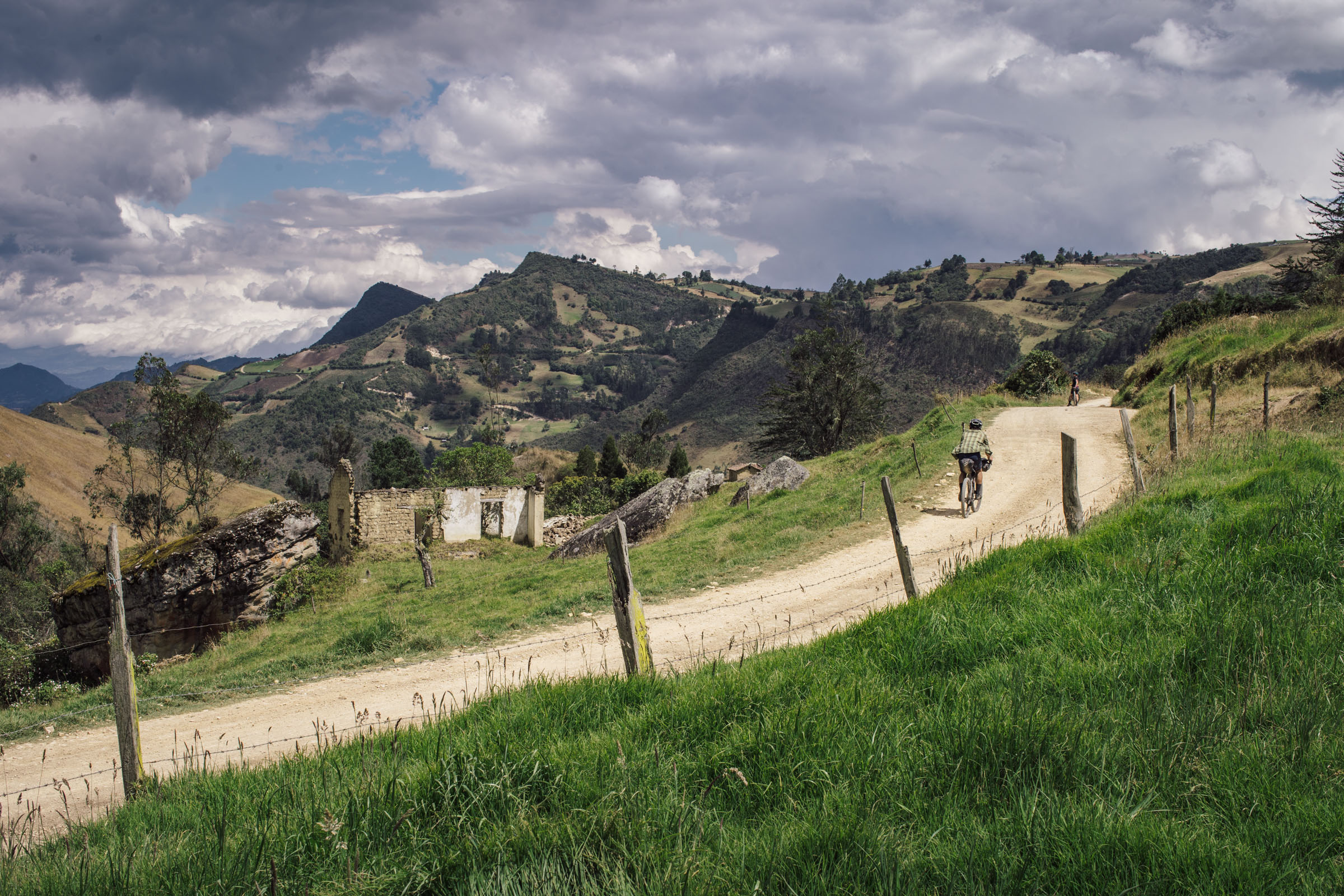
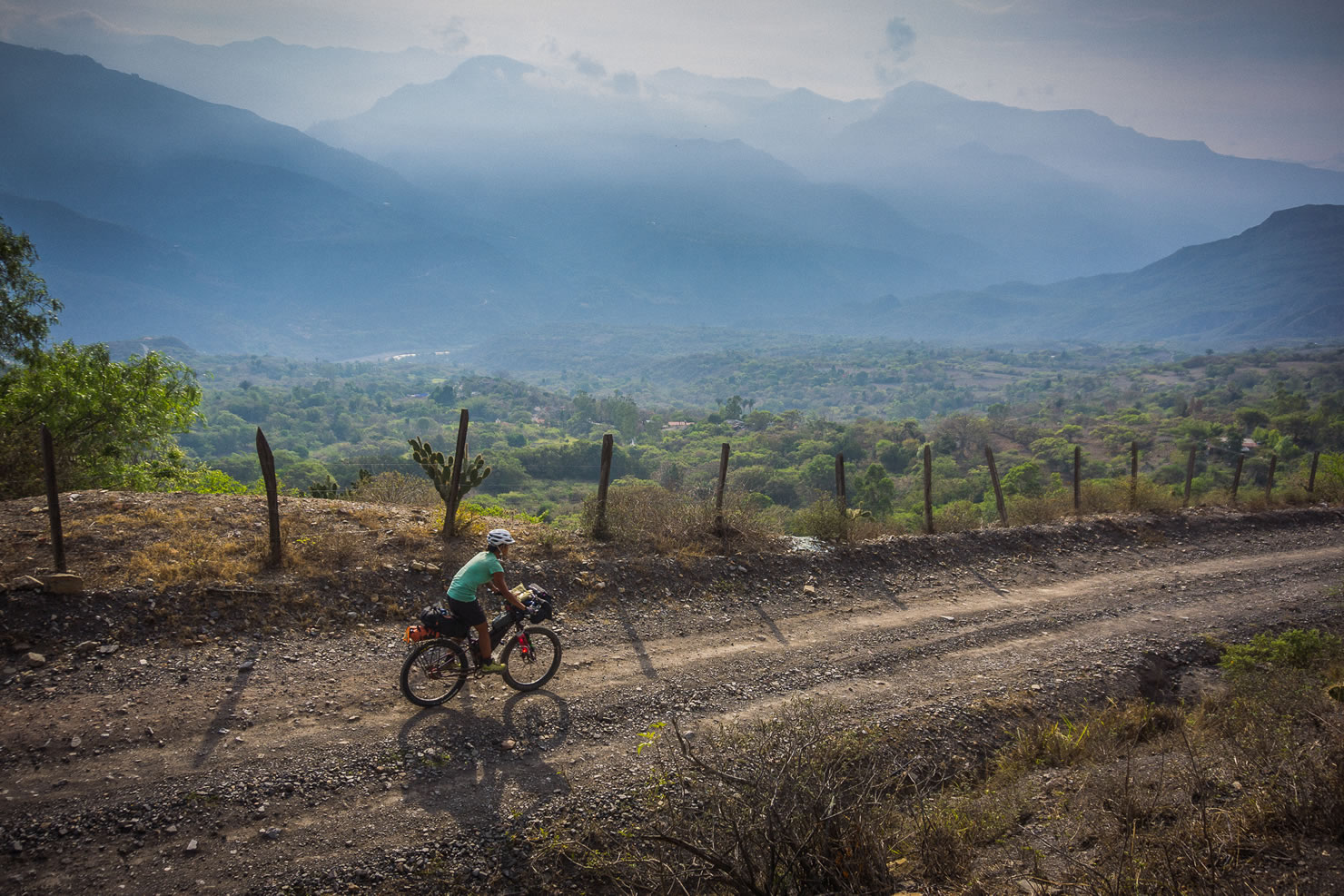
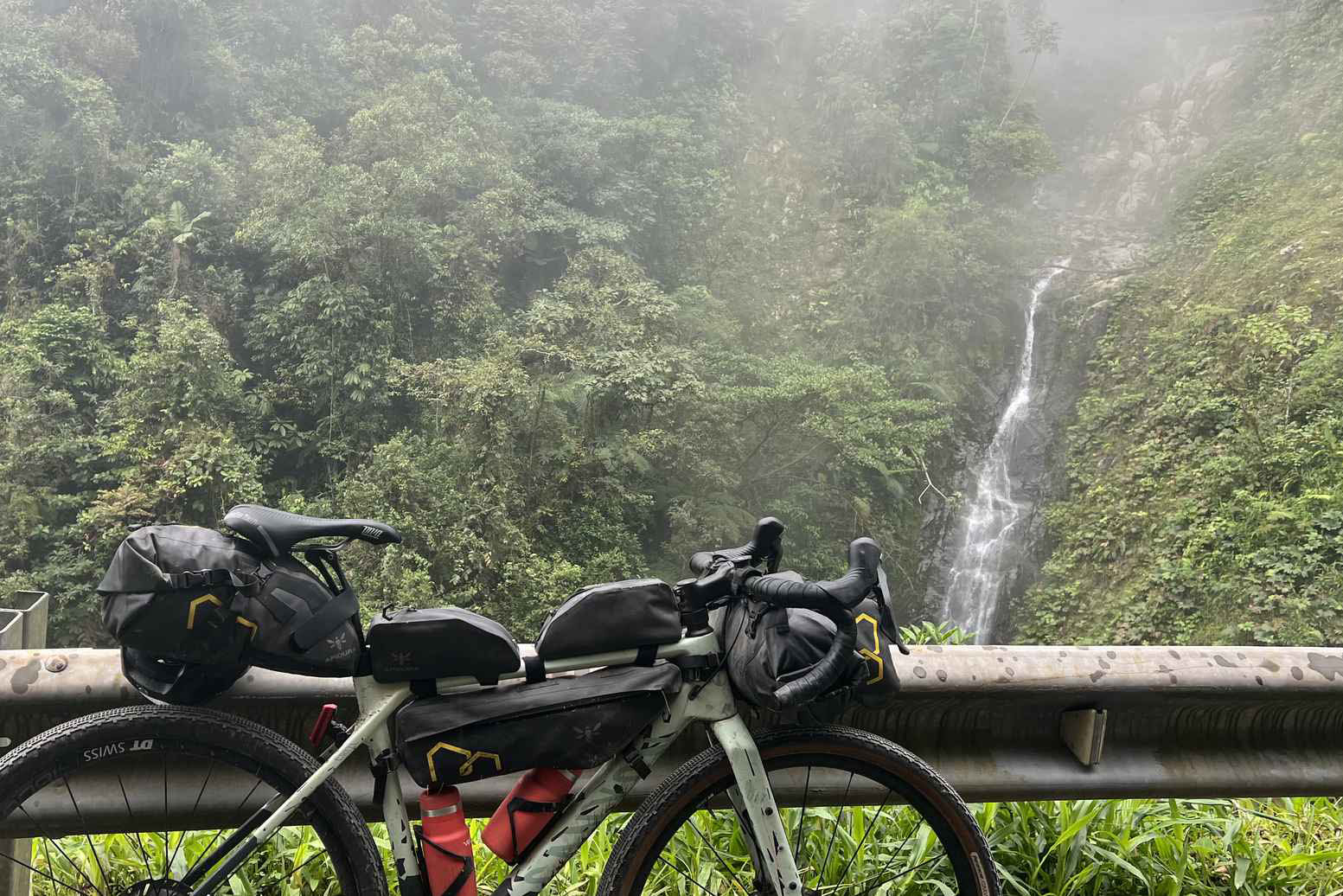
Please keep the conversation civil, constructive, and inclusive, or your comment will be removed.