

 Singletrack/MTB
 Gravel/All-road
 Dirt-road Touring
 Fat-bike


A Week in the Life of a Colombian Bike Tour: Vamos Campeones!




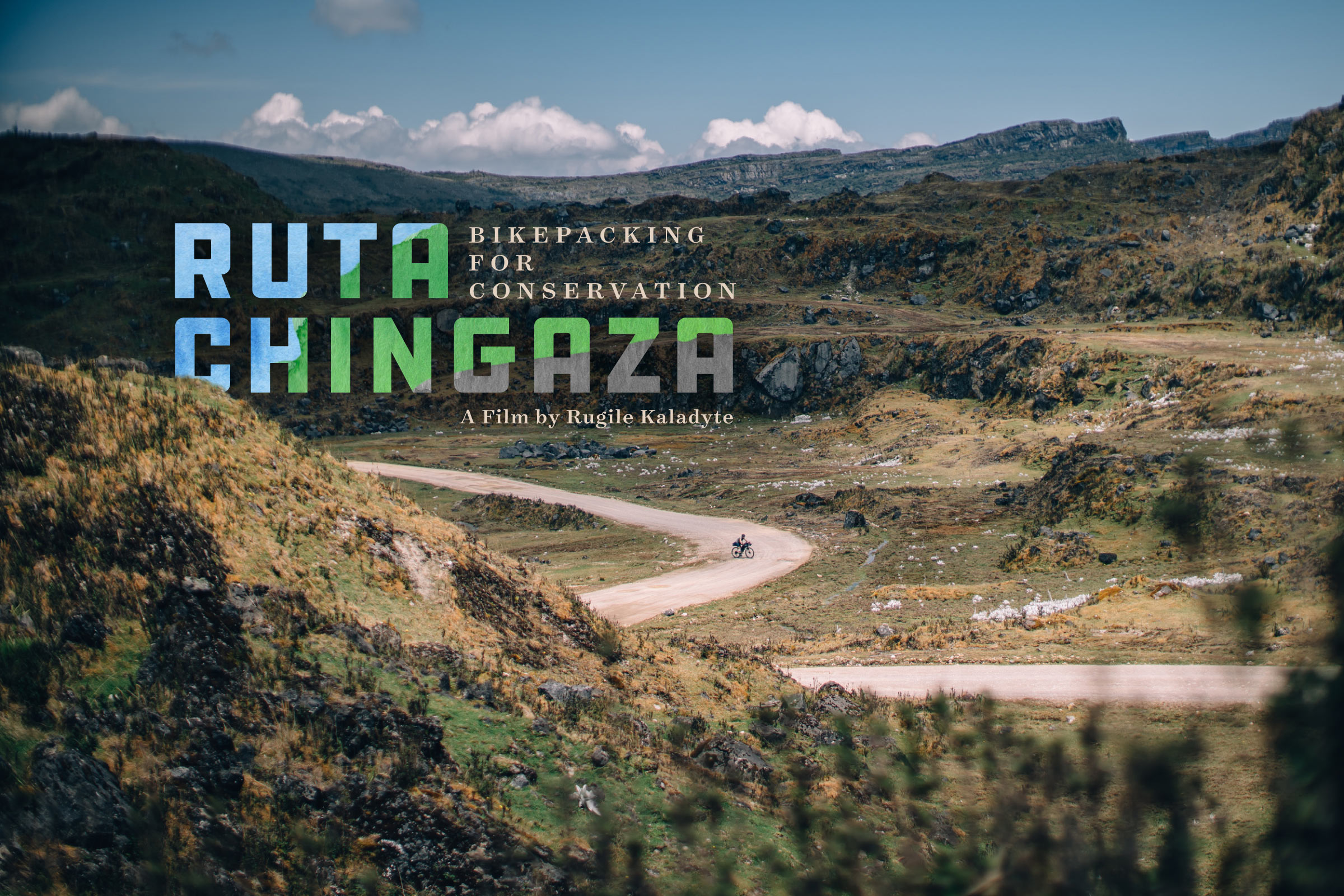
In this report from Colombia, Cass and Emma share a journal entry from riding a trimmed-down version of the Ruta Chingaza, a multi-day loop that takes them from a balmy, jungly 1,500 meters to a 3,400-meter expanse of páramo and its otherworldly frailejón, just a day’s ride on dirt roads from the capital, Bogotá. At 290 kilometers and with a hearty 10,000 metres of climbing, it’s quite the welcome to the Andes…
PUBLISHED Feb 13, 2026
Vamos Campeones!
Day 1: Bogotá to Skale
55.6km, 1335m ascent, -2333m descent, 3:50hr riding time
I have no idea why we never learn, but even after all these years, Emma and I can never extract ourselves early on “Day One” of any bikepacking trip. There’s always last-minute faffing to do, phones to charge, GPS devices to sync, or coffee to drink. But after various false starts, leave we finally do, for the classic climb out of Bogotá, known locally as El Alto de Patios.
Patios is a roadie’s favourite, gaining over 450 metres straight out of the gate, climbing from 2,600 to over 3,000 metres, almost 1,500 feet of climbing on top of the city’s 8,500 feet in elevation, an altitude that makes it the third highest capital in the world. Every Sunday, its Ciclovia – the day on which 120 kilometres of Bogotá’s city roads are closed to traffic – is said to draw a remarkable 6,000 cyclists to the climb, making it the most-ridden Strava segment worldwide.
Of course, we’re not just hours late. We’re a day late, too, so it’s Monday by the time we actually leave and begin what will be the first week’s ride in a month-long trip. But still, there’s one shoal after another of well-dressed roadies plummeting down from the mountains after their pre-work workouts, dodging and swerving around oncoming buses and trucks with fast-riding, fast-living South American panache and abandon. One rider scythes down the road in our direction, sees us for a split second, and yells, “Vamos Campiones!” So far, we’ve been tussling with diesel-belching traffic on the way up, which is never my favourite pastime, and his enthusiasm lifts my spirits no end.
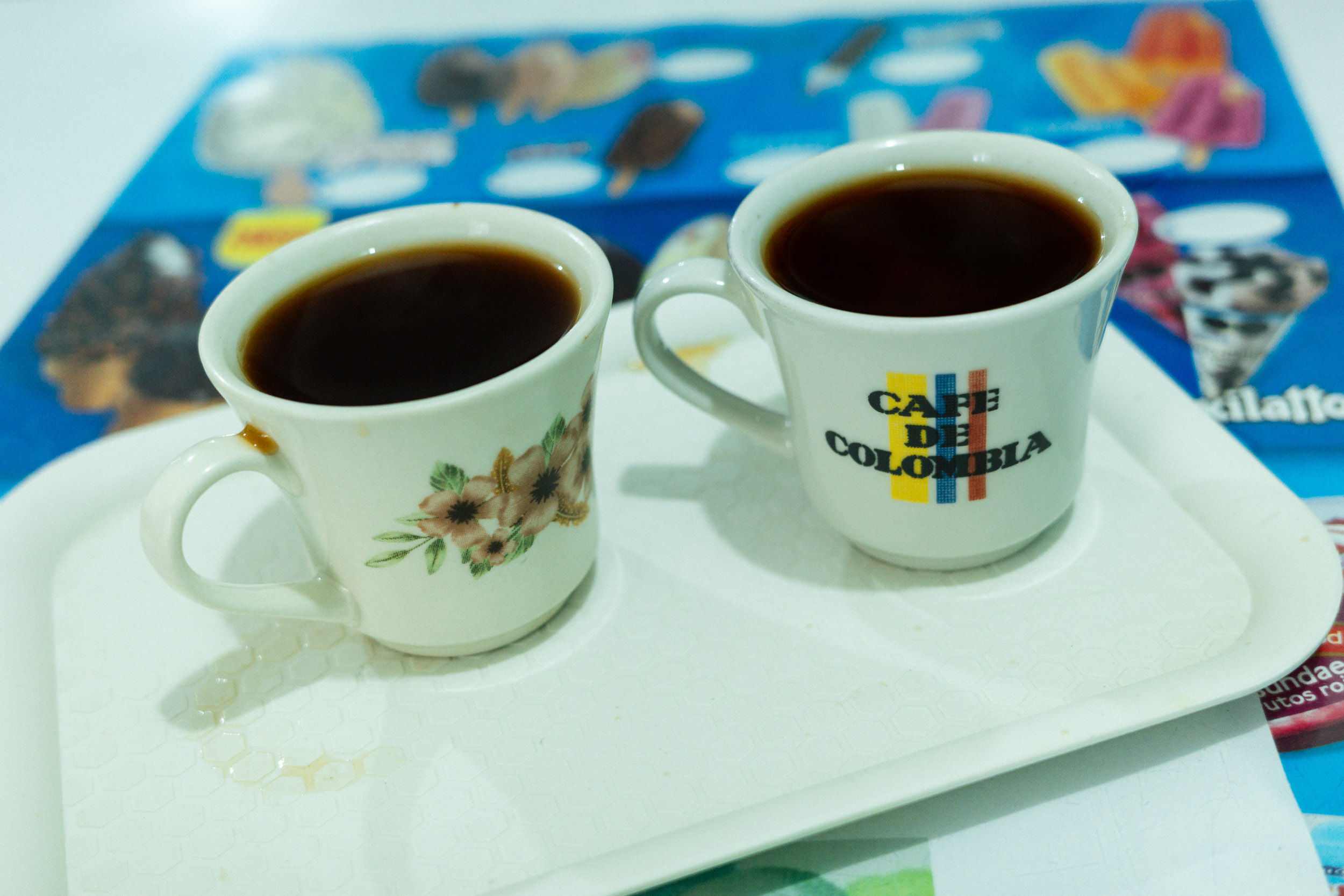
It’s also a welcome reminder that cycling is a national sport in Colombia, and it’s celebrated as such. Cars give us space on the climb, and considering we’re exiting a city of 14 million people – unofficially, at least – it’s really not that bad for a weekday morning. We stop at the appropriately named KOM Cafe, at the top of the climb, and sip strong americanos in enamel cups, before continuing onwards along a route we’ve been recommended by an expat rider, Nick, who has lived here for almost 30 years and whose wonderful website, Colombia Gravel Bicycle Club, is a treasure trove of unpaved routes in the area.


No matter how much I travel on my bike, I always feel a degree of uncertainty when I arrive in a new country, which is perhaps why I find impressions are strongest in the first few days, before the brain can adapt and everything begins to be taken for granted. Initially, I’m amazed by the number of commuters and recreational riders on the road on a Monday morning and how quickly pavement turns to dirt, despite the fact that the city appears to have no end, at least from the vantage point of this climb. Other key first impressions, particularly those pertaining to cycling, include the friendliness of Colombia’s dogs, a number of whom approach for attention rather than to take chase, as we’re used to in Mexico. The fact that we’re soon following an IMBA signposted bike route is also a heartening reminder that we’re in a country where cycling is visible, appreciated, and understood, as much as a sport as a form of transport.


Week one of our Grand Colombian Adventure involves cycling around the Chingaza National Park, a warm-up lap of sorts, before we head north into the rugged folds of Boyaca and Santander, birthplace of Colombia’s greatest riders, like Nairo Quintana, the Condor of the Andes.
Just half an hour in, we bump into two fellow bikepackers, Theresa and Joscha from Germany, who are on their last day of an eight-week bikepacking trip of their own. This initial Chingaza loop aside, their route is similar to ours, but in the opposite direction, so we gather road intel, like places to camp and cheap hotels, swap WhatsApps, and make loose plans to meet up when we circle back through Bogotá in a week’s time. Ah, the bikepacking community in action. Instafriends, not Instagram!


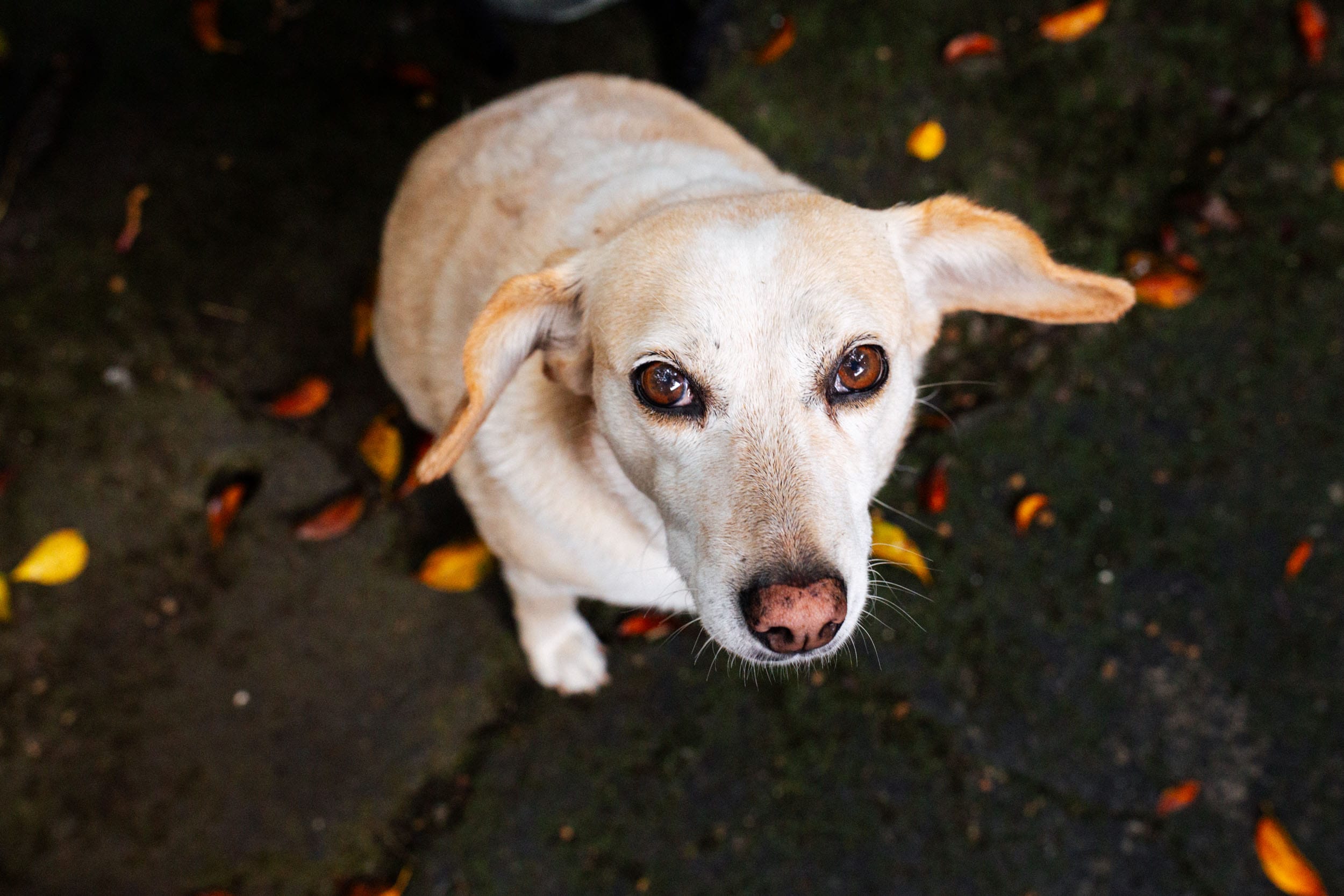
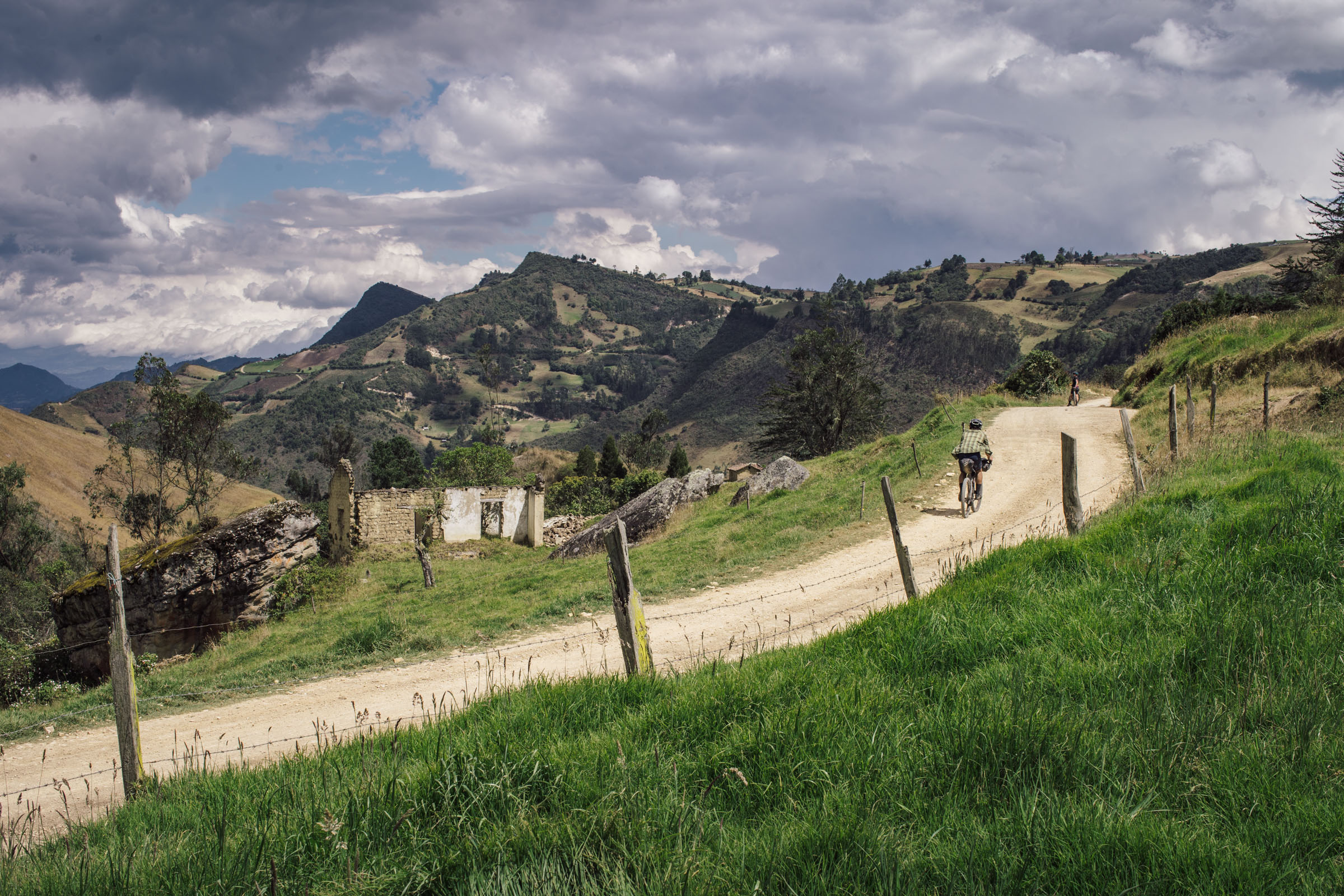
Onwards we ride as a dark sky rolls in above us, and rain starts to fall, first in pleasurable, refreshing droplets, then in a concerning downpour. Technically, we’re entering Colombia’s dry season, but clearly someone didn’t get the memo. We pull over under the awning of a village bus stop and tuck into a slice of leftover pizza from last night’s dinner in the city, joined by a bedraggled dog who sniffs hopefully in our direction. An older gentleman also pauses for the rain to pass, asking us where we’re heading and making suggestions on what dirt roads to take. In fact, we’re following Nick’s wise counsel, whose GPX track points us onto an ever-narrowing dirt track – a trocha, as they’re called in Colombia – that soon becomes sloppy, wet, and muddy. Still, even when we’re pushing our bikes up a steep grade, there’s nowhere else I’d want to be, filled with the excitement of a bike tour in an unfamiliar land, though for a moment, I’m transported to another green and wet bikepacking multiverse called Wales, our layers completely soaked through, our bikes caked in mud, huffing and puffing, past cows, tractors, and fields.

Choachi, our goal that day, proves to be a bustling little village where we begin to decipher the culinary lay of the land, sampling buñuelos, lovely puffy bread balls filled with cheese. Then we’re back on the bikes for a last few kilometres, in darkness, to the accommodation that friends in Bogotá have recommended to us. It’s actually a wildly steep descent that becomes ever more tropical and jungly with every moment, warm air displacing the cold we felt just a moment before. Being a popular weekend destination for Bogotá-based nature seekers, the hills here are home to many small lodges, between groves of massive palm leaves and bougainvilleas. But Skale Peregrino has a key difference. It’s run by a young Colombian couple who’ve spent three whole years bike touring around South America, artesanos making jewellery to finance their shoestring travels on bicycles they bought in Chile – before settling down to run this business on their return. As fellow cycloviajeros, we’re welcomed in with especially open arms and warm hearts, even by Colombian standards. Alejo, Lina’s husband, even sports Lachlan Morton’s cycling cap, which was gifted to him the year before, when the Transcordilleras ran past their front door.
Day one has been, by any accounts, quite perfect – from our relatively easy exit out of the city, complete with excellent col-top coffee, the small interactions we’ve had with people and furry creatures alike, to the sheer quality of the dirt roads we’ve ridden and how little traffic we’ve had to contend with. It’s hard to be anything but extremely excited for the week ahead, even as rain begins to fall once more.
Day 2: Eso Es Vida!
La Union to Wet Campspot
28km, 1717m ascent, -74m descent, 3:47hr riding time
We awake at 6 a.m. to see hundreds of gaviotas flying across the valley in the dawn light, above misty clumps that linger amongst the tree tops… none of whom I manage to catch on camera. Where’s that 400mm wildlife lens when you need it? Then we walk down to the river with Alejo so he can point out a mating duck couple and their nest of eggs, watching them dive in and out of the torrent for snacks – apparently their beaks are malleable, which allows them to access rocky crevices. Lina rustles us up a fantastic breakfast that includes tinto of course, a small cup of coffee and a Colombian staple across the cities and mountains alike, along with scrambled eggs, edible flowers, goat’s cheese from the resident goat, and papaya.
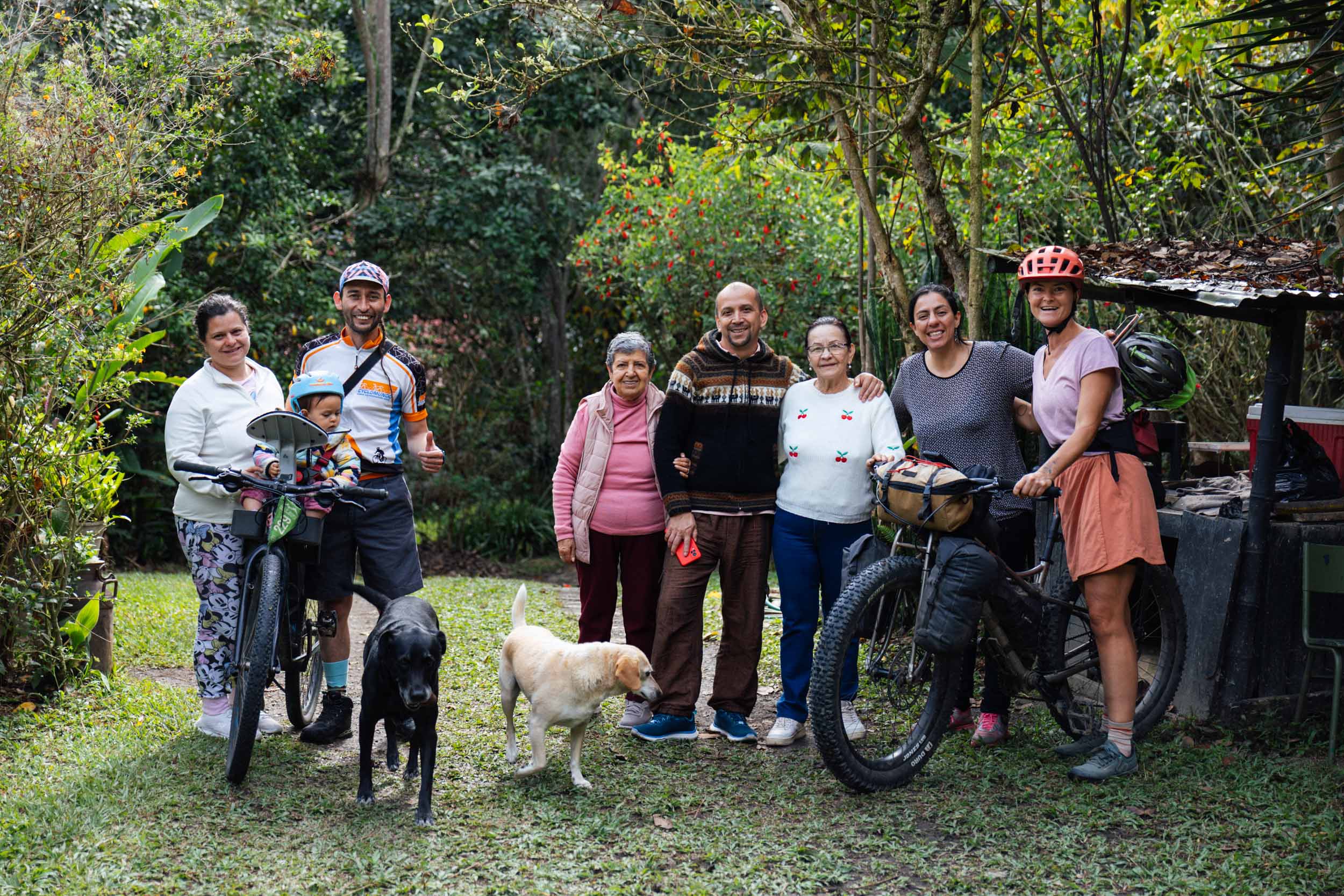


They prime us on the loop ahead – a ride up and around Lago Chingaza, a lake set at 3,400 metres and surrounded by páramo, the high elevation tundra that makes up much of the Colombian Andes – suggesting possible camping spots and marking small villages where we might find simple places to stay. Eso es vida! – This is the life! – says Lina’s mum, as everyone gathers around to hear our plans and inspect our bikes.


Our legs are sore after yesterday’s ride, and we wonder about the weight of our bikes, loaded with all our camping gear. But they’re featherweight compared to those Lina and Alejo toured on during their trip, which apparently tipped the scales at an incredible 80 and 120 kilograms each, loaded as they were with jewellery-making supplies and gear.
Then, after a fond farewells, Alejo and his daughter – in her bike seat – join us on the sharp climb to Fomeque, where we stop for a further round of tintos by the square, alongside a group of older men in sombreros who nod and smile when I wish them “buenos dias, señores“.


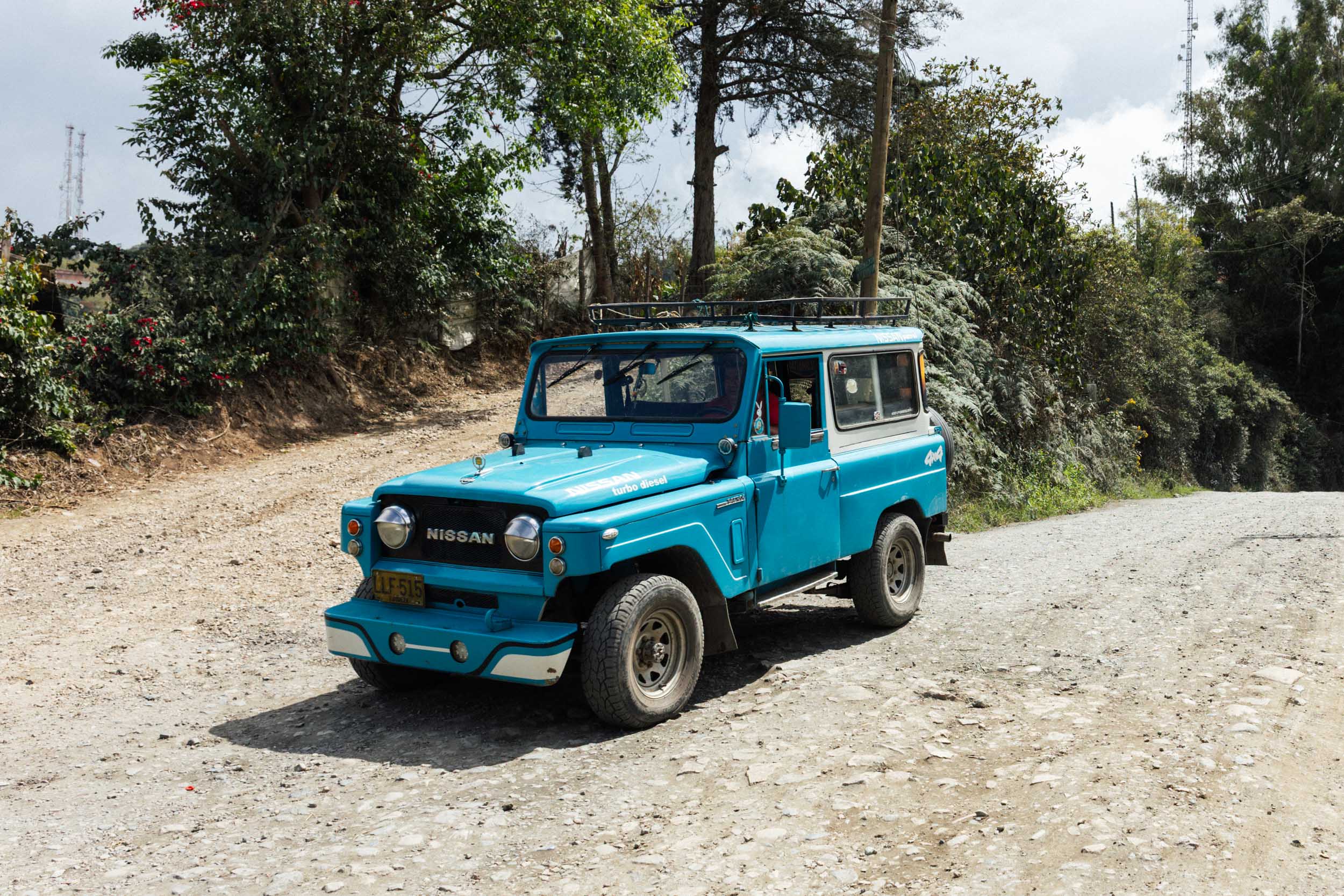
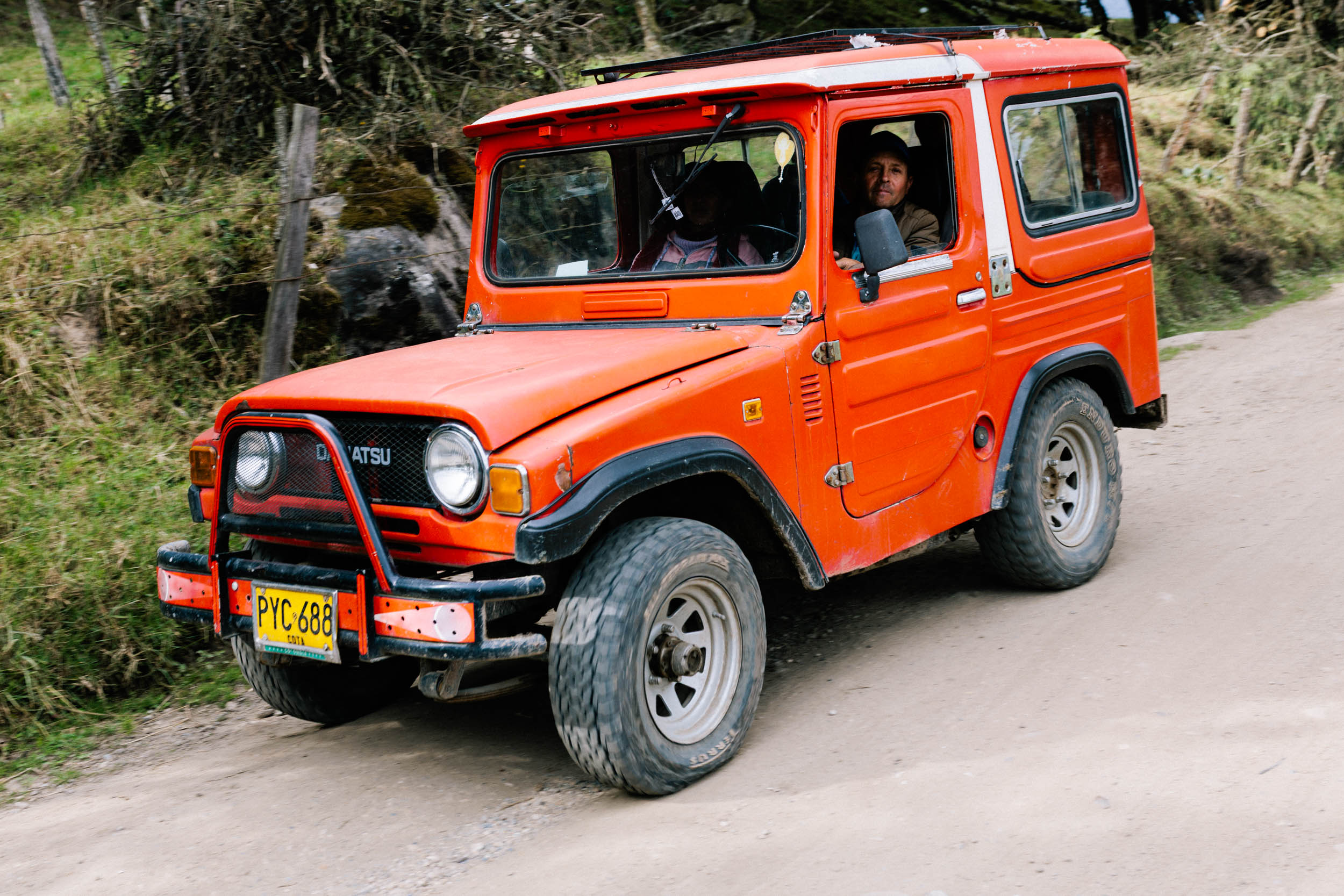
Beautifully preserved, 50-year-old Daihatsus, Nissans, Toyotas, and Suzukis bounce around town, painted in a bright palette of colours – reds, blues, greens, and bright yellows too. Not so long ago, this area was a zona roja run by separatists, definitely not a destination tourists would visit. But nowadays, the vibe is upbeat and welcoming, and we’re soon following a sign pointing us towards the main attraction in the area, Chingaza National Park.


Whilst somewhat daunting, the 2,000-metre climb that lies ahead is mostly gentle and stony under tyre. But it does ramp up in places, and then the day’s rain begins, first a refreshing face mist, then a downpour that quickly soaks us to the bone. Mud soon follows, and at one point, we can barely keep chains from working their way off chainrings. We stop to tend to them every few hundred metres, poking at our frames with sticks and scrubbing chains with an old toothbrush. Still, it’s warm enough that our spirits are high. Temperatures only start to cool off significantly when we hit 3,000 metres and, shivering, we begin to consider where we might camp for the night. Our decision is made for us when we hit a flash flood blocking passage across a bend in the road, where a huddle of stranded motorbikers in ponchos has gathered on either side.


We join a conversation with a road crew and a number of bystanders who have materialised as if from nowhere, given that we’ve seen almost no one all day, as we analyse the situation and squint into the rain. We also chat to a Colombian couple, completely plastic-packed in blue and purple ponchos and over trousers, bags tied around their shoes. “We thought it was paved!” the husband says with a broad smile, and they both laugh, in surprisingly good humour. Opinions are divided on whether a crossing will be possible before the morning. As we’re too cold to stand around much longer, we decide to pitch camp on a grassy knoll, just as the heavens open once more. Quickly, we strip off all our sodden clothes and dive into the tent in our birthday suits, straight into sleeping bags to warm up again. It’s so damp, chilly, and endlessly rainy that we can’t even muster the enthusiasm to cook dinner, dining instead on tortillas lacquered with arequipe – a thick, creamy, caramel-colored spread omnipresent in Latin America – then we crash out at 6:15 p.m., sleeping through until morning. I expect I dreamt of shorts, T-shirts, and blue skies.
Day 3: Giant Portholes In The Sky
Wet Campspot to San Juanito
39.2 km, 757m ascent, -1966 m descent, 2:52hr riding time
Our day begins graced with a few beams of oh so delicate sunshine that light up the mountains and lift our spirits in equal measure, encouraging an impromptu clothes wringing and drying session – well, as best you can in these intensely humid conditions. While we slept, it seems everyone made it across the river, and the one remaining worker, tasked with overseeing the water plant next to which we’re camp, wanders over from his makeshift portacabin, wearing thick, puffy synthetic pants that we eye enviously. He shares well-earned advice on where to place our sodden clothes to make the most of the subtle sunshine and suggests we give it a few hours, and they’ll be dry. But not only do we have to keep moving, but up in the páramo, the high mountain and treeless ecosystem that we’ve now reached, it’s hard to imagine anything really drying out. The swollen river has now subsided, so instead we layer back up in cold, damp clothes and take to the road again, the crossing low enough to be perfect for sandals but still calf-high for those in shoes.


Soon, we’re climbing again on a stony dirt road, a few frailejón – the distinctive plants so crucial for groundwater production in Colombia – dotted on the hillside here and there, like early arrivals to a party. Before long, the hills are blanketed with them, each so particular and punky that it’s hard not to want to engage in conversations with them. These plants, native only to Colombia, Venezuela, and Ecuador, have an otherworldly appearance and a density that makes me think that, if I didn’t know any better, we might have crash-landed on another world. Welcome to Planet Frailejón!


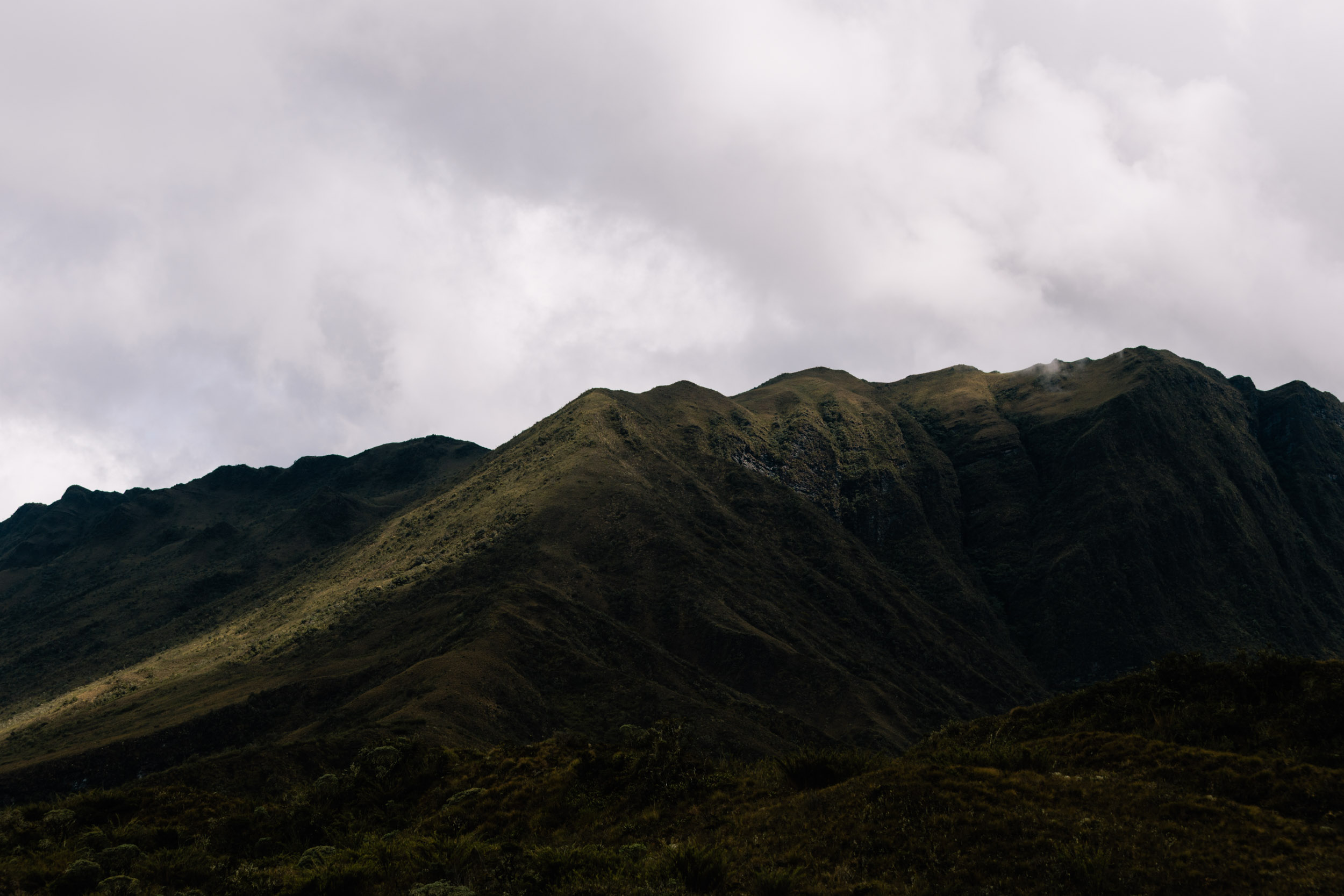
Laguna Chingaza appears on the horizon, hemmed by a thick bank of cloud, and the ever observant Emma spots a pato Chingaza – a Chingaza duck. So close to Bogotá, the National Park is a popular trekking destination. It’s more commonly accessed by a more maintained gravel road than the one we’ve taken – one that’s also, strangely, currently open to vehicles but closed to cyclists without special permission, hence the lack of traffic on our route via Fomeque. We cross a group of Colombians preparing for a hike, and then we’re back on our own again, climbing up and over one last flank of hills to the highest point of our route, before beginning a steep plummet back down into the valley on the other side. Portholes in the mist reveal carved mountains, momentarily, for the páramo is a place that is invariably shrouded in mysteries… one moment, an awe-inspiring mountainscape reveals itself, then it’s gone – for how long, we do not know. I’m tempted to wait it out, but it’s a game of patience, and we don’t have the time to linger too long, fearing the return of more rain. So, we keep moving, hoping for an ethereal beam to pierce the cloud cover and light up the land in its continual ebb and flow of light, mist, and cloud.


Mid monster descent, we stop to inspect a damp cluster of biodiversity, noticing tiny fingers of club moss poking out of the roadside verge and other colourful oddities. Further down, we pass two young girls on a motorbike with a chainsaw, smiling, signalling our impending arrival into the small settlement of San Juanito, in time for a late set lunch that includes a hearty bowl of potato and corn soup.


Although we’re mostly dry, our tent is still wet, so we decide to check into a small hotel overlooking the square, which lights up with the town’s name come sundown, so bright that we need to wear eye masks in bed. The room costs, incidentally, $13 and has a shoebox bathroom shaped in a way you have to sit at right angles to the toilet to have space for your legs. But the wifi is strong, and we watch an episode of Fallout after investigating the panadería next door, paired tintos with a big slice of moist banana cake.


Day 4: Floating In A Reverie
San Juanito to San Francisco
45.9 km, 1843m ascent, 1586m descent, 4:41hr riding time
The ride today reveals more fleeting aspects of the land between rolling clouds and rain; steep hillsides draped with waterfalls and farmland, mostly beans and lulo, similar to a passion fruit. We’re on the lookout for birds – particularly the Andean cock-of-the-rock, known for its vibrant red plumage – that Julian, an ultracycling legend/bikepacking birder, has told us about. Duly, we jot down our sightings in my journal for later research: pigeon size, with two big yellow tail feathers. Or, black with a long beak that curves downwards. Or, red chest with white on top (but could have been a flower). Pausing under an especially tall tree, Emma reports a sighting of a hundred parrots overhead that are spooked by a passing motorcyclist. They soar into the air, circle in the sky, see her, then squawk noisily and dive bomb her angrily with seed husks until she, too, moves on. So fascinating… have we too become bikepacking birders?


The vegetation here has shifted from what we’ve seen so far and stream crossings are plentiful. It’s now lush and tropical, with giant ferns decomposing by the roadside, wildflowers, and thick groves of bamboo. There are bromeliads everywhere, weighing down the branches of trees, perched on mossy fence posts, and lined up along electricity lines like starlings.


Reflecting the bumpiness of the road, if it’s not cute and small 4WDs, it’s knobbly-tired motorbikes that are the main form of transportation. Some are piloted by young boys with mullets and bright football shirts, others by folk in wool ponchos, cowboy hats, and wellington boots. Indeed, the men here cut quite the style. On one hilltop, we pass a young man standing beside his Suzuki motorbike, complete with purple rims, cooly observing the mountains. His attire? A flamboyantly patterned poncho with the image of the Virgen De Guadalupe. A neatly trimmed mohawk and well-fitted jeans. Even aviator-style sunglasses, despite the cloudy conditions. “Like he’s in the Colombian version of The Outsiders,” comments Emma.

Up and down through the clouds we ride, in a reverie. It’s discombobulating, and we wonder if perhaps we’re cycling in circles. We pass one especially vast landslide, where the whole mountain has slipped away, a deep scar in the dense forest to either side. Apparently, it happened last month, taking a whole farm with it.


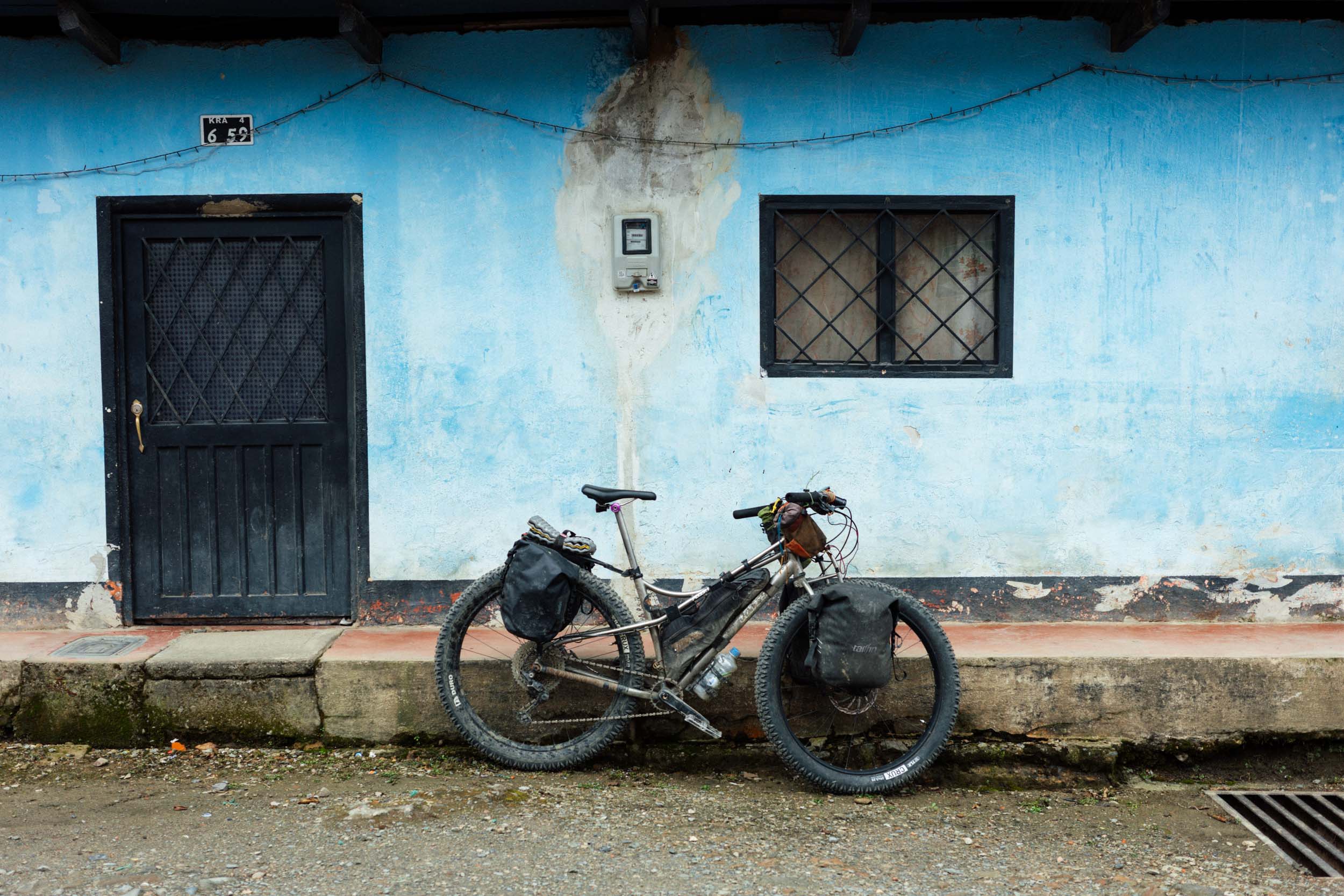
We stop for lunch in colourful El Calvario, a village where horses are parked up next to old trucks, and whose main street has a neat blue trim and is so steep that our calves pop as we push our bikes up it. A restaurant rustles us up the plat du jour, or comida corriente as it’s called in Colombia. Today, it’s a plate of barbecued pork, rice, patacones – smashed and fried plantains – and a tasty homemade salsa, washed down with a glass of lulo juice – made from the green orbs that we see growing on the edges of town. We chat to the three generations of women there, who quiz us about our journey. “You’re welcome back any time,” they say as we leave, after we gather outside for the most joyful of group photos.



Our trip is so peppered with these small interactions that I’m reminded of how bicycle touring, perhaps in part because of its inherent vulnerability, seems to bring out the very best in people. A wave from the back of a pickup truck, a hello honk of the horn, a brief conversation by roadside chat. We’re all looking for connections, and Colombians are never shy in reaching out to make them, especially to cyclists.


As we drop in elevation, we start sweating again and peel down to T-shirts, but not for long, because rain once again bookends our day, cooling us down to shivering. As we arrive in San Francisco, a smaller town than both El Calvario and San Juanito – which were hardly much themselves – we spy an open doorway, revealing a butcher’s shop that doubles up as the town coffee shop hangout.
In we drip for sugary tintos, chatting to the small crew who gather around us to ask about our travels across the mountains, indifferent to the pools of water that gather at our feet. Should we ask to camp on the covered basketball court or treat ourselves to another night in a hotel? Emma petitions for the latter, and I’m easily convinced, so I set off into the misty streets to find a place stay, tracking down a guesthouse a couple of blocks away. We’re now learning that all Colombian hospedajes have their quirks. This one, as glad as we are for it, has only curtains for doors, both to our room and the bathroom, and just the hint of a curtain between our window and the outside world. My feet may hang over the short bed, but there’s room to sit on the toilet seat!
Day 5: Muy Guapos
San Francisco to Skale
54.9km, 2,124m ascent, 2,736 m descent, 5:20hr riding time
Come morning, two men on horses who trot by, at eye level to our window and nod a hello to me. They’re wearing cowboy hats and have weedwackers over their shoulders, dogs skipping along behind.


Our breakfast is scrambled eggs with a bread called pan de sagu, which resembles tiny donuts and is, here at least, rock hard and old. But we’re grateful to fill our bellies, and as we ready ourselves to take to the hilly roads once more, almost everyone wants to know where we’re going. I compliment one man on his felt hat, a style we’ve noticed in recent days, and he tells us it’s typical of the region. His whole family is off to their finca, aboard two motorbikes with a baby in a harness and a dog in tow, to tend their beans and lulos.
Three stout climbs shape our day. Towards the top of the first, we cross paths with a father and his two sons on horseback, who ask us how long the journey from San Juanito has taken us, and we swap notes. Apparently, it’s a five-hour horse ride away. “Muy guapos”, says the older man, appraising both us and our muddy bicycles. Down the other side we descend, back in a realm of heavy mist and dense vegetation, skipping over potholes, only to cross a bridge that’s sprouting bromeliads above a fast-flowing river, to begin the next climb. We stop to chat with a group of kids, aged 4, 5, 8, and 10, each younger than the other by half their age, they tell us.


Emma’s hydraulic brakes have been misbehaving, and have decided to call it quits for today. Whilst we’re expecting this to be an issue on the impending descents, it actually results in an unusual, slow speed uphill crash, up an incline that’s so steep her bike rolls back and she topples to one side, leaving an angry bruise and road rash on her leg.


We finally made it to the top of the second climb for a much-anticipated picnic, in part to save hauling supplies up the final ascent of the day. Finally, bigger views reveal themselves, and there’s actual sunshine dappling the land, a sight blighted only by the massive ag farms that dot this green and buckled landscape.
After the last few days of almost-empty roads, rural traffic crescendos here, and mud turns to dirt. People wave and cheer from their vehicles, oblivious to all the dust that gets in our eyes as they bounce by. “Disfruta Colombia” says the man leading the construction team concreting a section of the road. “Animo!” says the lady from her front yard, as I close in on the crest of the climb. And “Ya casi” – almost there – calls out a driver to Emma from his old Toyota on the last stint back into Fomeque. There’s such enthusiasm for visiting Colombia, and for biking here in particular, that it never ceases to lift spirits and displace frustrations. Only a one-eyed farm dog seems to take offence at our presence, and I’m putting that down to him having a bad day.


It’s Friday afternoon so it’s all happening in the town’s plaza, where we pause to eat ice cream and tuck into a round of fried, doughy and warm buñuelo balls, another bikepacking staple. Then, at dusk, we make our way to Alejo and Lina’s once more, where we bask in a warm welcome, share tales from the road, and top up Emma’s brakes with fluid for the final stint of this tour. By now, we’re closing our loop; all that’s left is the return to Bogotá.


Day 6: Pretty Sure This is a Shortcut…
Skale to Eco Camping
35.8 km, 1,875m ascent, 705m descent, 3:54 ride time
It’s another calf-popper of a climb to escape the valley floor and ride back up to Choachi, where we tuck into local corn cakes stuffed with cheese and sweet pan de bono, a bread laced with sweet guayaba, washed down with excellent tintos and a mug of fresh mango juice too. A breakfast jackpot! We’re asked to move our bikes to one side, as the streets are being cordoned off for an impending event. Emma, whose Spanish can be a little hit-and-miss, thinks she’s told it’s for a dog parade. If so, given the sheer variety of dogs we’ve seen so far the mind boggles at the idea of such a gathering, and I wish we had time to see it.


Our intended road is busy with weekend traffic heading to the thermal baths, so instead we retrace our tyre tracks from day one, bumping into two local bikers on the climb back up to 3,000 metres. I like their style. Old hardtails. Stickered helmets. Quick-release seat posts. And knee pads strapped to handlebars for big descents.
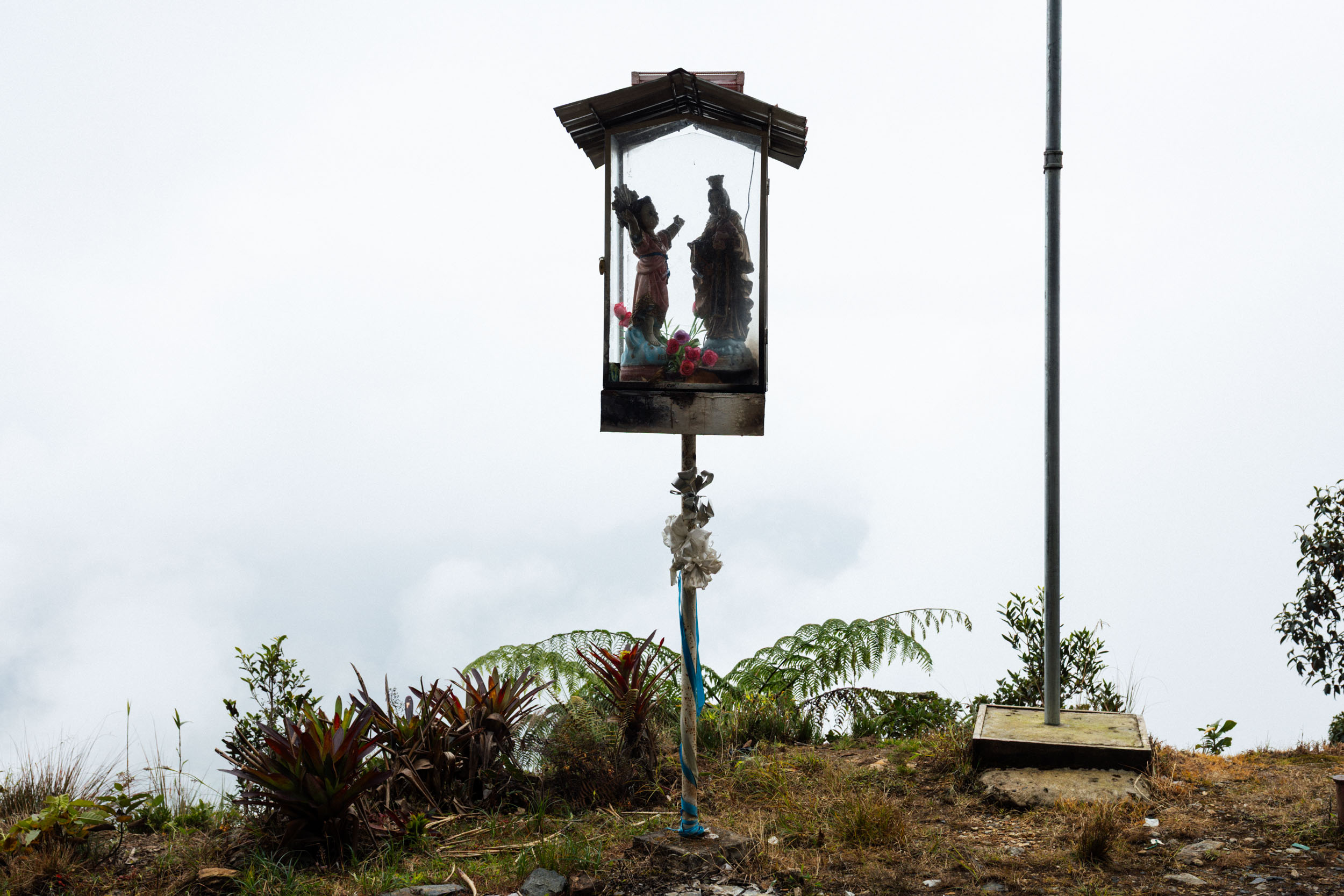
Onwards we ride, through Potrero Grande with its massive glass shrine, big enough to encase a perfectly white and beautifully restored Nissan Patrol. The cafe there is known for its fresh yoghurt, produced at a neighbouring farm, so we down a litre, sample some Colombian eggnog – sabajona – and feast on corn cakes wrapped in banana leaves. The table next door to us is singing along to what I presume are Colombian classics and knocking back cervezas with gusto. Beer and music are the theme of the day, and in one village after another, we see dozens of Águilas lined up on the hoods of cars, trunks open for maximum volume. Tailgate Sundays! Then we enjoy one especially sweet Daihatsu encounter with a beaming family who stop abruptly in the middle of the road to chat, their grandma waving enthusiastically from her little bench seat in the back.


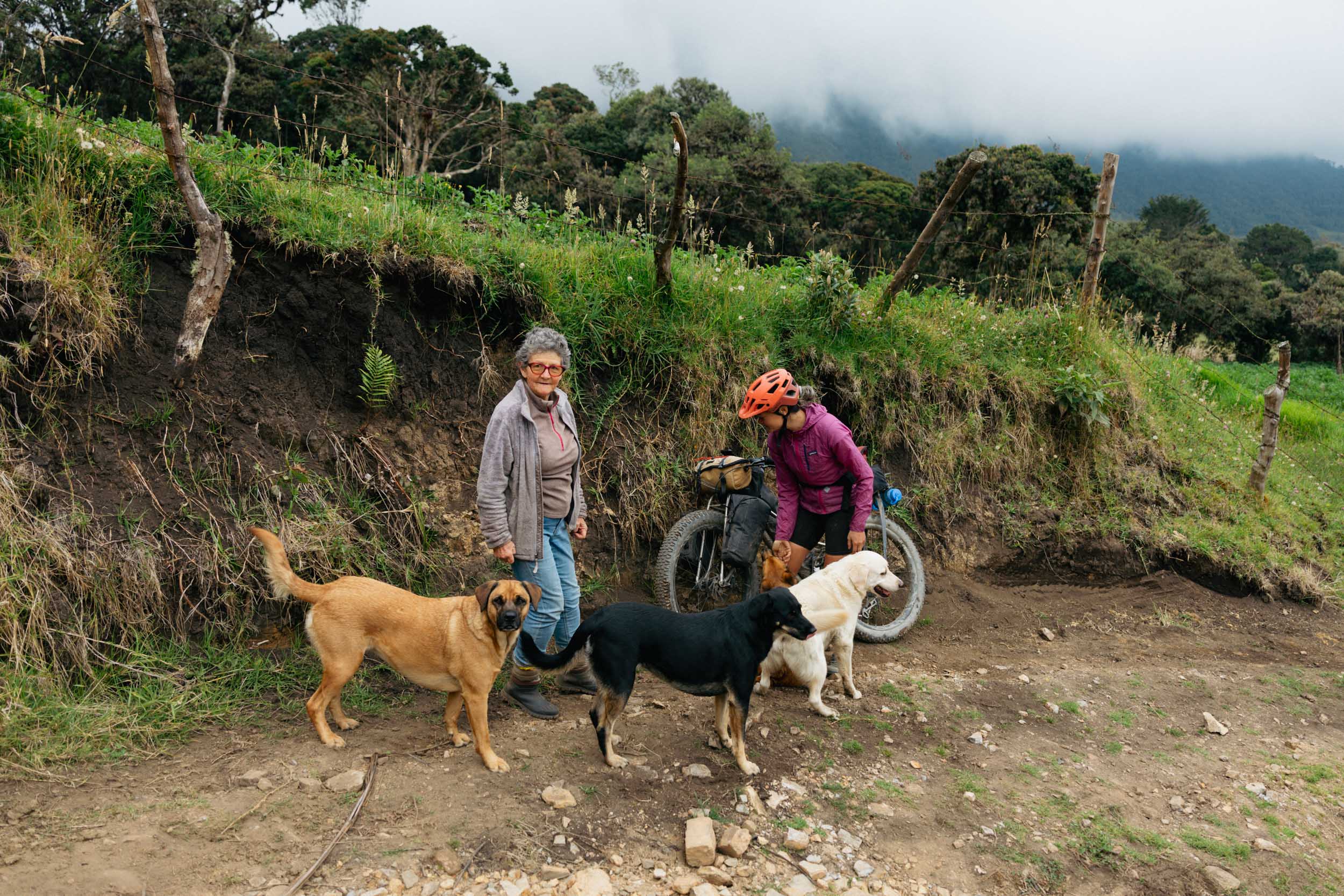

Our proposed destination for the night, and our last night before we’re back in Bogotá, is an off-grid complex with cabañas and a place to camp. After studying the map, I discover what I believe to be a shortcut but turns out to be the steepest trocha yet of the trip, and the beginning of a series of protracted bike pushes, rather than the easy end of day cruise we’d envisaged. Classic! Just when Emma is giving me “the look,” I catch sight of an older lady waving enthusiastically towards me, as her three dogs come tearing my way. Veronica is a writer who lives on the property, has curly hair, thick-rimmed glasses, and wraps us both in a big hug when she reaches us, insisting on carrying Emma’s panniers for the final hike to the cabañas. The setup there is beautiful, rustic, and shrouded in afternoon mist, with farting horses for company and especially loud frogs that require earplugs.


Day 7: Bad Bunny and Cumbia
Eco Camping to Bogotá
23.4km, 660m ascent, -807m descent, 1:42hr riding time
Come morning, Emma sits on a bucket and warms up a stack of arepas, and I make us cowboy coffee. We chat to the owner of the cabañas and note the machete on his belt, housed in a leather scabbard with long tassels that drape along the wet grass.


Our last day is a short one. After breakfast, there’s just a quick hike-a-bike to negotiate to get us back on a more established dirt track – Veronica and her dogs to the rescue, again! – then some fast rolling, uppaved roads deliver us to the top of Patios, as per our initial exit out of Bogotá. As someone who loves to run a speaker attached to my handlebars when I tour, I feel both vindicated and accepted by Colombians, to whom enjoying outdoor music is part of life. We pass one finca where Bad Bunny blares from a car parked by the front door, and in the next village, a farm worker wanders into a store with a radio on his belt, playing cumbia out loud.
It’s Sunday by now, and we’re thankful to drop back down into the vast metropolis of Bogotá in time for the tail end of Ciclovia, making it to our hotel before 2 p.m., when protected bike lanes are dismantled, and impatient drivers commandeer the capital’s streets once more, revving their vehicles eagerly.
We’ve planned a day off to dry gear and fix bikes before getting stuck into the main goals of our trip: heading north into Boyacá and Santander to tackle two routes posted here on BIKEPACKING.com. But what a first week in Colombia. Eso es vida!
La Ruta Chingaza (The ‘Mini’ Version)
Our route was a shorter version of the original Ruta Chingaza, as researched by Logan and Joe before the pandemic. We’d actually envisaged more of a warm-up ride to our first week in Colombia and planned to ride the Ruta EL Dorado, if only to feel the place out and build up confidence for the month ahead. As it turns out, the Ruta Chingaza was a pretty intense intro to touring here and certainly a fabulous loop if you’re ever heading for Bogotá.
Colombia Takeways
1. We only camped twice in our first week, in part due to poor weather. But whilst you don’t need a tent for this route or indeed much of Colombia, it does add a lot of flexibility and we loved having ours. Unless you’re up in the more remote páramo, best practise is to ask permission at fincas or enquire in villages as to whether you can set up your tent under covered basketball courts or outside churches. If you bring a tent, I’d suggest a freestanding one for this reason.
2. Ear plugs and eye masks are highly recommended for budget hotel living. Expect bright street lights, dogs barking, and pre-dawn rooster squawking, along with pop-up fiestas and regular cantankerous patron-day celebrations.
3. Bring a poncho even in the “dry” season! They’re great to throw over a puffy jacket around camp if it’s raining or misting, and to cover your bikes at night to protect drivetrains from rusting. There’s a nice-looking, bike-specific poncho made in Bogotá by the brand Helo Bags.
4. A set lunch – comida corriente – is a great way to refuel during the day. Portions are often huge, so we packed leftovers in a Sea to Summit resealable silicone bowl and saved them for later snacking. Dinners, on the other hand, can be tricker to track down as restaurants in small towns often close early.
5. Standard Andes advice: Pack light and run low gears! Expect steep grades! Big tyres are the way to go… but not too big… allow room for mud too. Having a grasp of Spanish is very useful, as we found everyone keen to chat and hear about what we were up to.



I hope you’ve enjoyed this taste of life on the road in Colombia, which I rank amongst the finest countries to visit for dirt road touring! I owe a big thanks to everyone who helped us out, including Juan Pablo Ortiz for recommending the route – Juan Pablo runs 14 Ocho Miles, a bike and outdoor store in Bogotá, as well as the Colombian bikepacking magazine, Deriva. To Alejo and Lina for treating us like long lost cycling relatives at the lovely Skale Ecolodge. To Nick Perkins, who helped guide us in and out of Bogotá in the most safe and most enjoyable of unpaved ways via his Gravel Colombia Bicycle Club website. And to Julian Manrique, who encouraged us to become bikepacking birders… because Colombia really is teeming with birdlife and birdsong, and trying to figure out who’s who is a fantastic way of slowing down and taking it all in.
Further Reading
Make sure to dig into these related articles for more info...
Please keep the conversation civil, constructive, and inclusive, or your comment will be removed.